Discover how to maximize your job search during the peak hiring season in New Zealand and Australia! This video provides key insights into why spring is the best time to secure employment, highlighting migration trends.
It is worthy to note that your best employers are not average companies, they are higher-performance companies. Successful companies will be hiring in September and October, as I explain in the video.
Take advantage of this time and ensure your readiness for the busy summer months. Perfect if you are a job seeker looking to make the most of this optimal hiring period.
New Zealand and Australia are the most foreign-friendly countries in the west.
Migrating to New Zealand or Australia for work can be a challenging endeavor, especially if you find yourself on the borderline of qualifications and skills required for these competitive job markets. As a career marketer and job consultant with 30+ years of experience, I want to offer some advice on how upskilling might be your best option and why self-improvement is a valuable goal in itself.
The Importance of Upskilling
Upskilling can significantly enhance your profile, making you a more competitive candidate in the job market. It is not only about meeting the minimum requirements but also about exceeding them and standing out among other applicants. Self-improvement through acquiring new skills or enhancing existing ones can lead to greater job satisfaction, better career prospects, and an improved quality of life.
Investigating Opportunities
To investigate opportunities in New Zealand or Australia, start with a thorough assessment of your current skills and achievements. Compare these with the market demand and immigration requirements in your desired industry. Job advertisements are a valuable resource for understanding the specific qualifications and skills needed for various roles. Familiarity with these requirements can help you set clear goals and identify areas for improvement.
Understanding Immigration Requirements
Over the past couple of generations, both New Zealand and Australia have been increasing their requirements for migrant job seekers. Due to the popularity of these two countries, it is likely this trend will continue. Additionally, the immigration websites for New Zealand and Australia provide detailed information on the qualifications required for different visa categories. If you want customised service, seek out reputable agencies like New Zealand Shores for immigration help. Ensuring you meet these requirements is crucial for a successful application and a smooth transition to working abroad.
Ethical Considerations
While I would love to work with everyone, I face a moral dilemma. Engaging in a business deal without ensuring that a job seeker can realistically secure a job and a satisfactory quality of life in a new country would be unethical. Therefore, if you are on the borderline of qualifications and skills, I encourage you to view upskilling and personal improvement as positive steps that can open doors not only in New Zealand and Australia but also in your home country or other potential destinations.
A Message of Hope
I hope this advice helps you find a path towards an improved profile. By enhancing your skills and aligning them with market demands and immigration requirements, you can significantly increase your chances of success. Self-improvement is a positive goal in itself, and I believe that with dedication and effort, you can achieve your career aspirations.
I wish you all the best in your journey, and perhaps we will meet again when you are ready to take the next step in your career.
Job finding always begins with digging out your skills.
Dig to present
Present to communicate
Communicate to be considered for the next steps in the process:
Short list,
Job interview,
Job offer.
Everything depends on how well your skills are understood and presented. This is the art of job finding in a nutshell.
To discover exactly what that means to you and your job market and your employers’ skills demand, just send your CV to me at Tate@employmentforimmigration.nz for a response in about a day. Include a few sentences about your efforts so far and readiness to immigrate if you could please.
The Post-Holiday Hiring Booom is almost here! There is a hiring boom that happens every year after the holidays.
Here are two strategies you can use at the same time:
Strategy 1 – Jump in this year, make as much progress as you can. You might get hired. If you do, that is great!
Strategy 2 – If you don’t get hired this year, at least you are already practiced and you may have some leads for getting hired during the Post-Holiday Hiring Boom that happens after mid-January.
What is special about the job market after the holidays?
This is a simple question. Every year there is a long holiday season. And after that long period of relaxing and reflection, people and businesses set new goals. Businesses often want to grow. People want the same thing. So what happens is that some employers need people to fill roles where critical skills have left and some employers need people to fill roles where new busienss goals require new skills.
To take advantage of these two strategies, the window of opportunity is closing. I suggest to get started during November. If you want job support, just send your CV with your questions to tate@employmentforimmigration.nz and I will respond in about a day.
Tate emphasizes the importance of preparing before starting a job search, with four to six weeks of preparation time needed for a best-in-class presentation profile. February is highlighted as the hot zone for hiring.
Tate offers end-to-end support for job searching for qualifying job seekers. Just send a few comments about your job finding status and your CV to tate@employmentforimmigration.nz
Tate: It’s a pleasure to work with Raymond. Raymond’s at the top of his game. And Telecom – one of the largest ones in Asia – and he’s the center point of Big Data turning that into strategic success for his employer.
If anyone can explain how my system can work successfully for them in their own country, or Australia, New Zealand, anywhere in the world, – Raymond is the one to do it. It is a pleasure to work with people like Raymond. It’s people like you, Raymond, and others that keep me at the front of my game.
Raymond: So actually, I’ve tried your approach – the one that we’ve discussed, and you’ve shown to me – here in Singapore and it actually works. So, I managed to book some meetings and book some interviews. So yeah, I can attest that your approach is working perfectly well, so I must have to check – to apply the same approach and also do some job applications in New Zealand, since my goal is to finally find a job and settle at New Zealand. And I’m actually also exploring… like what I’ve shared in the email… Australia, and also expand my market in Canada.
Tate: So, you’ve been applying to some of the big companies in Singapore?
Raymond: I’ve managed to book two to three interviews, so my recent one already undergoes a final interview. So hopefully I’ll be receiving some good news in the next few days.
Tate: Well, it works in Singapore, it works around the world – it’s a good system and I’m glad you’re discovering that.
I regularly get calls from middle managers asking for support covering all sorts of industries and roles. Super-skilled and highly qualified are complex profiles that need clear communication to win. But what is the strategy for skilled and under-qualified? Well, like a typical consultant, I can only say “that depends”. Usually, skill level and industry are main factors when under-qualified. The most challenging situation I most often see where my service has limited value is when an underqualfied middle manager is looking for a managerial role in a a high risk industry.
What is so difficult about a hiring a super-skilled, under-qualified middle manager?
I always kindly decline anyone unless I can see a clear shot at job success in the profile. When I arrive at this decision, I have sometimes found it difficult to explain to foreigners who may have built 100 different structures ranging up to to multi-million USD in value why they are unlikely to get a managerial job in the construction industry without adequate qualifications. Probably the best explanation can be presented in the graph below.
The above chart comes from a factsheet published by WorkSafe New Zealand. This act is enforced where the potential for injury to employees is reasonably high. Such environments will include construction sites, factories, stock yards, tree harvesting sites, etc…
As this chart indicates, there are severe consequences for those found reckless or negligent – that’s right, you don’t even have to be reckless, you can simply overlook something and it happens. For example, employing an unqualified manager might be considered as a failure to comply with health and safety duties when that decision is later seen by investigators as a cause for a risk of serious injury, illness or death.
If you are a middle manager lacking qualifications working in a high-risk industry, what are your options?
There are other roles below “manager”, including team lead, foreman, skilled carpenter, etc… This may be a viable entry point for a manager willing to work back up to the managerial level, while also allowing the local employer to keep risks low enough so that a hiring decision can be made.
What if you have little or no “hands on” skills?
Upskilling takes time. For some, it is the best option. I would suggest either to acqauire a relevant bachelor’s degree or learn some “hands on” skills to a level of a qualified tradesman. Maybe even get qualified if that is an option.
What if you want to try anyway?
There have been a number of cases where I have successfully worked with underqualified middle managers in high-risk roles. What happened in these cases was that I gave a clear warning, they decided to go ahead anyway and we went to work to maximise their chances on a range of issues including past practice, performance levels, ongoing study and motivation. Three things help: preparation, persistence and going the extra mile. It is about finding and building relationships. It is about a willingness to conduct face-to-face interviews on the spot. And that is how you maximise the chances, and yes, it can work, but I prefer to look at the other options first because I like to maximise the opportunities and not just the chances.
Finish
And that, my friends explains the challenges in terms of risk and the options in terms of job strategy. I am good at assisting with work but I am not touching your immigration or visa requirements. That will be up to you or your immigration agent. New Zealand and Australia have many high-demand job sectors that need strong candidates. The best job strategy in a nutshell is to position yourself as a low risk, high reward candidate. For details how that might apply to you, just send your CV to me at tate@employmentforimmigration.nz for helpful insights in about a day.
Have you ever wondered how easy or difficult it will be for you to get hired?
Here are the 3 main inicators of hirability 1) Skill level 2) Qualifications 3) Role demand
Highly skilled candidates: New Zealand and Australia are particularly interested in workers who have demonstrated expertise in a specific field and can add significant value to employers. If you have a track record of excellence in your field, you are likely to be in high demand. However, if you haven’t had the opportunity to develop high-value skills, you may face the challenge of differentiating yourself from local jobseekers. To overcome this challenge, it’s important to emphasise what makes you different and how you can make a unique contribution to the NZ/AU job markets.
Relevant qualifications: Employees with relevant qualifications are highly sought after in both New Zealand and Australia. Generally, a full trade qualification or at least a Bachelor’s degree is required, sometimes higher depending on the role. If you have these qualifications, along with high-value skills, you are likely to be in high demand. However, if you do not have the specific qualifications required for a particular industry, your skills may still be able to compensate in some cases. For example, some industries may prioritise skills over formal qualifications. However, it’s important to note that certain professions, such as doctors and plumbers, typically require specific qualifications that cannot be overlooked.
Roles in high demand: Our job markets are particularly interested in candidates who can fill roles in skills shortage areas. It’s worth noting that being on an official skills shortage list is not a prerequisite for being considered for a high demand role. Sometimes in-demand roles aren’t widely advertised and it’s important to understand that demand arises when employers have a genuine need for a particular skill. It could be a highly specialised niche that is not widely known. For example: I assisted a drone designer / distributor / business owner find work with New Zealand’s largest drone company. There is no list anywhere that considers that candidate as a high demand role for New Zealand. But that employer understood he was the best guy in South Africa with population 60 million. He was ready to hire him instantly. So keep an eye out for job advertisements, but also explore hidden opportunities that your skills may attract.
In summary: We are looking for overseas candidates with high-value skills and relevant qualifications who can fill roles in high-demand sectors.
Basic strategy: By showcasing your expertise, highlighting what makes you different and targeting employers who need your specific skills, you will increase your chances of being a desirable candidate for employment in our part of the world.
For a free assessment of your skills, send your CV with a few comments about your status to me at tate@employmentforimmigration.nz I answer in about a day.
“Tate has been extremely helpful from the start of my journey, coached me along the way, gave me hope when I received rejections and overal kept me on course until I was able to land a role.”
Haroon Patel Risk & Control Accountant Supply Chain Distribution Admin
As Unilever’s “Controls Expert”, Haroon was responsible for Unilever’s Global Controls Framework from their headquarters in London. To understand what that means, just look at Unilever’s Wikipedia page:
Listed on 6 stock exchanges
Turnover = 60 billion Euros
Employees= 150,000
Founded in 1929
This is why I call Haroon “The Superman of Risk and Controls” and it is indeed an honour to be his link to a bright future in New Zealand. Not only is he super talented, he is also an approachable and likeable guy. I wish Haroon and his family all the best that New Zealand has to offer.
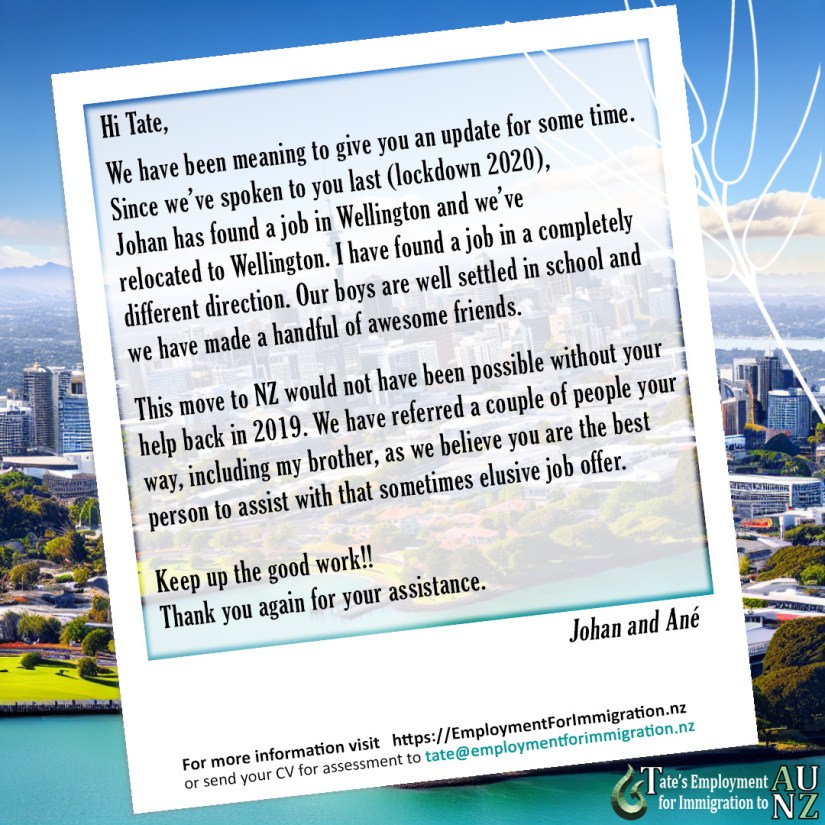
Hi Tate, We have been meaning to give you an update for some time.
Since we’ve spoken to you last, Johan has found a job in Wellington and we’ve relocated to Wellington. I have found a job in a completely different direction. Our boys are well settled in school and we have made a handful of awesome friends.
This move to NZ would not have been possible without your help back in 2019. We have referred a couple of people your way, including my brother, as we believe you are the best person to assist with that sometimes elusive job offer. Keep up the good work!! Thank you again for your assistance.














 Employment for Immigration to New Zealand, Australia and Beyond