
New Zealand is calling out for bold entrepreneurs to help fuel its next wave of growth. NZ $1 million minimum. For a $2 million investment in an existing business enables a 12-month fast-track to residence.

New Zealand is calling out for bold entrepreneurs to help fuel its next wave of growth. NZ $1 million minimum. For a $2 million investment in an existing business enables a 12-month fast-track to residence.

No Degree? You still might be able to get permanent work as a foreignger. Having a formal 4-year qualification is not the only pathway to find work. There are over 700 different job categories that will allow migration to New Zealand and Australia.
Instructions: To find out if you comply to one of our shortage lists, just click on the official government websites above and have a careful look.
If you comply with one or more roles on these lists: Send your CV to me with a short note so that I may give you information about finding work.
Send Your CV Here: tate@employmentforimmigration.nz
Include job title and target country. Daily responses.

Spring has arrived in the Southern Hemisphere, and with it comes renewed energy in the job markets of New Zealand and Australia. While the statistics show some challenges, they also reveal important opportunities for skilled migrants who are ready to make their mark.
It’s worth noting that only in New Zealand would 5.2% unemployment make front-page news — in many countries, that would be celebrated as a sign of a healthy, fully employed economy. Kiwis are quite pedantic about this statistic.
Both countries have different opportunities for work:
For migrants, this dual trend creates a two-sided opportunity: fill the gaps left behind in New Zealand or ride the economic growth wave in Australia.
Spring is traditionally a strong hiring season in both countries:
Despite the statistics, one constant remains:
New Zealand and Australia present complementary opportunities this spring. New Zealand needs skilled migrants to replace a shrinking workforce, while Australia is expanding and paying top dollar to attract talent. For those ready to move, the coming months are a golden window to act.
If you have the right skills, clear goals, and a results-driven profile, now is the time to step forward. Employers are looking — and the market is opening up.
Put your best foot forward this spring. Get a fast, practical CV assessment from a 17-year veteran of the NZ & AU job markets.
What you’ll receive (free insights) for qualifying job seekers:
How to request your assessment:
Confidential. No fluff—just useful, actionable insights you can apply to your job hunt.
New Zealand’s Economy in Crisis: 50,000 Jobs Gone, Kiwis Fleeing to Australia
https://www.propertynoise.co.nz/new-zealands-economy-in-crisis-50000-jobs-gone-kiwis-fleeing-to-australia/?utm_source=chatgpt.com
New Zealand’s Q2 Jobless Rate Rises to 5.2% (shocking)
https://www.reuters.com/world/asia-pacific/new-zealands-q2-jobless-rate-rises-52-2025-08-05/?utm_source=chatgpt.com
New Zealand’s Population Exodus Hits 13-Year High
https://www.reuters.com/world/asia-pacific/new-zealands-population-exodus-hits-13-year-high-economy-worsens-2025-08-15/?utm_source=chatgpt.com
Employment Rises as Jobs Market Stabilises (MEI July 2025)
https://www.mpamag.com/nz/news/general/employment-rises-as-jobs-market-stabilises/547768?utm_source=chatgpt.com
What the Latest Jobs Data Is (and Isn’t) Telling Us
https://thespinoff.co.nz/the-bulletin/31-07-2025/what-the-latest-jobs-data-is-and-isnt-telling-us?utm_source=chatgpt.com
What’s Ahead for New Zealand Hiring in 2025 — Beyond Recruitment
https://www.beyondrecruitment.co.nz/blog/2025/08/whats-ahead-for-new-zealand-hiring-in-2025?utm_source=chatgpt.com
MBIE Labour Market Release Calendar (Jobs Online & MEI Data)
https://www.mbie.govt.nz/business-and-employment/employment-and-skills/labour-market-reports-data-and-analysis/jobs-online/release-calendar?utm_source=chatgpt.com

The table below shows the main countries where skilled migrants move for permanent residence and, later, citizenship. Figures are based on 2025 plans and best estimates. They are not exact, because each country counts migration differently, but this gives a clear picture of the opportunities.
| Country | 2025 Program / PR Plan | Estimated Skilled Migration | Pathways to Residence | Key Salary / Threshold Rules | High Demand Sectors |
|---|---|---|---|---|---|
| Canada | Target ~395,000 permanent residents | 230,000–260,000 (economic class) | Express Entry, Provincial Programs | No national minimum salary; points system + market wages | Healthcare, STEM, Trades, Education |
| Australia | Program 185,000 (≈70% skilled) | 125,000–135,000 | Skills in Demand Visa, ENS 186, Regional 494 | CSIT A$76,515; SSIT A$141,210 | Healthcare, Trades, Engineering, ICT |
| United Kingdom | Skilled Worker → ILR (5 years) | Lower inflows expected | Skilled Worker, Health & Care Worker | £38,700 general; lower for Immigration Salary List jobs | Healthcare, some high-skill STEM |
| New Zealand | Skilled Migrant Category; Green List | Reduced from 2023–24 highs | SMC, Green List (Straight to or Work to Residence) | NZ$33.56/hr median; 1.5×–2× for points | Trades, Care, Transport, Engineering |
| Germany | Skilled Immigration Act; EU Blue Card | ≈200,000 skilled visas (2024) and rising | EU Blue Card, Skilled Worker, Opportunity Card | Blue Card salary rules vary by job group | Engineering, IT, Healthcare, Trades |
Across these systems, a genuine, correctly-paid job offer is the single most powerful lever—it enables sponsorship, meets salary floors, and anchors later steps (PR and citizenship). Timelines, visa classes, and settlement routes differ by country, but the offer is the hinge that connects skill shortages to permanent pathways. (For formal immigration advice, always consult a licensed adviser in the relevant country. If you need an introduction, just ask.)
If you want a no-cost assessment, send your CV. For suitable profiles, we may benchmark your profile against the current shortage lists, salary thresholds, and sector demand above, and recommend a job-first search plan that aligns with today’s high demand job sectors.
Information only — not immigration advice. Always check official sites or a licensed adviser.
Governments in New Zealand and Australia are tightening quality controls while rewarding in-demand skills, higher earnings, and regional commitment. Policy levers now centre on: salary thresholds, occupation lists (including new trades), faster residence pathways, and regional schemes.
Most skilled pathways now hinge on an employer nomination or job offer:
Bottom line: the right written offer — aligned to wage thresholds and an eligible occupation — is often the key that unlocks the visa door.
I’m 100% job-focused (not an immigration adviser). If you want help winning interviews and offers, email your CV for a no-cost assessment: tate@employmentforimmigration.nz. I also provide insider knowledge that helps clients map roles, employers, and outreach strategies that result in a high rate of employer responses, so you can approach the market with a competitive, employer-ready profile and job-finding strategy that works.
Compliance note (not immigration advice):
This article is general information. Only licensed immigration advisers/lawyers can give immigration advice. Please confirm eligibility and rules on the official Immigration New Zealand and Australian Department of Home Affairs websites, or with a licensed professional. If needed, I may introduce you to an experienced and friendly immigration agent in NZ / AUS.
[1] https://www.newzealandshores.com/residence-via-employment/skilled-migrant-category-resident-visa
[2] https://www.immigration.govt.nz/work/requirements-for-work-visas/wage-rates-for-work-visas
[3] https://www.newzealandshores.com/news/wage-threshold-update-2025
[4] https://www.workingin-newzealand.com/news/inz-changes-to-green-list-wage-thresholds
[5] https://greenstoneimmigration.co.nz/skilled-residence-visa-wage-thresholds-to-increase-this-august
[6] https://www.mbie.govt.nz/immigration-and-tourism/immigration/recognised-seasonal-employer-rse-scheme
[7] https://www.stats.govt.nz/information-releases/labour-market-statistics-march-2025-quarter
[8] https://eiglaw.com/austalia-skilled-visa-income-increase
[9] https://www.ey.com/en_gl/tax-alerts/australia-planning-for-1-july-2025
[10] https://immi.homeaffairs.gov.au/visas/working-in-australia/skilled-occupation-lists
[11] https://www.australiavisa.com/other-visas/dama-designated-area-migration-agreements
[12] https://www.homeaffairs.gov.au/help-and-support/regional-migration
[13] https://www.abs.gov.au/statistics/labour/earnings-and-working-conditions/average-weekly-earnings-australia/latest-release
[14] https://www.homeaffairs.gov.au/employing-and-sponsoring/sponsoring-workers/employer-sponsored-visas/temporary-skill-shortage-visa

What do employers think about ATS Keywords and task lists? Applicant Tracking Systems (ATS) are used by recruiting software to quickly evaluate CVs. The job market has rsponsded by entering long lists of these words in the CV. Contrary to popular opinion, this devalues communication and wastes time. Your CV is expensive real estate, so treat it like beachfront property.
1. Tasks don’t show results
As noted in the video, many CVs devote one‑fifth or more of their real estate to “lists of tasks,” offering no evidence of real delivery. Employers end up asking fundamental questions like, “What did you actually achieve?”
2. Keywords ≠ impact
The prevalent practice of inserting industry-specific keywords to “beat the ATS” often leaves human readers unimpressed. ATS may register the terms, but hiring teams still wind up asking basic questions to understand a candidate’s performance.
3. Formatting never replaces substance
Cramming in keywords or tasks may satisfy algorithmic filters temporarily but modern ATS systems evaluate contextual relevance and coherence alongside keywords. A human reviewer reads a CV for tangible value—not repeating buzzwords.
Metrics give recruiters a clearer understanding of your contributions. A bullet like “increased client retention by 37% over 6 months” immediately communicates value Teal. Contrast that with bland task lists such as “managed client accounts”—the difference is stark.
Quantified results show data-based achievements, not self‑reporting with vague claims. Recruiters know you’ve tracked and reflected on your work, strengthening trust in what you say Jobscan+12Teal+12Resume Worded+12.
Hiring managers spend mere seconds reviewing each CV. Metrics help your accomplishments stick in their memory. Without them, your CV easily blends in Resume WordedIndeed.
Well-placed keywords matter—but they’re far more effective when embedded in stories of real contribution. Combining a results-oriented narrative with relevant keywords ensures your application stands up both to screening tools and to human reviewers Jobscan+8The Interview Guys+8jobsolv.com+8.
A redditor who had hiring experience explained the issue bluntly:
“I’ve been saying this forever. When I was in hiring roles, I wouldn’t give these types of statements any weight whatsoever; there’s no way to verify any of it.” LinkedIn+6Reddit+6Jobscan+6
And elsewhere:
“They are important to sell the impact that your work had … If you can’t identify an impact of your work, why would anyone hire you?” Reddit
These insights reinforce that even metrics need to be credible and verifiable—a solid reminder to be honest and precise.
Managed client onboarding onboarding processCoordinated communication between departmentsHandled client queries and schedulesReduced client onboarding time by 40%, trimming average setup duration from 10 to 6 daysImproved client satisfaction score by 12 points through streamlined departmental communicationResolved 90% of client service queries within 24 hours, boosting retention by 15%By shifting the focus from what you did to what you achieved, your CV becomes a performance proof document—not just a record of responsibilities. That’s what recruiters and hiring managers want to see.

The job market landscape in Australia and New Zealand has undergone significant transformation in 2025, creating unprecedented opportunities for skilled migrants. Both countries are experiencing critical labor shortages across multiple sectors, with governments actively prioritizing skilled migration to fill these gaps. This comprehensive guide reveals the hottest job sectors, salary expectations, and strategic insights for migrants seeking work in these dynamic markets.
Healthcare remains the most in-demand sector in both countries, with critical shortages driving aggressive recruitment campaigns12. The aging population and post-pandemic healthcare needs have created a perfect storm of opportunity.
Australia’s Healthcare Hotspots:
New Zealand’s Healthcare Priorities:
The digital transformation wave has created an insatiable demand for tech professionals, with cybersecurity specialists particularly sought after following high-profile data breaches in both countries56.
Australia’s Tech Boom:
New Zealand’s Digital Priorities:
Both countries face massive infrastructure challenges, creating sustained demand for engineering professionals and skilled trades12.
Australia’s Construction Surge:
New Zealand’s Infrastructure Needs:
A significant shift has occurred in 2025, with skilled trades receiving unprecedented recognition and fast-track pathways to residency910.
Australia’s Trade Opportunities:
New Zealand’s Trade Revolution:
From August 2025, 10 new trade occupations join the Green List Work to Residence pathway910:
Australia implemented significant income threshold increases in July 20251112:
New Zealand updated its median wage requirements in August 20251013:
Research shows that skilled migrants contribute significantly more to productivity than their wage costs suggest1516. 81% of employers rate migrant performance as ‘good’ or ‘very good’15.
Key advantages foreign workers offer:
Healthcare: International medical training often exceeds local standards15
Technology: Diverse coding backgrounds and emerging tech expertise15
Engineering: International project experience and specialized knowledge15
Trades: Specific techniques and quality standards from overseas training15
Australian workplace culture in 2025 emphasizes psychological safety and hybrid work models17. Key expectations include:
New Zealand maintains a work-life balance focus with emphasis on:
Australia’s Priority Streams:
New Zealand’s Green List Advantage:
Both countries offer significant incentives for regional work:
Australia:
New Zealand:
Research local market rates thoroughly – employers must pay market rates or visa thresholds, whichever is higher11. Highlight international experience as a value-add proposition15. Consider total compensation packages including superannuation, leave benefits, and professional development opportunities15.
Current processing times vary significantly by visa type and country:
Australia (2025 estimates):
New Zealand (2025 estimates):
The skilled migration landscape in both countries is expected to remain robust through 2025 and beyond. Critical sectors like healthcare, technology, and skilled trades will continue driving demand, while government policy increasingly favors employer-sponsored and regional pathways.
Key trends to watch:
For skilled migrants considering Australia or New Zealand, 2025 represents a golden opportunity. With critical shortages, competitive salaries, and streamlined pathways, both countries are actively seeking the skills you bring. The key to success lies in understanding the specific demands of each market, leveraging your international experience, and choosing the pathway that best aligns with your skills and career goals.
The time to act is now – these opportunities reflect genuine economic needs that will persist well into the decade, making skilled migration a strategic career move for the ambitious professional.
“It’s been a long road toward work migration. There were a lot of obstacles along the way, but now I’m finally seeing the light at the end of the tunnel—with a job and sponsorship offer in Australia!
I’ve been well-prepared for this journey thanks to your help and guidance. A big thanks to you, Tate, for making this journey possible.”
Carlo A.
Civil Engineer
from Philippines
There’s no substitute for experience. Carlo led large-scale projects and expanded his former employer’s client base—a lasting impact. Now in Brisbane, his new employer is already shifting strategy to harness his strengths. Skills like his will always be in demand.
Well done, Carlo!
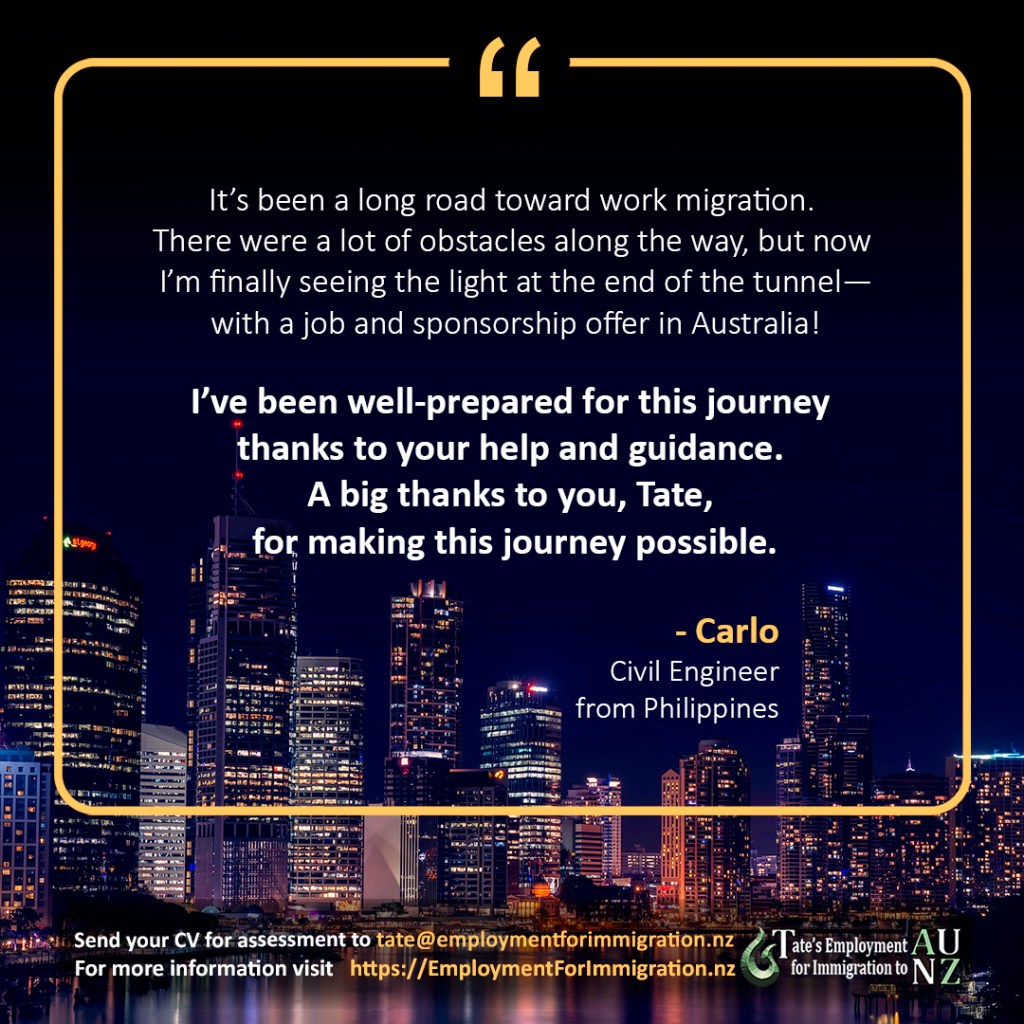
Carlo surprised me with a scheduled meeting and no explanation. I assumed he was going to ask for support in his job hunt, which is something I offer to all my clients. But he greeted me with a big smile and words of appreciation. He just wanted to thank me for helping him find work in Australia. Here is a short clip of our exchange, posted here with permission >>
https://youtube.com/shorts/vcZOv_iXh-4

By Tate Ulsaker — Employment for Immigration | July 2025
Every migrant who embarks on the journey to find work abroad carries a powerful vision: building a new life, supporting loved ones, and achieving stability. Yet the path often feels like navigating a maze—full of gatekeepers, automated systems, and silent rejections.
Here’s the empowering truth: it isn’t your skill or drive holding you back—it’s often the approach. In this post, we tackle the five most common misconceptions that trip up migrant job seekers—and offer clear, actionable consulting steps to overcome them.
Mistake: Waiting passively for interview invites.
Reality: Employers begin evaluating during your very first outreach.
Evidence: Anecdotal insights from recruiters show that talent teams rely heavily on early conversational cues. Personalized outreach earns trust early—and increases interview chances significantly.
Mistake: Assuming your CV will be thoroughly read.
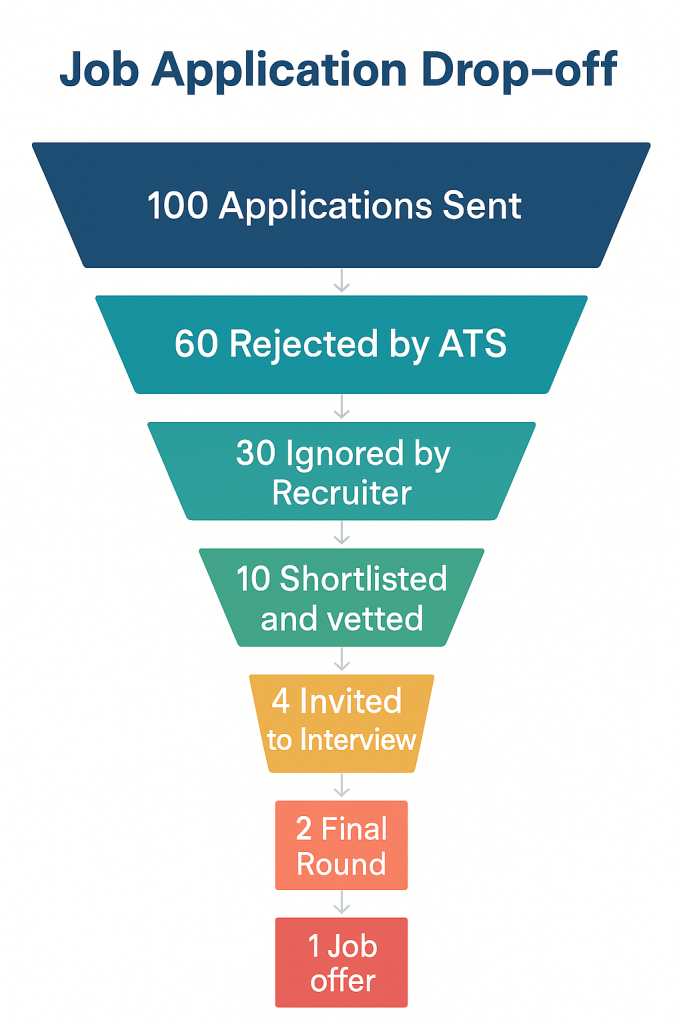
Reality: Recruiters spend just 6–8 seconds on resumes —and ATS filters often eliminate up to 70% of applications.
Mistake: Listing tasks instead of achievements.
Reality: Recruiters prioritize measurable impact.
Evidence: CareerSite data suggests only 11% of applicants are deemed suitable during initial screening .
Mistake: Only contacting accredited employers.
Reality: Most employers, accredited or not, are open to migrants—accreditation takes just days and low cost .
Mistake: Relying solely on job portals.
Reality: Generic job applications get ~1–5% responses . Personalized outreach doubles response rates to ~17%.
Ready for a dive into the migrant job search strategy?
Join our free presentation, where we’ll walk through live demos of:
📧 Claim your spot:
Send your CV + a short note on your migration/job goals to tate@employmentforimmigration.nz. We’ll book your session—no cost, no obligation.

By Tate’s Employment for Immigration – NZ & Australia Migration Experts
You got the call — now what?
If you’re a skilled migrant and an employer from New Zealand or Australia has just invited you for an interview, you’re one step closer to the opportunity you’ve been working towards. But this moment can also feel daunting: a new country, a new process, and a video call that might decide your future.
Here’s how to approach it systematically, professionally, and with growing confidence.
Even if your interview is just a few days away, you can turn that time into preparation gold.
Remember, this preparation time is your advantage. Most local candidates don’t use it wisely — but you can.
Most of our clients face two kinds of interviews:
Occasionally, you’ll face:
Knowing the format helps you prepare the right tone, timing, and delivery style.
If you’re one of our clients, more than 80% of your real interview performance is built during the Video CV preparation process. This is where we systematically record, review, and refine the most powerful way to express your skills — with evidence, impact, and clarity.
Even if you’re not a client yet, you can still benefit by understanding what we do:
1️⃣ Show Value to the Employer’s Bottom Line
Use achievements that reflect real-world business outcomes.
Example: A software developer eliminates 90 minutes of manual work per employee per day across 40 staff →
That’s 60 hours saved daily, equivalent to 7.5 FTEs. If each FTE costs $100k/year, that one improvement creates over $750,000 in annual value.
This kind of quantified result speaks the employer’s language — efficiency, cost savings, ROI.
2️⃣ Show Competence Through Experience Volume
The number of times you’ve done something matters.
Example: A primary teacher with 10 years’ experience might have led over 8,000 classroom sessions. A nurse may have prepared 5,000 IVs or conducted 2,000 patient assessments.
These counts show repetition and mastery. Repetition builds trust. It tells the employer, “I can do this reliably.”
Great interviews don’t just list skills — they place them inside stories. The best stories:
This is the same STAR method we build into your Video CV — and it’s what makes you memorable to employers.
You got the call — because you’re good enough. Now it’s time to show how your skills deliver value and how your experience builds confidence. Whether you’re working with us directly or preparing on your own, following a structured approach is the best way to stand out.
🎥 If you’d like help building your own Video CV or preparing your key interview answers with real impact, send your CV to Tate@employmentforimmigration.nz as a first step. He will respond within 1-day with insights and support.
We help you get ready to not just take the call — but to win the role.
 Employment for Immigration to New Zealand, Australia and Beyond