
Zoom Meetings
Market Updates, Practical Advice

FAQ – Frequently Asked Questions

Helping skilled migrants find real jobs in New Zealand, Australia (and beyond), with professional support, upgraded tools, and employer-focused strategy.


1) What exactly do you offer, and how is it different from a recruiter or immigration agent?

We are not a recruiter or immigration agent. We are career consultants who work for you, not for employers.

What we offer:

  • CV upgrades, Video CVs, and Photo Portfolios to showcase your value.
  • Coaching on how to identify the right employers and contact decision-makers directly.
  • Live job hunt demonstrations to show you exactly how to engage employers.
  • Ongoing support until you receive a job offer.

We teach you the strategy, build your confidence, and help you take control of your job search.


2) Do I qualify if I donโ€™t have permanent residence or a visa yet?

Yes. You may still qualify for support even if you donโ€™t yet hold a visa or permanent residence.

How we support you:

  • We offer a free assessment to review your visa status and job prospects.
  • We guide you through sponsorship-focused strategies and pathways.
  • Weโ€™ve helped clients secure interviews and job offers before receiving their visas.

You donโ€™t need a perfect setup to startโ€”you just need a clear, proven process.

3) Can tradespeople and semi-skilled workers also benefit from your service?

Absolutely. Our services are not limited to degree-qualified professionals.

We help by:

  • Highlighting your real-world experience and practical value.
  • Tailoring applications to employers who value skills over certifications.
  • Showing you how to contact employers directly, where trust often matters more than paperwork.

Your attitude and effort are often more important than your qualifications.


4) Do you apply for jobs on my behalf?

No. We donโ€™t apply for jobs for youโ€”we teach you how to do it better.

Why this matters:

  • Employers are more responsive to direct applications from candidates.
  • It builds trust and increases sponsorship opportunities.
  • You gain control over your future job searches.

We are the only service in Australasia that provides a live, 1.5-hour demonstrationโ€”using your actual employer listโ€”to show you exactly how to contact decision-makers in your industry. One by one, we contact real employers in front of you, showing the strategy in action.

Youโ€™ll also receive optimized documents, outreach scripts, and targeted support to refine your process at every stage.

5) Can you help me get visa sponsorship?

Yes. We help job seekers improve their chances of sponsorship through trust-building and direct outreach.

Hereโ€™s how:

  • We identify employers that are open to sponsorship.
  • We help you present yourself in a way that reduces perceived risk.
  • We teach you how to start real conversations that can lead to offers.

Weโ€™ve supported many clients with limited visas to secure sponsored roles in New Zealand and Australia.


6) What should I do if Iโ€™ve applied to 50+ jobs and heard nothing back?

This is a clear signal that your strategy needs to change.

We help by examining:

  • Whether your CV is being read correctly (ATS or hiring manager).
  • Whether your job hunt is too passive (e.g., relying only on job boards).
  • Whether youโ€™re tailoring your applications properly.

With the right approach, many clients go from 50+ silent applications to 5+ meaningful conversations within weeks.

7) How do your methods actually improve employer response rates?

Our approach goes beyond polishing your documentsโ€”we focus on making you more visible, more credible, and more hireable in the eyes of employers.

What makes the difference:

  • We teach targeted outreachโ€”how to contact the right person in the right company with the right message.
  • We provide live coaching and demonstrations for messaging and phone outreach, using real employer lists.
  • By preparing to best-in-class standards and following our direct engagement strategy, our clients achieve average employer response rates of over 80%โ€”thatโ€™s 40 times higher than standard job board methods.
  • We strengthen your personal brand with standout tools like Video CVs and Photo Portfolios that make a lasting impression.

This system consistently turns silence into opportunityโ€”and interest into interviews.


8) What if Iโ€™ve lost confidence or feel stuck in my job search?

Thatโ€™s commonโ€”and completely fixable.

We help you regain control by providing:

  • A structured action plan so you know what to do next.
  • Live coaching and ongoing encouragement.
  • Evidence that your skills have value through improved employer responses.

Confidence returns when you see progressโ€”and weโ€™re with you every step of the way.


9) Whatโ€™s the biggest mistake most job seekers make in New Zealand or Australia?

The biggest mistake is waiting for advertised roles and applying passively.

Hereโ€™s what works better:

  • Proactively contacting employersโ€”even without an advertised job.
  • Customizing your application to match the companyโ€™s actual needs.
  • Building trust by showing initiative and professionalism.

Success comes to those who step outside the crowdโ€”and weโ€™ll show you how to do that effectively.


10) Can I get a free assessment before I commit to the full program?

Yes. We offer a no-obligation initial assessment so you can make an informed decision.

Your free assessment includes:

  • A review of your current CV or professional background.
  • A description of the entire process end-to-end is given during a meeting.
  • A readiness check for job applications or sponsorship potential.
  • Honest advice on your best path forward.

This helps you understand where you stand before you invest.


11) What if Iโ€™ve been applying through job boards with no response?

We see this oftenโ€”applying only through job boards is the slowest path to results.

We help by:

  • Replacing passive applications with active outreach.
  • Showing you how to bypass gatekeepers and talk to decision-makers.
  • Helping you build relationships, not just submit CVs.

We teach a system that makes employers come to you.

12) Can you help me if my visa is running out soon?

Yesโ€”we regularly support clients in urgent visa situations, and we know how to move quickly when time is limited.

Our approach:

  • We help you immediately prioritize high-potential employers who are most likely to respond.
  • We coach you on how to communicate your situation professionally to reduce perceived risk.
  • We focus on high-impact outreach strategies that can deliver results in daysโ€”not weeks.

Time is tight, but success is still possible. One client in a high-level, tightly regulated industry secured a job offer within just three days using our hyper-engagement process. It was the turning point that protected his migration outcome.

While that speed is rare and not guaranteed, it shows whatโ€™s possible with the right tools, focus, and guidance.

13) Can I get support if Iโ€™m already working but want a better job?

Yes. Many of our clients are already employed but want to:

  • Change industries or locations.
  • Move to higher-paying roles.
  • Secure sponsorship for permanent residency.

We help you transition smoothly with a professional strategy and confidential support.

14) Iโ€™m interested in your servicesโ€”how can I find out whatโ€™s relevant to me personally?

The best first step is to send us your CV along with a brief message outlining your migration goals, current visa status (if applicable), and how soon youโ€™re ready to begin work.

Weโ€™ll review your background and provide you with a free personalised assessment. If youโ€™re in a position to be hired, weโ€™ll also offer you a one-on-one meeting to discuss targeted strategies and realistic next steps based on your profile.

Email: Tate@employmentforimmigration.nz
This gives you tailored insightsโ€”no guesswork, no generic adviceโ€”just clear feedback on where you stand and how we can help.

Market Updates, Migrant Resources

2025 Remote Work Trends: Opportunities for Migrants

In 2025, remote work has become a strategic entry point for migrants aiming to establish themselves in New Zealand or Australia. While not a direct route to permanent residency (PR), remote work offers a practical means to build local experience, networks, and demonstrate commitmentโ€”key factors in long-term settlement.โ€‹

๐ŸŒ Remote Work Landscape in 2025

New Zealand:

  • Visitor Visa Flexibility: As of January 27, 2025, New Zealand allows visitors on certain visas to work remotely for overseas employers without breaching visa conditions. โ€‹Immigration New Zealand
  • Digital Nomad Visa: Introduced in early 2025, this visa permits remote workers to stay and work in New Zealand for up to three months, with no minimum income requirement. โ€‹

Australia:

  • Remote Work Acceptance: While Australia doesn’t have a specific digital nomad visa, remote work is widely accepted, especially in sectors like IT, marketing, and customer service. โ€‹

Opportunities for Remote Work

In-Demand Remote Roles:

  • Technology: Software developers, data analysts, and cybersecurity experts.โ€‹
  • Creative Fields: Graphic designers, content creators, and digital marketers.โ€‹
  • Customer Support: Virtual assistants and customer service representatives.โ€‹

Where to Find Opportunities:

  • Job Portals: Websites like Jobgether and FlexJobs list remote positions suitable for applicants in New Zealand and Australia.โ€‹
  • Networking: Platforms like LinkedIn and industry-specific forums can be valuable for finding remote opportunities.โ€‹

Strategies to Secure Remote Work

  • Tailor Your Resume: Highlight remote work experience and relevant skills.โ€‹
  • Upskill: Consider certifications in high-demand areas like project management or digital marketing.โ€‹
  • Time Zone Consideration: Be prepared to work flexible hours to accommodate clients in different time zones.โ€‹
  • Professional Online Presence: Maintain an updated LinkedIn profile and consider creating a personal website or portfolio.โ€‹

โš–๏ธ Legal Considerations

New Zealand:

  • Tax Implications: Working remotely in New Zealand for more than 92 days in a 12-month period may trigger tax obligations. โ€‹
  • Work Restrictions: Remote work must be for an overseas employer; working for a New Zealand-based company requires a different visa. โ€‹

Australia:

  • Visa Requirements: Ensure your visa permits remote work; some visas may have restrictions. โ€‹Immigration New Zealand
  • Tax Residency: Staying in Australia for more than six months may classify you as a tax resident, with associated obligations.โ€‹

Pros and Cons of Remote Work Migration

Pros:

  • Flexibility: Ability to work from anywhere, allowing for travel and exploration.โ€‹
  • Cost Savings: Potentially lower living costs compared to major cities.โ€‹
  • Work-Life Balance: Opportunity to design a lifestyle that suits personal preferences.โ€‹

Cons:

  • Isolation: Lack of in-person interaction can lead to feelings of loneliness.โ€‹
  • Time Zone Challenges: Coordinating with teams in different time zones can be demanding.โ€‹
  • Legal Complexities: Navigating visa requirements and tax obligations can be complex.โ€‹

Final Thoughts

Embracing remote work in New Zealand or Australia offers exciting possibilities for migrants. By understanding the legal landscape, identifying suitable opportunities, and adopting effective strategies, you can successfully navigate this path. Remember, while the journey may have its challenges, the rewards of flexibility and global experience are well worth the effort.โ€‹

Market Updates, Migrant Resources

Navigating AI: A Designerโ€™s Guide to Future-Proofing

AI is no longer just a future conceptโ€”itโ€™s here, and itโ€™s changing how design gets done. For many graphic designers, this brings both opportunity and anxiety. Will clients stop hiring creatives? Will algorithms do all the work? Or is there a smarter path forward?

This blog explores the real and perceived threats from AI over the next 1, 5, and 10 yearsโ€”and shows how creative professionals can adapt, using both strategy and mindset.

To support these insights, weโ€™ve embedded key moments from a coaching session with a talented graphic designer. These YouTube Shorts offer real-time reflections on navigating AI, taking ownership, and keeping human creativity front and center.


๐Ÿ” 1-Year Outlook: AI Tools Are Everywhereโ€”Now What?

Real Threats

AI design tools like Midjourney, Canva AI, and Adobe Firefly now enable non-designers to produce compelling content quickly. This reduces demand for junior freelance work and entry-level design support.

Perceived Threats

Designers worry: โ€œIf AI can create in seconds what takes me hours, am I already obsolete?โ€


๐ŸŽฅ Short: Embracing AI โ€” Adapting Skills for a New Era

“You donโ€™t need to click and hope. You need someone to take responsibilityโ€ฆ to turn hopes into outcomes.”

๐Ÿ’ก Key Takeaway: AI can generate options, but brands still want accountability. Clients arenโ€™t just buying imagesโ€”theyโ€™re buying confidence, refinement, and strategic thinking. Thatโ€™s where you come in.


โœ… Response Strategy

  • Learn the tools, but donโ€™t rely on them blindly.
  • Position yourself as a decision-maker, not just a tool-user.
  • Help clients go from โ€œclick and hopeโ€ to refined outcomes that reflect brand values and user needs.

๐Ÿ“‰ 5-Year Outlook: Automation Shrinks the Middle

Real Threats

As AI continues evolving, more companies will automate branding kits, templates, and campaign assets. This puts pressure on mid-tier designers who once thrived in this space.

Perceived Threats

The fear here is deeper: โ€œCreativity is now AIโ€™s job, not mine.โ€


๐ŸŽฅ Short: Harnessing AI to Amplify Your Unique Strengths

“What if AI does the busy work, so you can focus on what you do best? What if it brings your strengths forward, not replaces them?”

๐Ÿ’ก Key Takeaway: AI is only a threat if you compete with it on its terms. Instead, use it to amplify your strengths, accelerate your workflow, and differentiate your offering.


โœ… Response Strategy

  • Focus on areas where human judgment and taste matter.
  • Use AI to speed up initial drafts, generate variations, or prototype ideasโ€”then apply your eye for what works.
  • Present yourself as a hybrid designer: part creator, part strategist, part technologist.

๐ŸŒ 10-Year Outlook: From Creator to Creative Leader

Real Threats

Within a decade, itโ€™s possible that AI could handle full creative productionโ€”concepts, layouts, copy, and testingโ€”all with minimal human input. Designers who stick to execution-only roles may find themselves left behind.

Perceived Threats

This triggers existential fears: โ€œWill there even be a place for me?โ€


๐ŸŽฅ Short: Understanding AI โ€” The Illusion of Thinking in Design

“It mimics care. It mimics thought. But itโ€™s not real. Youโ€™re still the one behind the desk, taking responsibility.”

๐Ÿ’ก Key Takeaway: AI may simulate style, emotion, or even empathyโ€”but it canโ€™t truly care or take ownership. A future-proof designer is one who leads, guides, and brings authenticity to the work.


โœ… Response Strategy

  • Evolve from executor to editor and brand guardian.
  • Lead with empathy, context, and ethical judgmentโ€”things AI can’t replicate.
  • Build a personal brand that connects human-to-human, not just machine-to-client.

๐Ÿ” Closing Loop: The Value of Human-Led Design

๐ŸŽฅ Bonus Short: Transform Clicks into Results โ€” The AI Accountability Solution

โ€œYou donโ€™t need someone who clicks and hopes. You need someone who takes ownership.โ€

๐Ÿ’ก Final Thought: AI is powerful, but clients still want a human in the loop. Your value is not in beating AIโ€”itโ€™s in using it well, taking responsibility, and showing care in ways a program never can.


๐Ÿงฉ Summary Table

TimeframeReal ThreatsPerceived ThreatsWhat You Can Do
1 YearClients use AI for quick jobsโ€œAI is faster than meโ€Learn the tools, lead the outcomes
5 YearsMid-tier roles shrinkโ€œAI does all the creativityโ€Specialize, co-create, differentiate
10 YearsAI runs full campaignsโ€œThereโ€™s no place leftโ€Become a leader, not just a doer

๐ŸŽฌ Want to See the Discussion?

You can watch all the clips from this coaching session here:


๐Ÿ’ฌ Final Message to Designers

AI is not your enemyโ€”itโ€™s your wake-up call.

Use it to accelerate what you do, not replace who you are. Clients still want trust, judgment, and vision. Be the one who brings it all together.

Everyone Need Encouragement, Market Updates

Coping with Homesickness: Strategies for Migrants

Starting a new life abroad is a courageous and hopeful step, but one that often comes with unexpected emotional hurdles. Among the most common is homesicknessโ€”the emotional response to separation from family, familiar surroundings, and cultural norms. This feeling can affect even the most determined migrants and may linger longer than expected.

For skilled migrants relocating to New Zealand, Australia, or exploring pathways in Europe or North America, success is not just about landing a jobโ€”itโ€™s about building a meaningful life. This article provides practical strategies and mindset shifts that migrants use to turn uncertainty into belonging.


Strategies Migrants Use to Cope with Homesickness

These are not just coping mechanismsโ€”they are the foundations of long-term emotional resilience and personal success in a new land.

1. Staying Connected with Home

Maintaining ties with your home country provides emotional grounding. Regular phone and video calls with family members and close friends remind migrants that they are not alone and still part of a larger network of support12. Many migrants schedule weekly catch-ups with loved ones, even if time zones make this challenging. Social media groups dedicated to people from their homeland also offer community and shared understanding.

Additionally, cultural continuity plays a huge role in emotional well-being. Migrants often find comfort in cooking traditional dishes, listening to music from home, or celebrating cultural holidays. These practices offer a sense of control and familiarity that softens the feeling of dislocation12.

2. Building a Support Network

Forming new relationships is essential for adapting to a new country. Many migrants seek out cultural associations, community centers, or church groups where they can connect with others facing similar challenges12. These spaces offer validation and camaraderie that ease the burden of isolation.

At the same time, making connections with locals is just as important. Learning to build friendships outside of oneโ€™s cultural circle not only helps with language practice but also leads to broader acceptance and opportunities. Migrants often report that even small gesturesโ€”such as chatting with neighbors, attending workshops, or joining local sports clubsโ€”make a large emotional impact34.

3. Personalizing Your Space

Creating a familiar, cozy space at home can significantly improve emotional well-being. Simple things like hanging family photos, displaying mementos from your hometown, or arranging furniture in a culturally familiar way can bring emotional comfort and a sense of ownership5. This tactic helps transform temporary accommodation into a space that feels emotionally safeโ€”a critical anchor during difficult days.

Some migrants also create dedicated โ€œcomfort zonesโ€ within their homesโ€”spaces for prayer, tea, or readingโ€”that help preserve cultural rituals and offer moments of reflection or calm.

4. Exploring the Host Culture

Embracing your new country is not about abandoning your identityโ€”itโ€™s about adding layers to who you are. Successful migrants take time to learn the language, understand local customs, and participate in daily life as much as possible16. This doesnโ€™t happen overnight, but consistent small effortsโ€”like watching local news, trying new foods, or observing holiday traditionsโ€”can ease the adjustment process.

Joining community events, enrolling in a class, or volunteering helps migrants interact with the host society in low-pressure settings. These moments not only reduce homesickness but help develop a sense of place and belonging23.

5. Maintaining Physical and Mental Health

Migrants often overlook their physical and mental health while focusing on settlement tasks, but well-being is a long-term investment. Regular physical activityโ€”whether walking, jogging, yoga, or gym sessionsโ€”boosts mood, reduces anxiety, and builds structure into the day52.

Equally important is mental health. Migrants can benefit from accessing culturally sensitive counseling, mental health hotlines, or peer-support groups. A growing number of online and in-person services now cater to migrant communities, offering resources that normalize and address emotional stress14.

6. Volunteering and Helping Others

Taking part in community service or volunteer projects offers a double benefit. It gives migrants a chance to give back and also helps them feel more integrated. Whether itโ€™s planting trees, tutoring students, or helping with a food drive, volunteering fosters purpose and builds a stronger connection with the new environment2.

Many migrants discover that helping others in small ways builds self-esteem and restores a sense of agency, especially during early periods of vulnerability.

7. Setting Goals and Reflecting on Purpose

Migrants often report that reminding themselves of why they moved helps them through hard times. Whether it’s to secure a better future for children, pursue professional growth, or escape political hardship, reconnecting with that purpose provides motivation2. Setting short- and long-term goals also adds structure and keeps the focus forward-looking.

Some migrants use journaling or vision boards as tools to track progress and celebrate small wins. Others speak affirmations or reflect with trusted mentors. These actions shift attention from what’s missing to what is being built.


The Mindset That Shapes Your Migration Journey

More than any external factor, your internal state can shape how you experience migration. Here are the three most powerful mindsetsโ€”both helpful and harmfulโ€”that influence migrant success.


Positive Mindsets That Support Integration

1. Growth Mindset

Migrants with a growth mindset believe that abilitiesโ€”like language learning or professional adaptationโ€”can improve with effort. They embrace challenges as learning experiences rather than signs of failure. This mindset fosters resilience, especially when migrants face setbacks like job rejections, communication barriers, or unfamiliar processes67.

Even when struggling with English or local customs, migrants with this mindset tend to seek resources, practice daily, and persist until progress becomes visible. In turn, they build not only skills but also self-confidence and emotional stability.

2. Willingness to Interact

Social courageโ€”the willingness to talk to strangers, attend events, or ask questionsโ€”makes a significant difference in how quickly migrants integrate15. This doesnโ€™t mean being extroverted; it means making a consistent effort to connect with people, even when itโ€™s uncomfortable.

This mindset helps overcome shyness or fear of embarrassment. Over time, even small conversations with neighbors, coworkers, or shopkeepers help build familiarity and trust. These connections are the stepping stones to a real sense of community.

3. Sense of Purpose

A clear sense of purpose acts as a compass during the toughest times. Migrants who keep their long-term goals front of mind are more likely to endure early struggles and take strategic action. This mindset helps reframe daily challengesโ€”from housing issues to credential recognitionโ€”as part of a larger journey toward stability and success7.

Purpose can come from career ambition, family hopes, or even the pursuit of a better lifestyle. When migrants tie their sacrifices to something meaningful, they gain strength and avoid burnout.


Limiting Mindsets That Hinder Adjustment

1. Fixed Mindset

Migrants with a fixed mindset often believe their skills or intelligence are unchangeable. For example, someone who thinks “I will never speak English well” may avoid trying altogether. This mindset leads to fear of failure, low confidence, and missed opportunities67.

Unfortunately, fixed thinking can prevent even capable migrants from seeking help, taking risks, or applying for jobs that might challenge them. Breaking this mindset often requires supportive coaching or early success stories to prove improvement is possible.

2. Sense of Alienation

When migrants view themselves as permanent outsiders, it becomes harder to engage with the host community8. This mindset can develop if migrants experience repeated rejection or cultural misunderstanding. Over time, they may withdraw, limiting their ability to participate in society meaningfully.

The danger of alienation is that it creates a self-fulfilling cycleโ€”avoiding interaction leads to less integration, which leads to even more feelings of isolation. Migrants must actively counter this by creating bridges, not barriers.

3. Fear of Discrimination

Discrimination is a real issue in many countries, but allowing the fear of it to dominate your mindset can be paralysing. Migrants who assume they will be rejected or stereotyped often hesitate to apply for jobs, avoid asking for help, or refuse to speak up13.

While caution is wise, excessive fear can limit potential and cut off positive experiences before they start. Itโ€™s vital to develop discernment and find safe ways to build trust, advocate for oneself, and seek allies.


Conclusion: From Homesick to Homegrown Strength

Migration is an emotional and psychological journeyโ€”not just a logistical one. Feelings of homesickness are natural and valid, but they do not need to define your story.

With the right strategies and a supportive mindset, migrants can overcome the initial shock of relocation and begin creating a new chapter filled with purpose, connection, and hope. Itโ€™s not about losing your identityโ€”but about expanding it in a way that honors where youโ€™ve come from and where youโ€™re going.


Footnotes & References

  1. https://canadianimmigrant.ca/living/wellness/missing-home-strategies-to-help-you-lessen-the-impact-of-homesickness โ†ฉ โ†ฉ2 โ†ฉ3 โ†ฉ4 โ†ฉ5 โ†ฉ6 โ†ฉ7
  2. https://chatterfox.com/10-tips-on-how-to-overcome-homesickness-as-an-immigrant โ†ฉ โ†ฉ2 โ†ฉ3 โ†ฉ4 โ†ฉ5 โ†ฉ6 โ†ฉ7
  3. https://www.impossiblepsychservices.com.sg/our-resources/articles/2020/02/03/coping-with-homesickness-depression-anxiety-expatriate โ†ฉ โ†ฉ2 โ†ฉ3
  4. https://www.octagonpeople.com/homesickness-5-coping-strategies-for-expats โ†ฉ โ†ฉ2
  5. https://www.gooverseas.com/blog/ways-reduce-homesickness-abroad โ†ฉ โ†ฉ2 โ†ฉ3
  6. https://blog.oup.com/2018/09/migrants-intercultural-experiences โ†ฉ โ†ฉ2 โ†ฉ3
  7. https://www.brainzmagazine.com/post/how-do-mindset-and-identity-affect-the-success-of-migrants-in-their-new-country โ†ฉ โ†ฉ2 โ†ฉ3
  8. https://www.live-work.immigration.govt.nz/live-in-new-zealand/tips-for-settling-in/feeling-homesick โ†ฉ

Migrant Resources

A Comprehensive Guide to Housing for New Migrants in Australia

Australia’s housing landscape presents both opportunities and challenges for new migrants. Whether you’re arriving for work, study, or family reunification, securing the right accommodation is one of the first major steps in your settlement journey. This guide explores the key aspects of the Australian housing marketโ€”from types of accommodation and typical costs to short-term strategies, rental processes, home ownership, and support systemsโ€”to help migrants make informed and confident decisions.

Understanding the Housing Landscape

Australiaโ€™s major cities (Sydney, Melbourne, Brisbane) are known for high housing costs, while regional and suburban areas offer more affordability but often fewer services or job opportunities. The current housing crisis has made affordable rentals harder to find, especially for temporary visa holders and those from non-English-speaking backgrounds who may face language barriers, lack of references, or unfamiliar rental systems (The Conversation, RMIT).

Humanitarian migrants often experience transitional housing shifts. Research shows that around 59% of humanitarian entrants move at least once shortly after arrival as they shift from temporary to more permanent arrangements (AIFS – BNLA).

Housing Types and Costs

Accommodation Types

  • Shared Housing: Rooms in shared homes. Cost: AUD $150โ€“$250/week
  • Studio Apartments: Single self-contained units. Cost: AUD $300โ€“$450/week
  • One-Bedroom Units: Suitable for individuals or couples. Cost: AUD $400โ€“$600/week
  • Two-Bedroom Units: Ideal for small families. Cost: AUD $550โ€“$800/week
  • Full Houses: Suitable for larger families. Cost: AUD $600โ€“$1,000+/week

These costs vary by location. Sydney and Melbourne are the most expensive cities, while regional and suburban areas offer lower rental prices (Settlement Service).

Where to Live: Urban, Suburban or Regional?

  • Urban Centres: High cost, high opportunity. Best for employment access but intense rental competition.
  • Suburban Areas: Balanced affordability and access to jobs and services.
  • Regional Communities: Lower costs and close-knit communities, but fewer jobs and services.

Lifestyle factors like school quality, public transport, and cultural community access also impact the best choice for you (Australian Visa Advice).

Short-Term vs. Long-Term Housing

Short-Term Strategies

Temporary options include:

  • Hostels
  • Serviced apartments
  • Airbnb

These options give time to explore neighborhoods and build documents (rental history, bank statements) needed for longer-term rentals (AIFS – BNLA).

Long-Term Transition

Many migrants secure long-term leases within 3โ€“6 months. Itโ€™s common to start with temporary housing before finding something more permanent. Preparation and attending open inspections help with successful rental applications (AIFS – BNLA).

Navigating the Rental Market

Application Process

Youโ€™ll need:

  • ID (Passport or visa)
  • Proof of income/employment
  • References or alternative documentation (bank records, job contracts)

Being prepared allows faster applications in competitive markets (Australian Visa Advice).

Tenant Rights and Legal Terms

Understand:

  • Lease agreements
  • Bond (security deposit)
  • Condition reports
  • Tenant rights (vary by state)

You can get legal advice from community centers or tenant unions if unclear (Home Affairs).

Managing Costs and Avoiding Housing Stress

Housing should not exceed 30% of your income. Higher than this can lead to stress and limit spending on food, transport, and health (Refugee Council).

If you’re struggling:

  • Explore house sharing
  • Look in outer suburbs
  • Use rent assistance via Centrelink (if eligible)
  • Get help from financial counselors

Considering Home Ownership

Buying a Home: Costs and Rules

  • Deposit: 10โ€“20% of purchase price
  • Other Costs: Stamp duty, legal fees, inspection costs
  • Median Prices: AUD $885,000+ (house), AUD $673,000+ (unit) (Your Mortgage)

For non-permanent residents, FIRB approval is often required. Some banks impose stricter lending rules for temporary visa holders (Home Affairs).

Mortgage Preparation

  • Establish good credit history
  • Seek pre-approval
  • Compare lenders and interest rates
  • Consider working with a broker familiar with migrant lending

Challenges to Expect

Language & Culture

  • Language barriers can make it harder to understand leases and negotiate.
  • Cultural expectations around housing differ.
  • Seek bilingual support or use translated materials to understand your rights.

Discrimination

  • Discrimination based on nationality or ethnicity still exists.
  • Know your rights under anti-discrimination laws.
  • Tenant advocacy groups can help with complaints or mediation.

Support Services

Government Programs

  • Centrelink: Rent assistance
  • Humanitarian Services: Short-term housing support
  • State Housing Authorities: Long public housing waitlists, but still an option

Community Support

  • Ethnic community groups
  • Religious charities
  • Migrant advocacy networks

These groups help with:

  • House searches
  • Inspections
  • Paperwork
  • Legal support

Online Tools

  • Realestate.com.au and Domain.com.au for housing listings
  • MoneySmart for budgeting and financial tools
  • Settlement Services for legal and housing rights info (Home Affairs)

Top Cities for New Migrants

CityJob SectorsCost of LivingNotes
SydneyFinance, Tech, EducationVery HighHigh-paying jobs but expensive
MelbourneCreative, HealthcareHighCultural hub and balanced living
BrisbaneHealth, HospitalityModerateWarm climate and outdoor lifestyle
AdelaideTech, EducationLow-ModerateFamily-friendly and quiet
PerthMining, Public ServicesModerateHigh salaries and relaxed lifestyle
HobartTourism, ArtsLowPeaceful and scenic
Gold CoastTourism, RetailModerateCoastal living with lower costs
CairnsEnvironmental SciencesLowTropical lifestyle and relaxed pace

Final Thoughts

Your housing journey in Australia wonโ€™t be perfect from day oneโ€”and thatโ€™s okay. Many migrants move 2โ€“3 times before settling. The key is to plan carefully, know your rights, and ask for help when needed.

Start with short-term shelter, learn the market, build documentation, and set clear financial goals. From there, you can work towards a secure, long-term place that suits your needs.

Australia welcomes skilled and motivated newcomersโ€”with the right approach, your new home is within reach.

Market Updates

The Fourth Industrial Revolution and Its Impact on Australia and New Zealand

The Rise of Industry 4.0

Industry 4.0, also known as the Fourth Industrial Revolution, is transforming the economic and industrial landscape of Australia and New Zealand. It integrates cutting-edge technologies such as artificial intelligence (AI), the Internet of Things (IoT), robotics, cloud computing, and data analytics into manufacturing and industrial processes. This revolution is not just changing the way products are made but also reshaping job markets, industry competitiveness, and economic growth.

How Industry 4.0 is Reshaping Manufacturing

The manufacturing sector is at the forefront of this revolution, with smart factories leveraging automation, real-time monitoring, and advanced data analytics to enhance productivity. Notable trends include:

  • Smart Factories: Investment in connected systems that collect and analyze data across production lines is increasing. Siemens’ Tonsley Innovation District in South Australia is a prime example of a smart factory hub.
  • Advanced Manufacturing: The industry is moving towards AI-driven, robotics-enhanced production lines that allow for increased precision and efficiency.
  • Data-Driven Decision Making: 87% of manufacturing managers in Australia and New Zealand now prioritize data analytics, surpassing global averages.
  • Sustainability and Green Manufacturing: 72% of industry leaders now prioritize sustainable materials, energy sources, and waste reduction.
  • Supply Chain Resilience: The integration of digital tracking tools is helping businesses anticipate and respond to disruptions more effectively.

The Impact on Major Industries

While manufacturing leads the charge, Industry 4.0 is influencing multiple sectors across Australia and New Zealand.

Mining and Resources

The mining sector is benefiting from automation, AI-driven exploration, and remote operations. Autonomous haulage trucks, predictive maintenance powered by machine learning, and digital twin technology are streamlining operations and reducing risks. However, traditional mining jobs may decline as automation increases.

Agriculture and Food Production

Smart farming techniques, precision agriculture, and IoT-enabled monitoring systems are improving crop yields and resource efficiency. Drones, automated irrigation, and AI-based pest management are transforming agribusiness, making it more sustainable and profitable.

Construction and Engineering

The use of 3D printing, digital modeling (BIM), and automated machinery is revolutionizing construction. Robotics and AI are reducing manual labor while increasing efficiency, safety, and sustainability in infrastructure projects.

Logistics and Supply Chain

IoT, blockchain, and AI-driven forecasting are helping businesses optimize logistics networks, predict demand surges, and manage inventory in real-time. Automation in warehousing and transport is reducing operational costs and improving efficiency.

Healthcare and Biotech

Telehealth, AI diagnostics, and robotic surgeries are advancing medical care. The digital transformation of patient records and AI-driven drug discovery are opening new frontiers in biotech innovation and personalized medicine.

Winners and Losers in the Economy

As with any industrial revolution, Industry 4.0 creates both opportunities and challenges.

Winners

  • Skilled Tradespeople & Engineers: Those specializing in automation, robotics, IoT, and AI integration will be in high demand.
  • Data Scientists & Cybersecurity Experts: As industries become increasingly data-driven, professionals skilled in data analytics, cybersecurity, and AI development will see growing opportunities.
  • Sustainability Specialists: Experts in green manufacturing, renewable energy, and waste management will benefit from the push toward sustainability.
  • IT Professionals & Digital Transformation Consultants: Businesses are seeking guidance on integrating Industry 4.0 technologies effectively.

Losers

  • Low-Skilled Manual Laborers: Jobs in traditional manufacturing, warehousing, and even some service industries are at risk due to automation.
  • Legacy Businesses That Fail to Adapt: Companies that resist digital transformation may struggle to compete with data-driven and automated rivals.

How Skilled Professionals Can Adapt

To stay competitive in an Industry 4.0-driven job market, professionals need to upskill and align with emerging technologies:

  • Engineers & Tradespeople: Gaining expertise in AI-assisted machinery, smart factory operations, and industrial automation will be critical.
  • IT & Data Professionals: Expanding knowledge in AI, machine learning, cybersecurity, and cloud computing will ensure relevance.
  • Managers & Business Leaders: Embracing data-driven decision-making, digital project management, and sustainability leadership will enhance career prospects.

Where Are the Gaps for Skilled Migrants?

As Industry 4.0 accelerates, skill shortages are emerging, creating opportunities for foreign professionals in high-demand fields. Areas with strong demand include:

  • Industrial Automation & Robotics Engineers
  • AI & Machine Learning Specialists
  • Cybersecurity Experts
  • Data Scientists & Analysts
  • Renewable Energy & Sustainability Experts
  • Advanced Manufacturing Technicians
  • IoT & Cloud Computing Specialists
  • Smart Logistics & Supply Chain Analysts

A Bright Future: Economic Growth and High Quality of Life

The Fourth Industrial Revolution presents both disruption and opportunity. For those who adapt, Australia and New Zealand offer strong economies, global leadership in advanced industries, and an enviable quality of life. With the right skills and strategies, professionals can leverage Industry 4.0 to secure high-paying, future-proof careers in one of the worldโ€™s most dynamic regions.

Sources by Category

General Industry 4.0 Overview

  1. SAP Industry 4.0: https://www.sap.com/australia/products/scm/industry-4-0/what-is-industry-4-0.html
  2. KPMG Industry 4.0 Report: https://kpmg.com/au/en/home/insights/2023/10/industry-4-0-industrial-manufacturing.html

Manufacturing and Automation

  1. Gov2 on Australian Manufacturing: https://www.gov2.com.au/the-future-of-australian-manufacturing-embracing-industry-4-0/
  2. Robycs Technology in Australia: https://robycstechnology.com.au/industry-4-0-in-australia/
  3. Tulip on Smart Factories: https://tulip.co/ebooks/industry-4-0/

Mining and Resources

  1. IBM Mining Technology Report: https://www.ibm.com/think/topics/industry-4-0
  2. EY Mining & Automation Insights: https://www.ey.com/en_au/mining-metals/ai-in-mining

Agriculture and Food Technology

  1. AgTech Adoption in Australia: https://www.mbie.govt.nz/business-and-employment/economic-development/industry-transformation-plans/advanced-manufacturing
  2. Precision Farming Solutions: https://www.callaghaninnovation.govt.nz/assets/documents/Industry-4-0/Aotearoas-Industry-4.0-journey-november-2024.pdf

Healthcare & Biotech

  1. AI in Healthcare: https://business.canon.co.nz/insights/digital-transformation-in-manufacturing-industry
  2. Smart Healthcare Solutions: https://www.smartindustry.com/benefits-of-transformation/digital-transformation/article/55132388/smart-factories-a-roadmap-to-optimization-not-overhaul

Market Updates

The Best Countries for Forestry Managers Looking to Migrate in 2025

Overview

The demand for forestry managers in 2025 is primarily driven by the size of a countryโ€™s forestry sector, total forest area, and employment levels in forestry-related roles. Analyzing Western countries, the United States and Canada stand out due to their vast forest areas and well-developed forestry industries. Finland and Sweden also exhibit high demand due to their economic dependence on forestry.

Key Findings

  • United States has the highest demand for forestry managers among Western countries in 2025.
  • Canada follows closely, with significant employment opportunities in the sector.
  • Finland and Sweden exhibit strong demand due to their economic reliance on forestry.
  • Germany, Australia, and New Zealand have active forestry sectors but show comparatively lower demand for forestry managers.

Demand in Key Countries

United States

  • Forest Area: 304 million hectares.
  • Employment: Approximately 11,300 foresters (U.S. Bureau of Labor Statistics).
  • Trends: Job listings on Indeed and ZipRecruiter indicate strong hiring in states like California and North Carolina.
  • Market Growth: Expected to grow by 2.7% from 2022 to 2032.

Canada

  • Forest Area: 310 million hectares.
  • Employment: 46,000 in forestry and logging (2022).
  • Registered Foresters: Over 5,300 in British Columbia alone, with a national estimate between 10,000 and 15,000.
  • Economic Contribution: $33.7 billion in GDP (2022).
  • Job Market: Strong demand across provinces, particularly in British Columbia and Alberta.

Finland

  • Forest Area: 22.95 million hectares.
  • Employment: 160,000 directly and indirectly in forestry.
  • Economic Contribution: EUR 12 billion in exports (2023).
  • Hiring Trends: Forestry roles actively listed on Glassdoor.

Sweden

  • Forest Area: 27.8 million hectares.
  • Employment: 30,200 in forestry (2022); total industry employment exceeds 60,000.
  • Economic Contribution: SEK 184 billion in exports (2023).
  • Job Listings: Available on platforms like Glassdoor.

Germany

  • Forest Area: 11.4 million hectares.
  • Employment: 562,000 in agriculture, forestry, and fishing.
  • Demand Level: Moderate, with job postings on Indeed.

Australia

  • Forest Area: 125 million hectares.
  • Employment: 5,600-5,900 projected in 2025.
  • Demand Level: Moderate, with active job listings on SEEK and Indeed.

New Zealand

  • Forest Area: 7.8 million hectares.
  • Employment: Over 40,000 in the forestry sector.
  • Job Listings: 226 active forestry-related jobs on SEEK.
  • Economic Contribution: $6.0 billion in projected export value (2025).

Comparative Table: Forestry Sector Indicators

CountryForest Area (Million Ha)Employment in Forestry (2022-2024)Registered Foresters (Estimate)Economic Contribution
United States30411,300 foresters~11,300Significant, exact GDP not detailed
Canada31046,000 (industry total)~10,000-15,000$33.7B in 2022 GDP
Finland22.95160,000 (direct/indirect)Not specifiedEUR 12B exports in 2023
Sweden27.830,200Not specifiedSEK 184B exports in 2023
Germany11.4562,000 (agri, forestry, fishing)Not specifiedNot detailed
Australia1255,600-5,900 (projected 2025)Not specifiedNot detailed
New Zealand7.8Over 40,000Not specified$6.0B export value projected 2025

Discussion

  • The U.S. and Canada have the strongest demand for forestry managers, with the U.S. leading in absolute numbers.
  • Finland and Sweden have strong demand due to their economic reliance on forestry.
  • Germany, Australia, and New Zealand maintain notable forestry sectors but show lower demand compared to North America and Nordic countries.
  • The lack of precise numbers for forestry managers, especially in Canada, highlights the decentralized nature of forestry regulation and reporting.

Conclusion

For migrants looking to work as forestry managers, the United States and Canada offer the best opportunities, followed by Finland and Sweden in Europe. The U.S. likely has the highest absolute demand, supported by its large forestry sector and extensive job listings.


Key Citations

  • Careers in Forestry: U.S. Bureau of Labor Statistics.
  • The Job Market for Foresters: CareerExplorer.
  • Overview of Canada’s Forest Industry: Natural Resources Canada.
  • Forest Industry in Finland: Maa- ja metsรคtalousministeriรถ.
  • Forestry Labour Force in Sweden: Skogsstyrelsen.
  • Germany – Employment Data: 2024-2025 Forecast.
  • Forestry Industry Reports: SEEK, Indeed, Statista, Forestry Professionals BC.

Migrants considering relocation into the forestry sector should prioritize these countries based on their career goals and the local job market trends in 2025.

Market Updates

Australiaโ€™s High-Demand Job Segments: Opportunities for Skilled Migrants in 2025

Australia is currently experiencing significant shortages across various professions, creating a wealth of opportunities for skilled migrants with qualifications and proven expertise. From healthcare to education, technology to trades, the demand for talented professionals in roles such as psychologists, teachers, software engineers, nurses, electricians, and more is at an all-time high.


Job Segments and Roles in Demand

Below, weโ€™ve categorized the listed professions into their key job segments, reflecting Australiaโ€™s current labor market needs.

1. Health Professionals

  • Psychologist
  • Registered Nurse

2. Education Professionals

  • Primary School Teacher
  • Secondary School Teacher

3. Information and Communication Technology (ICT) Professionals

  • Software Engineer
  • Developer Programmer

4. Trades and Technicians

  • Electrician
  • Carpenter
  • Motor Mechanic
  • Fitter
  • Metal Fabricator
  • Chef

5. Business and Management Professionals

  • Sales and Marketing Manager

Why These Shortages Exist and What the Future Holds

Each job segment faces unique challenges contributing to the shortage of skilled workers. Hereโ€™s a breakdown of the reasons behind the demand, future projections, and cutting-edge changes shaping these fields.

1. Health Professionals

  • Why the Shortage Exists: An aging population and rising healthcare needs, particularly in mental health services and regional care, have outstripped the supply of psychologists and registered nurses.
  • Future Outlook: Demand will continue to grow as Australiaโ€™s population ages, with an increasing focus on accessible healthcare.
  • Cutting-Edge Changes: Telemedicine and personalized care are revolutionizing the sector, offering new ways to deliver services.
  • Interesting Fact for Migrants: Regional areas often offer incentives like visa pathways or higher pay to attract health professionals willing to work outside major cities.

2. Education Professionals

  • Why the Shortage Exists: Growing student populations and retention challenges, especially in rural schools, have created a gap in primary and secondary teaching roles.
  • Future Outlook: The need for teachers is expected to persist, driven by population growth and educational reforms emphasizing STEM (Science, Technology, Engineering, and Math).
  • Cutting-Edge Changes: Technology integration, such as virtual classrooms and AI-driven learning tools, is transforming education delivery.
  • Interesting Fact for Migrants: Teachers may need to have their qualifications assessed by the Australian Institute for Teaching and School Leadership (AITSL) to ensure recognition.

3. Information and Communication Technology (ICT) Professionals

  • Why the Shortage Exists: Rapid digital transformation and global competition for tech talent have fueled demand for software engineers and developer programmers.
  • Future Outlook: The tech sectorโ€™s growth shows no signs of slowing, with rising needs in AI, cybersecurity, and cloud computing.
  • Cutting-Edge Changes: Innovations in artificial intelligence, machine learning, and data security are at the forefront of this field.
  • Interesting Fact for Migrants: Australiaโ€™s tech hubs, like Sydney and Melbourne, are thriving, and many companies sponsor visas for skilled ICT workers.

4. Trades and Technicians

  • Why the Shortage Exists: A lack of locally trained workers, combined with booming construction, infrastructure projects, and a recovering hospitality sector, drives shortages in roles like electricians, carpenters, motor mechanics, fitters, metal fabricators, and chefs.
  • Future Outlook: Ongoing infrastructure development and hospitality growth ensure sustained demand for tradespeople.
  • Cutting-Edge Changes: Automation in manufacturing, sustainable building materials, and advanced culinary techniques are reshaping these trades.
  • Interesting Fact for Migrants: Trades often qualify for the Skilled Occupation List, easing the migration process, and apprenticeships can be a pathway to permanent residency.

5. Business and Management Professionals

  • Why the Shortage Exists: Economic diversification and the expansion of digital commerce have increased the need for sales and marketing managers adept at modern strategies.
  • Future Outlook: As businesses embrace e-commerce and data-driven approaches, demand for skilled managers will rise.
  • Cutting-Edge Changes: Digital marketing tools and data analytics are redefining how managers operate.
  • Interesting Fact for Migrants: Experience with international markets can be a significant advantage, as Australian firms value global perspectives.

Employer Expectations for Skilled Migrants

Australian employers in these high-demand fields seek more than just technical expertise. Generally, they prioritize:

  • Qualifications and Experience: Proven skills and recognized credentials are essential, often requiring assessment by relevant Australian bodies (e.g., AHPRA for health professionals).
  • Adaptability: The ability to adjust to Australiaโ€™s collaborative and innovative workplace culture is highly valued.
  • English Proficiency: Strong communication skills are critical for teamwork and client interaction.
  • Cultural Fit: Employers appreciate migrants who embrace Australiaโ€™s emphasis on work-life balance and diversity.

Taking time to understand local norms and gaining Australian work experience (even through volunteering) can set candidates apart.


What Professionals Love About Living in Australia

Once skilled migrants secure quality work at market rates, they often cite the following as highlights of life in Australia:

  • High Quality of Life: Safe cities, excellent healthcare, and a sunny climate make Australia a top destination.
  • Work-Life Balance: A culture that values time off allows professionals to enjoy beaches, mountains, and vibrant urban life.
  • Welcoming Communities: Australiaโ€™s multicultural society and friendly locals help newcomers feel at home.
  • Natural Beauty: From the Great Barrier Reef to the Outback, the countryโ€™s landscapes are a major draw.

Conclusion

Australia will hire high achievers in any industry. We have identified a particularly sharp need for the following roles from among the top 20 high demand roles for 2025: psychologists, teachers, software engineers, nurses, tradespeople, and managers presents a golden opportunity for skilled migrants. These shortages, driven by demographic shifts, technological advancements, and economic growth, show no signs of abating, promising a bright future for these professions. With employers eager for qualified talent and a lifestyle that blends career success with personal fulfillment, Australia is calling. If youโ€™re a professional in one of these high-demand fields, now is the time to explore the possibilities Down Under!

Market Updates

Changes to Skilled Migration in New Zealand and Australia: What You Need to Know

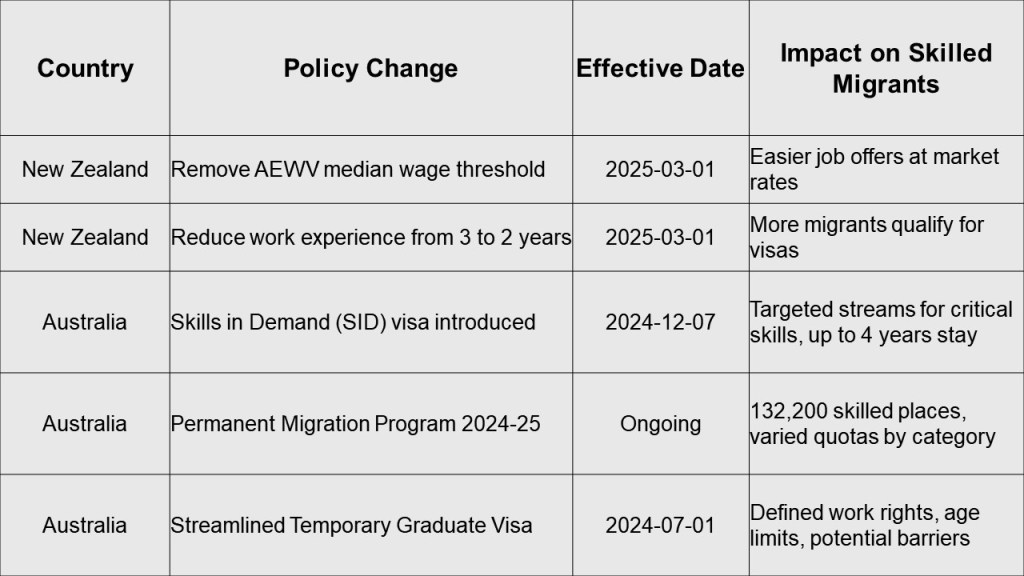
Governments in New Zealand and Australia are making significant changes to skilled migration policies, aiming to simplify the process and address ongoing labor shortages. For skilled professionals looking to relocate, these adjustments could mean easier access to work opportunities. While details are still emerging, hereโ€™s a breakdown of whatโ€™s changing and how it might impact job seekers.


New Zealand: Easier Access for Skilled Migrants

New Zealand is implementing a series of reforms to the Accredited Employer Work Visa (AEWV), starting in 2025. These updates aim to streamline the process and increase access for skilled workers:

  • Removal of Median Wage Threshold (Effective March 2025): Employers will no longer need to offer salaries above the national median wage. Instead, wages can be based on market rates, making more job opportunities accessible to skilled migrants.
  • Reduced Work Experience Requirement (Effective March 2025): The minimum required work experience for visa eligibility is being reduced from three years to two, allowing more workers to qualify.
  • New Seasonal Visa Pathways (Effective November 2025): These will include a multi-entry three-year visa for experienced workers and a seven-month single-entry visa for lower-skilled roles, particularly in agriculture.
  • Streamlined Job Check Process (Effective July 2025): The government is working to simplify the employer Job Check process, reducing delays in hiring skilled workers.

These changes aim to make migration more accessible for professionals across various industries. However, eligibility still depends on employer demand and individual qualifications.


Australia: Overhaul of Skilled Migration Pathways

Australia is also restructuring its skilled migration system with new visa options and streamlined pathways:

  • Introduction of the Skills in Demand (SID) Visa(December 2024): Replacing the Temporary Skills Shortage (TSS) visa, this new visa allows stays of up to four years and includes three streams:
    • Core Skills: For occupations in demand.
    • Specialist Skills: For highly skilled workers with higher salary thresholds.
    • Labour Agreement: For occupations negotiated with industries.
  • Permanent Migration Program Adjustments (2024-25): Australia has allocated 185,000 places, with 132,200 for skilled migrants. Employer-sponsored visas are increasing, while independent skilled migration quotas are reducing.
  • Temporary Graduate Visa Changes (July 2024): This visa now has clearer work rights and duration limits, with an age cap of 35 for most applicants.
  • New Ballot Process for Select Nationalities (October 2024): Certain countries, such as India and China, will have a lottery system for select visas, introducing an element of chance into the application process.

These adjustments are part of Australiaโ€™s broader Migration Strategy to attract skilled professionals and fill labor gaps.


What This Means for Skilled Migrants

The reforms in both countries are designed to:

  • Reduce barriers for skilled professionals.
  • Provide more opportunities through employer-sponsored pathways.
  • Address workforce shortages in key industries such as construction, IT, healthcare, and agriculture.

However, eligibility criteria and employer preferences still play a crucial role in migration success. If youโ€™re considering a move, staying informed about industry trends and job market demands will be key.


Need More Information?

For visa-related queries, consider consulting reputable immigration agencies such as New Zealand Shores and Australian Shores. If youโ€™re seeking job search advice and professional guidance, Employment for Immigration provides tailored support for skilled migrants.


Final Thoughts

Both New Zealand and Australia are making it easier for skilled workers to enter their job markets, but the full impact of these changes will depend on implementation and industry needs. Staying informed and preparing strategically will be essential for those looking to take advantage of these new opportunities.

Practical Advice

Skype is Shutting Down after 20-years. Here are some alternatives.

Skype is closing down in May 2025. My clients around the world will be searching for an alternative service to make calls primarily to New Zealand and Australia. See the article from CNN here: https://edition.cnn.com/2025/02/28/tech/skype-microsoft-shutdown/index.html

Key Points

  • It seems likely that several virtual phone number providers can replace Skype for quality calls to New Zealand and Australia, with local caller ID for employer comfort.
  • Research suggests that global providers like Twilio, Vonage, and RingCentral are accessible from regions like Asia, Middle East, Africa, South America, Europe, North America, Pacifica, and Eastern Europe.
  • The evidence leans toward good call quality varying by location and internet, with costs starting from $9โ€“$20 per user per month, plus per-minute charges.
  • An unexpected detail is that many providers offer free trials, helping users test call quality before committing.

Provider Overview

Below is a list of recommended service providers, categorized by their global availability, ensuring they meet your needs for quality calls and local caller ID in NZ and AUS. These providers are suitable for users in various regions, with call quality depending on your location and internet connection.

Service Details

  • Twilio: Offers virtual numbers in over 100 countries, including NZ and AUS, with caller ID masking. Costs around $1.50 per month for a NZ number, plus per-minute call rates. Features include SMS, call recording, and forwarding.
  • Vonage: Provides international calling with virtual numbers, starting at $19.99 per month for basic plans, with additional international call charges. Includes call forwarding and voicemail.
  • RingCentral: Cloud-based platform with virtual numbers, starting at $20 per user per month, plus international call costs. Offers team messaging and video conferencing.
  • JustCall: Call center software with virtual numbers, starting at $15 per user per month, with pay-as-you-go calls. Features call recording and routing.
  • AVOXI: Global communication solutions, with variable pricing by country, including monthly fees and per-minute charges. Offers call forwarding and recording.
  • KrispCall: Cloud telephony with virtual numbers, starting at $9 per user per month, plus international call costs. Includes call routing and recording.

Testing and Verification

To ensure quality before purchase, consider:

  • Using free trials offered by many providers to test call clarity from your location to NZ and AUS.
  • Checking customer reviews from users in your region for reliability.
  • Verifying network coverage in your area and the destination countries.
  • Contacting support for region-specific performance insights.

Survey Note: Comprehensive Analysis of Virtual Phone Number Providers for International Calling

This detailed survey note explores alternatives to Skype for making quality calls to New Zealand and Australia, focusing on services that provide local caller ID to enhance employer comfort. Given Skype’s closure in May 2025, the need for reliable, high-quality communication solutions is pressing, especially for global clients. The analysis covers providers accessible from regions including Asia, Middle East, Africa, South America, Europe, North America, Pacifica, and Eastern Europe, with a focus on call quality, cost, and service options. It also includes guidance on testing and verifying service quality prior to purchase, ensuring users can make informed decisions.

Background and Context

The user’s query highlights the importance of maintaining quality connections for calls to New Zealand and Australia, with a specific requirement for local caller ID to appear on the employer’s phone. This feature is crucial for fostering trust and familiarity, particularly in business communications. Given the global distribution of the user’s clients, the solution must be accessible and effective across diverse regions, with call quality being a primary concern alongside cost and functionality.

The research began by identifying the need for virtual phone number services that allow calls to be made with a local number appearing as the caller ID, rather than the user’s actual foreign number. This led to an exploration of VoIP and cloud-based communication platforms, which are well-suited for international calling with such features. The analysis considered major global providers known for their extensive coverage and then categorized them by region to align with the user’s requirements.

Methodology

The investigation involved searching for services that offer virtual phone numbers in NZ and AUS, with the capability to mask caller ID for outgoing calls. Key criteria included call quality, cost structures, and service options, with a focus on providers that have a presence or good performance in the specified regions. Given the global nature of these services, the approach was to identify major providers and assess their suitability for users in each region, acknowledging that call quality may vary based on local internet infrastructure and provider network coverage.

Detailed Provider Analysis

The following table lists the identified service providers, their descriptions, cost estimates, and service options, based on available information as of March 2, 2025. These providers are recommended for their ability to meet the user’s needs across all regions, with notes on regional considerations where applicable.

ProviderDescriptionCost EstimateService Options
TwilioCloud communications platform with virtual numbers in over 100 countries, including NZ and AUS, supporting caller ID masking.~$1.50/month for NZ number, plus per-minute call ratesSMS, MMS, call recording, call forwarding
VonageGlobal telecommunications company offering virtual numbers and international calling services.Starts at $19.99/month for basic plans, additional international call chargesCall forwarding, voicemail, call recording
RingCentralCloud-based platform with virtual numbers, suitable for international calling with team features.Starts at $20/user/month, plus international call costsTeam messaging, video conferencing, call queues
JustCallCloud-based call center software with virtual numbers, focused on business communications.Starts at $15/user/month, pay-as-you-go for callsCall recording, call monitoring, call routing
AVOXIGlobal provider of cloud-based communication solutions, offering virtual numbers and international calling.Variable by country, monthly fees and per-minute chargesCall forwarding, voicemail, call recording
KrispCallCloud telephony platform providing virtual numbers and international calling services.Starts at $9/user/month, plus international call costsCall forwarding, call recording, call routing

Regional Accessibility and Call Quality

Given the global nature of these providers, they are accessible from all specified regions: Asia, Middle East, Africa, South America, Europe, North America, Pacifica, and Eastern Europe. However, call quality may vary based on the user’s location and internet connection. For example:

  • In Asia, providers like Twilio, Vonage, and JustCall have offices in countries like Singapore and India, suggesting good local coverage.
  • In the Middle East, Twilio and Vonage have operations, with AVOXI also likely having coverage due to its global network.
  • For Africa, Twilio and Vonage have partnerships, and KrispCall may offer competitive service based on its pricing.
  • In South America and Europe, major providers like Twilio, Vonage, and RingCentral are well-established, with strong network infrastructure.
  • North America and Pacifica (including the US and Canada) benefit from the providers’ strong presence, given their headquarters locations.

To determine the best provider for a specific region, users should consider local reviews and network coverage, as these factors influence call quality. For instance, providers with local data centers or partnerships with regional telecoms may offer better performance.

Cost and Service Options

Costs vary significantly, with plans starting as low as $9 per user per month (KrispCall) to $20 per user per month (RingCentral), plus additional per-minute charges for international calls. This flexibility allows users to choose based on their call volume and budget. Service options like call recording, forwarding, and routing enhance functionality, particularly for business users, while features like SMS and video conferencing add value for comprehensive communication needs.

Testing and Verification Strategies

To ensure quality before purchase, users can leverage the following strategies:

  • Free Trials: Many providers, such as Twilio, Vonage, and JustCall, offer free trials or demo accounts. Use these to test call clarity and reliability from your location to NZ and AUS.
  • Customer Reviews: Check online reviews and ratings from users in your region, available on platforms like G2 or Capterra, to gauge performance and reliability.
  • Network Coverage: Verify the provider’s network coverage in your area and the destination countries, often detailed on their websites, such as Twilio.
  • Support Services: Contact provider support for region-specific performance insights, ensuring they offer 24/7 assistance for any issues.
  • Cost Comparison: Compare pricing plans to find the most cost-effective option, considering both monthly fees and per-minute rates for international calls.

These steps help mitigate risks and ensure the chosen service meets your quality and cost expectations, particularly given the global scope of your clients.

Unexpected Findings

An interesting detail is the availability of free trials, which is not always highlighted in initial searches. This feature allows users to test call quality without financial commitment, providing a practical way to assess suitability before purchase, especially for users in regions with variable internet quality.

Conclusion

This survey note provides a comprehensive overview of virtual phone number providers suitable for replacing Skype, focusing on quality calls to NZ and AUS with local caller ID. By considering global providers like Twilio, Vonage, and RingCentral, and leveraging testing strategies, users can find a reliable solution tailored to their regional needs and budget. The information is current as of March 2, 2025, and users are encouraged to verify details with providers for the latest offerings.

Key Citations