
Testimonial Posts

Flavien Charpentier Testimonial

Well, there’s lots of value in it [in your services], and different ones. 

One of them is that you offer a service which is of really really high quality. It’s a rare service. It’s not something you can get everywhere. 

And, you not only offer that service, but I think it’s delivered brilliantly and it helps me to offer myself, if you like, to the market in a much more favourable way. 

Also I even learned about myself!  And it’s also important when it comes to actually doing an interview. Because now, looking at you, I’m looking at myself on the screen, and it helps me as well, moving in a better way. It’s learning. And then, so, not only you help me to find a job, but you also help me to behave better in front of a camera, you know, so, I’m understanding my career better. 

And also you’ve got qualities. You’re sensible enough to see where there is a difference to be made and where your candidate can actually sell his skill set better.  And that you see. You’ve got that vision of people and of the market, which allows you to show the candidate in the best possible way.  

So yeah, great! I’m really happy with your services, Tate. Thank you so much! 

Flavien Charpentier
FMCG Financial Director
[Transcript of the Video]


This is a testimonial from 2021 – the year of uncertainty, lockdowns and no international travel and a low rate of hiring world-wide.ย  In spite of all this, Flavien was able to advance and get a better job in his country of residence (Switzerland), and I’m proud to have helped him in this process during this challenging time.ย 

How is this relevant now? The answer is simple – don’t wait for the crisis to motivate you to move in a better direction. If yourย life goal is to migrate permanently, the best time to take control of your destination is always now.ย  And if you are ready to migrate permanently to New Zealand, Australia or any other English speaking country – yourย small steps today can lead you to success sooner than you might think.ย 

As a first step, I always begin with your resume and a short description of your immigration goals.ย  Send to me personally atย tate@employmentforimmigration.nz for a helpful response, usually on the same day. I will offer meeting options to qualifying candidates in my response.

Testimonial Posts

Raymond: Team Lead / Senior IT consultant in Singapore – Testimonial


Video Transcript:

Uncategorized

For Middle Managers Seeking Work in Injury Risk Industries

I regularly get calls from middle managers asking for support covering all sorts of industries and roles. Super-skilled and highly qualified are complex profiles that need clear communication to win. But what is the strategy for skilled and under-qualified? Well, like a typical consultant, I can only say “that depends”. Usually, skill level and industry are main factors when under-qualified. The most challenging situation I most often see where my service has limited value is when an underqualfied middle manager is looking for a managerial role in a a high risk industry.

What is so difficult about a hiring a super-skilled, under-qualified middle manager?

I always kindly decline anyone unless I can see a clear shot at job success in the profile. When I arrive at this decision, I have sometimes found it difficult to explain to foreigners who may have built 100 different structures ranging up to to multi-million USD in value why they are unlikely to get a managerial job in the construction industry without adequate qualifications. Probably the best explanation can be presented in the graph below.

The above chart comes from a factsheet published by WorkSafe New Zealand. This act is enforced where the potential for injury to employees is reasonably high. Such environments will include construction sites, factories, stock yards, tree harvesting sites, etc…

As this chart indicates, there are severe consequences for those found reckless or negligent – that’s right, you don’t even have to be reckless, you can simply overlook something and it happens. For example, employing an unqualified manager might be considered as a failure to comply with health and safety duties when that decision is later seen by investigators as a cause for a risk of serious injury, illness or death.

If you are a middle manager lacking qualifications working in a high-risk industry, what are your options?

There are other roles below “manager”, including team lead, foreman, skilled carpenter, etc… This may be a viable entry point for a manager willing to work back up to the managerial level, while also allowing the local employer to keep risks low enough so that a hiring decision can be made.

What if you have little or no “hands on” skills?

Upskilling takes time. For some, it is the best option. I would suggest either to acqauire a relevant bachelor’s degree or learn some “hands on” skills to a level of a qualified tradesman. Maybe even get qualified if that is an option.

What if you want to try anyway?

There have been a number of cases where I have successfully worked with underqualified middle managers in high-risk roles. What happened in these cases was that I gave a clear warning, they decided to go ahead anyway and we went to work to maximise their chances on a range of issues including past practice, performance levels, ongoing study and motivation. Three things help: preparation, persistence and going the extra mile. It is about finding and building relationships. It is about a willingness to conduct face-to-face interviews on the spot. And that is how you maximise the chances, and yes, it can work, but I prefer to look at the other options first because I like to maximise the opportunities and not just the chances.

Finish

And that, my friends explains the challenges in terms of risk and the options in terms of job strategy. I am good at assisting with work but I am not touching your immigration or visa requirements. That will be up to you or your immigration agent. New Zealand and Australia have many high-demand job sectors that need strong candidates. The best job strategy in a nutshell is to position yourself as a low risk, high reward candidate. For details how that might apply to you, just send your CV to me at tate@employmentforimmigration.nz for helpful insights in about a day.

Practical Advice

A short Checklist: Are You Able To Get Hired In New Zealand Or Australia?

Have you ever wondered how easy or difficult it will be for you to get hired?

Here are the 3 main inicators of hirability
1) Skill level
2) Qualifications
3) Role demand

Highly skilled candidates:ย New Zealand and Australia are particularly interested in workers who have demonstrated expertise in a specific field and can add significant value to employers. If you have a track record of excellence in your field, you are likely to be in high demand. However, if you haven’t had the opportunity to develop high-value skills, you may face the challenge of differentiating yourself from local jobseekers. To overcome this challenge, it’s important to emphasise what makes you different and how you can make a unique contribution to the NZ/AU job markets.

Relevant qualifications:ย Employees with relevant qualifications are highly sought after in both New Zealand and Australia. Generally, a full trade qualification or at least a Bachelor’s degree is required, sometimes higher depending on the role. If you have these qualifications, along with high-value skills, you are likely to be in high demand. However, if you do not have the specific qualifications required for a particular industry, your skills may still be able to compensate in some cases. For example, some industries may prioritise skills over formal qualifications. However, it’s important to note that certain professions, such as doctors and plumbers, typically require specific qualifications that cannot be overlooked.

Roles in high demand:ย Our job markets are particularly interested in candidates who can fill roles in skills shortage areas. It’s worth noting that being on an official skills shortage list is not a prerequisite for being considered for a high demand role. Sometimes in-demand roles aren’t widely advertised and it’s important to understand that demand arises when employers have a genuine need for a particular skill. It could be a highly specialised niche that is not widely known. For example: I assisted a drone designer / distributor / business owner find work with New Zealandโ€™s largest drone company. There is no list anywhere that considers that candidate as a high demand role for New Zealand. But that employer understood he was the best guy in South Africa with population 60 million. He was ready to hire him instantly. So keep an eye out for job advertisements, but also explore hidden opportunities that your skills may attract.

In summary:ย We are looking for overseas candidates with high-value skills and relevant qualifications who can fill roles in high-demand sectors.

Basic strategy:ย By showcasing your expertise, highlighting what makes you different and targeting employers who need your specific skills, you will increase your chances of being a desirable candidate for employment in our part of the world.

For a free assessment of your skills, send your CV with a few comments about your status to me at tate@employmentforimmigration.nz I answer in about a day.

Testimonial Posts

Haroon Patel Testimonial

Haroon Patel
Risk & Control Accountant
Supply Chain Distribution Admin


As Unilever’s “Controls Expert”, Haroon was responsible for Unilever’s Global Controls Framework from their headquarters in London. To understand what that means, just look at Unilever’s Wikipedia page:

  • Listed on 6 stock exchanges
  • Turnover = 60 billion Euros
  • Employees= 150,000
  • Founded in 1929

This is why I call Haroon “The Superman of Risk and Controls” and it is indeed an honour to be his link to a bright future in New Zealand. Not only is he super talented, he is also an approachable and likeable guy. I wish Haroon and his family all the best that New Zealand has to offer.

Testimonial Posts

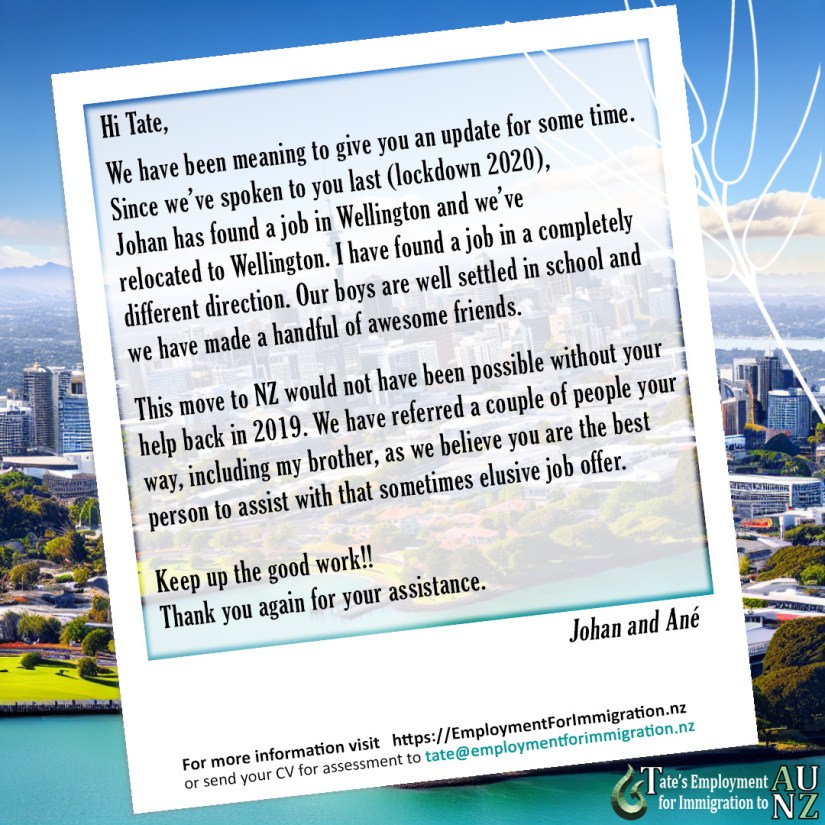
Johan and Anรฉ Testimonial/Update

Hi Tate,
We have been meaning to give you an update for some time.ย 

Since weโ€™ve spoken to you last, Johan has found a job in Wellington and weโ€™ve relocated to Wellington. I have found a job in a completely different direction.ย  Our boys are well settled in school and we have made a handful of awesome friends.ย 

This move to NZ would not have been possible without your help back in 2019. We have referred a couple of people your way, including my brother, as we believe you are the best person to assist with that sometimes elusive job offer.ย  Keep up the good work!! Thank you again for your assistance.

Kind regards,
Johan and Anรฉย 

Testimonial Posts

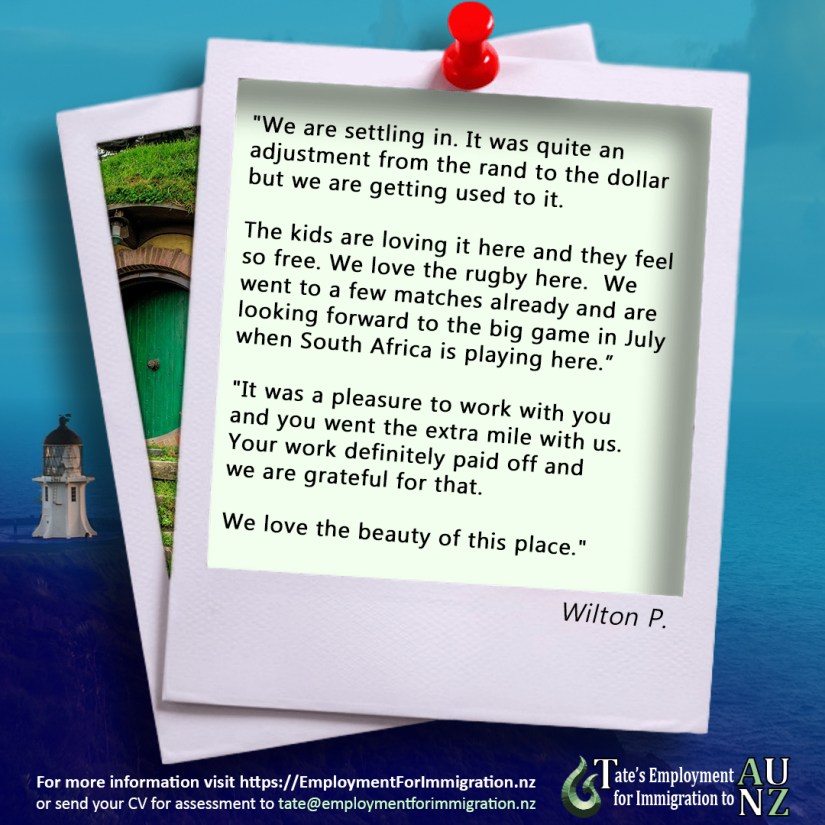
Wilton P. Testimonial/Update

“We are settling in. It was quite an adjustment from the rand to the dollar but we are getting used to it. The kids are loving it here and they feel so free. We love the rugby here.  We went to a few matches already and are looking forward to the big game in July when South Africa is playing here.

It was a pleasure to work with you and you went the extra mile with us. Your work definitely paid off and we are grateful for that. We love the beauty of this place.”

~Wilton Pieterse~

Everyone Need Encouragement

Celebrate your Victories

Why I wrote this. I wanted to write something helpful to people who feel demoralised by the job search. It is easy to feel demoralised and then when the mood is down progress is slower and results can be even worse. We humans need to be in a positive state of mind if we want to be at our best performance, getting good results. What is also true and I see it from time to time, job seekers don’t know how well they are doing. For example, if you get a job interview, you are already a winner. You are 1 step away from getting the gold medal. Getting a job interview is like getting silver at the olympics, nothing to feel bad about. Getting short-listed is like winning bronze, this is a great space to be in, so don’t quit. Gold will come. Keep doing what works and celebrate the small victories along the way.

CELEBRATE YOUR VICTORIES

Are you struggling to find a job in today’s labour market? You’re not alone. Job hunting can be a difficult and time-consuming process, and it can be discouraging when you don’t get a job offer right away. But don’t worry, there’s a way to make the process less daunting: continuous improvement.

According to a 2015 study* it takes an average of six weeks to get an interview, and even longer to get an offer. For foreign migrants, the average numbers may be 20% higher if preparation is done really well. That’s a long time to wait, but it’s important to remember that getting a job takes time. It’s a process, not an event. If you’re feeling down because you haven’t received an offer yet, take a moment to notice the progress you’ve made.

The concept of continuous progress is one that many organisations use to guide their goals, using terms such as kaizen, lean management and change management. These approaches emphasise making small improvements over time that lead to big changes in the long run. You can apply the same principles to your job search by celebrating the small wins along the way.

Breaking big jumps down into smaller steps also allows you to see where the problems are. For example, if you’re having trouble getting interviews, ask yourself if you need to get through the AI vetting system to a real person, or if you’re getting real responses, maybe the challenge is with communication about your strengths or perhaps your job targets aren’t matched well enough yet? Breaking down your goals into smaller steps can help you identify and address these barriers.

In conclusion, continuous improvement is a powerful tool that can be applied to your job search. By breaking the process down into small steps and celebrating the progress along the way, you can stay motivated and positive even in the face of rejection. Remember that getting a job takes time, but by making steady progress you can focus on improving each step of the way. In time, you’ll get there faster and with greater confidence. Good luck with your job search!

=-=-=-=-=-=-=-=-=-=-=-=-=-=-=-=-

* The study I mentioned can be found in a report published by Glassdoor titled “Why Is Hiring Taking Longer?” The report is based on data from millions of job applications, 344,250 interview reviews from hiring events across industries and company sizes in the United States, Canada, United Kingdom, France, Germany, and Australia. The report can be found at the following link: https://research-content.glassdoor.com/app/uploads/sites/2/2015/06/why-is-hiring-taking-longer.pdf

NEED HELP?

For helpful advice in about a day, send your CV and a short description of your status to tate@employmentforimmigration.nz.