
Easy Entry Job Finding Service (offer)

Everyone Need Encouragement, Market Updates

Navigating the Current Challenges in the Australian and New Zealand Job Markets

Understanding the Challenges in 2024

In 2024, job seekers in New Zealand and Australia face a challenging market. The year started with a promising hiring pace, but by mid-year, New Zealand experienced a significant slowdown. Australia is facing a milder downturn, though hiring overall has declined this year compared to last. This is the feedback I am getting from both employers and job seekers. Supporting this, the New Zealand Treasury Department reports that unemployment is expected to rise from 4.3% to 4.9% due to economic stagnation. As noted in their August 2024 Economic Update, โ€œThe labour market likely eased with weak economic activity, indicating a rise in unemploymentโ€ (Treasury Economic Update, August 2024).

Whatโ€™s Causing the Job Market Slowdown?

The economic environment, marked by inflation and recession concerns, has led employers to be cautious with hiring. Many businesses prioritize local hires due to cost and efficiency considerations, while foreign job seekers face delays due to visa processing times and other administrative requirements. According to Talent International, โ€œcandidates are seeking higher salaries to compensate for [inflation], yet organizations are driving cost-conscious decisions,โ€ slowing hiring in sectors like project services where budget constraints are common (Talent International Employment Trends).

For foreign candidates, these delays can mean waiting weeks or even months for visa decisions, which has become a deterrent for employers in less urgent hiring situations. This added complexity has tempered hiring momentum, making it essential for foreign job seekers to understand the impact of visa policies on their job search.

The Upcoming Opportunity: February and March 2025

Despite the current hiring challenges, February through March 2025 offers a promising window for job seekers. This period aligns with the new business year when many companies assess staffing needs and begin hiring for long-term roles. Given stabilizing economic demand, the Treasury anticipates gradual recovery, making early 2025 an ideal time to seek opportunities (Treasury Economic Update).

The Best Position For Any Job Seeker

No matter the economics of the state, industry leaders at the top of their game will remain in prime position for faster hires and higher salaries. The key is to make complex skills easily understandable at every stage of the hiring process. Talent International confirms, โ€œwhile ‘we have seen the cooling of salaries across many job families, hard-to-find niche talent will always test the top end of what the market has to offerโ€ (Talent International Employment Trends).

Positive attitude is a force in itself, but doesn’t replace good preparation.

Strategic Suggestions for Job Seekers

Engage Directly with Industry Contacts
Establishing direct communication with hiring managers provides invaluable insights into specific needs and hiring trends. This feedback better positions you for upcoming job interviews, as industry contacts can share insights on skills in high demand and potential hiring opportunities.

Leverage Decemberโ€™s Relaxed Atmosphere for Networking
Employers are typically less busy in December, making it an ideal time to connect and gather information that may lead to applications in the new year.

Prepare for Peak Hiring Season in February
January is perfect for reviewing your profile and gathering feedback. In February, the peak hiring period, prepared candidates may see response rates of two responses per hour of outreach effort. Success varies based on availability, industry, and individual motivation.*

* Note: different inddustries have different seasons. Example: for Teachers, the biggest hiring period is for Term 1 start. This is happening now. February will be too late for them. There are also many agricultural seasons. If your market has seasonality, take that into account.

Focus on Feedback to Gauge Market Positioning
Collecting feedback from at least ten hiring managers provides insights beyond general market advice, helping you understand where you stand. If you arenโ€™t receiving personalized feedback, this may be a sign to seek professional guidance. Direct responses from employers are the gateway to job interviews.

Showcase Your Unique Skills and Value
Employers remain open to hiring foreign candidates with scarce skills. Emphasize your expertise and how it fills gaps in the local market, as this can make you a competitive candidate in Australia or New Zealand.

Conclusion

Though the current market is tough, opportunities will come for those prepared to engage strategically. By staying informed, building industry connections, and timing your job search with hiring cycles, you can increase your chances of success. Stay resilient, and focus on the early 2025 hiring season, as it may be your perfect window for a career opportunity in Australia or New Zealand.


Online Courses

Free Crash Course

Unlock Your Dream Job Overseas โ€“ Free Crash Course!

In these difficult times, weโ€™re listening to your needs. Our Free Crash Course was created specifically for migrants who need a boost in securing a job in New Zealand or Australia. Discover proven strategies to increase employer responses, ace interviews, and stand out in todayโ€™s competitive job market.

๐Ÿ‘‰ Free Crash Course: Unlock Overseas Job Success

Everyone Need Encouragement

“Let the Numbers Speak for You” โ€“ A High Achieverโ€™s Guide to Self-Promotion

As a high achiever, you’ve always let your work and results speak for themselves. But when the time comes to promote yourself in a new role or market, it can feel uncomfortableโ€”like you’re bragging. The solution? Let the numbers speak for you.

Instead of boasting about your achievements, report them just as you would present results in a boardroom. Think of yourself as a project, where your past performance, metrics, and accomplishments are the facts that demonstrate your value.

Why Let the Numbers Do the Talking?

  • Numbers are undeniable: Data and metrics provide concrete evidence of your success. Whether it’s the revenue youโ€™ve increased, the efficiency you’ve improved, or the number of projects you’ve led, numbers make your achievements real and relatable.
  • Professional, not personal: Focusing on metrics shifts the conversation from being about you personally to the impact youโ€™ve made. This allows you to present your achievements in a clear, factual wayโ€”without feeling like you’re bragging.
  • It highlights your true value: Decision-makers respond to measurable results. By showing the scope and scale of your achievements through numbers, you’re effectively communicating your worth and aligning your strengths with the needs of potential employers.

How to Let the Numbers Speak for You

  1. Be Specific: Don’t just say you improved a processโ€”show the exact percentage of improvement, the revenue it saved, or the number of hours it cut.
  2. Highlight Key Metrics: Choose the numbers that best represent your success, whether it’s growth, cost savings, or increased efficiency.
  3. Organize Your Achievements: Present your data in a way that’s easy to understand, just like you would in a report or presentation. Clarity and logic matter.

Your achievements are more than just wordsโ€”they’re backed by results. When you let the numbers speak for you, youโ€™re allowing your true value to shine without ever having to brag.

If you’re a high achiever looking to confidently present your strengths, I can help you organize and communicate your success effectively. Reach out today to discover how you can let the facts and figures show the world what you’re capable of.

Watch the video below to learn more about letting your numbers speak for you:

Job Finding Stories

Overcoming a Sudden Job Closure: Juan’s Case Study

Introduction:

Juan’s journey to securing employment and residency in New Zealand is a testament to the effectiveness of a structured job-hunting strategy, multimedia presentation, and proactive engagement with potential employers. In this case study, we explore how a tailored approach, confidence-building techniques, and networking helped Juan overcome unexpected challenges to land his second job within two days of direct outreach.

1. Core Strengths Development and Profile Preparation

From November 2023 to July 2024, Juan worked with Tate’s Employment for Immigration to identify and summarize his core strengths and achievements. This foundation, reflected in his CV, Video CV, and photo portfolio, helped Juan stay clear on his key selling points throughout the job search.

  • Result: Juan was always well-prepared for interviews, able to confidently recall his achievements, which provided potential employers with a clear understanding of his technical expertise.

2. Cold-Calling Confidence and Proactive Job Search

A crucial turning point in Juanโ€™s journey was overcoming his initial reluctance to cold-call employers. Through Session 4 of his program, Juan witnessed live demonstrations of cold calls made on his behalf by his consultant. This gave him the confidence to engage directly with hiring managers.

3. Effective Multimedia Presentation

Juanโ€™s photo portfolio and Video CV set him apart in a competitive job market. These tools allowed potential employers to see his practical skills in action, making his profile more compelling than a traditional CV alone.

  • Result: His multimedia materials helped confirm Juanโ€™s technical expertise and contributed to him being shortlisted for interviews, where he continued to impress.

Unexpected Challenges: A Lesson in Networking

Although Juanโ€™s first job in New Zealand helped him gain experience that contributed to securing his second job, the process didnโ€™t unfold as he expected. Juanโ€™s direct boss, who had promised a referral, declined to provide one when contacted by his prospective employer. Instead, he only confirmed Juanโ€™s employment details, leaving the new employer with limited insight into Juanโ€™s performance.

However, Juanโ€™s networking efforts paid off. The site engineer who worked closely with Juan stepped in to provide a strong reference, confirming Juanโ€™s skill with repairs, maintenance, and equipment installations. This confirmation aligned with Juanโ€™s interview responses and ultimately reassured the employer of his qualifications.

  • Result: Despite the setback, Juanโ€™s professional relationships with other colleagues proved valuable. The site engineerโ€™s referral helped secure his new role, even without the support of his direct boss.

Outcome: Securing Employment and Residency

Juanโ€™s journey demonstrates the importance of a proactive job-hunting strategy and the value of networking. Despite unexpected setbacks, Juanโ€™s persistence and the strength of his preparation led to a positive outcome.

  • Job Secured: Juan received a job offer within two days of his cold-calling efforts, securing his visa and allowing him to remain in New Zealand.
  • Professional Growth: Juanโ€™s experience in his first New Zealand job, along with the skills and materials he developed, made him a standout candidate for his second role.
  • Overcoming Challenges: Despite his direct bossโ€™s lack of support, Juanโ€™s site engineer provided the referral needed to confirm his abilities, underscoring the power of professional relationships.

Conclusion: A Story of Overcoming Setbacks with a Structured System

Juanโ€™s success is a testament to the power of perseverance and a well-organized job search strategy. Through effective coaching, multimedia tools, and a proactive mindset, Juan was able to navigate the complexities of redundancy, visa constraints, and competition. His story is a reminder that even when unexpected challenges ariseโ€”such as the lack of a promised referralโ€”strong preparation, networking, and persistence can overcome these obstacles.

Key Takeaways:

  • Structured Approach: Identifying core strengths and preparing a multimedia portfolio provided Juan with the confidence and tools needed to succeed in interviews.
  • Cold-Calling Mastery: Live demonstrations of cold-calling helped Juan adopt this approach, leading to rapid results in his job search.
  • Networking Pays Off: Despite a lack of support from his direct boss, Juanโ€™s relationships with other colleagues, such as the site engineer, proved crucial in securing his second job.
Job Finding Stories

Nanoscale “Theoretical Engineer” Snapped up by The Netherlands

Iโ€™m excited to share a success story about Nick, a brilliant engineer with a unique market niche. Nick is a Mechanical, Electrical, and Theoretical Engineer. What is a Theoretical Engineer, you might ask? Well, they are very rare and specialized. They are found working in the nonphysical world, in nanoscale processes that create computer chips, for example.

For 10 years, Nick was the go-to Principal Equipment Service Engineer for 15 companies, managing 50 machines valued in the tens of millions of dollars. When others couldn’t solve the problem, Nick was the one they called. His expertise in semiconductor manufacturing, one of the most advanced industries in the world, is truly exceptional.

Although his market was too small in New Zealand, Nick secured a prestigious role in the Netherlands using the strategies we developed together.

No dust allowed

Testimonial Posts

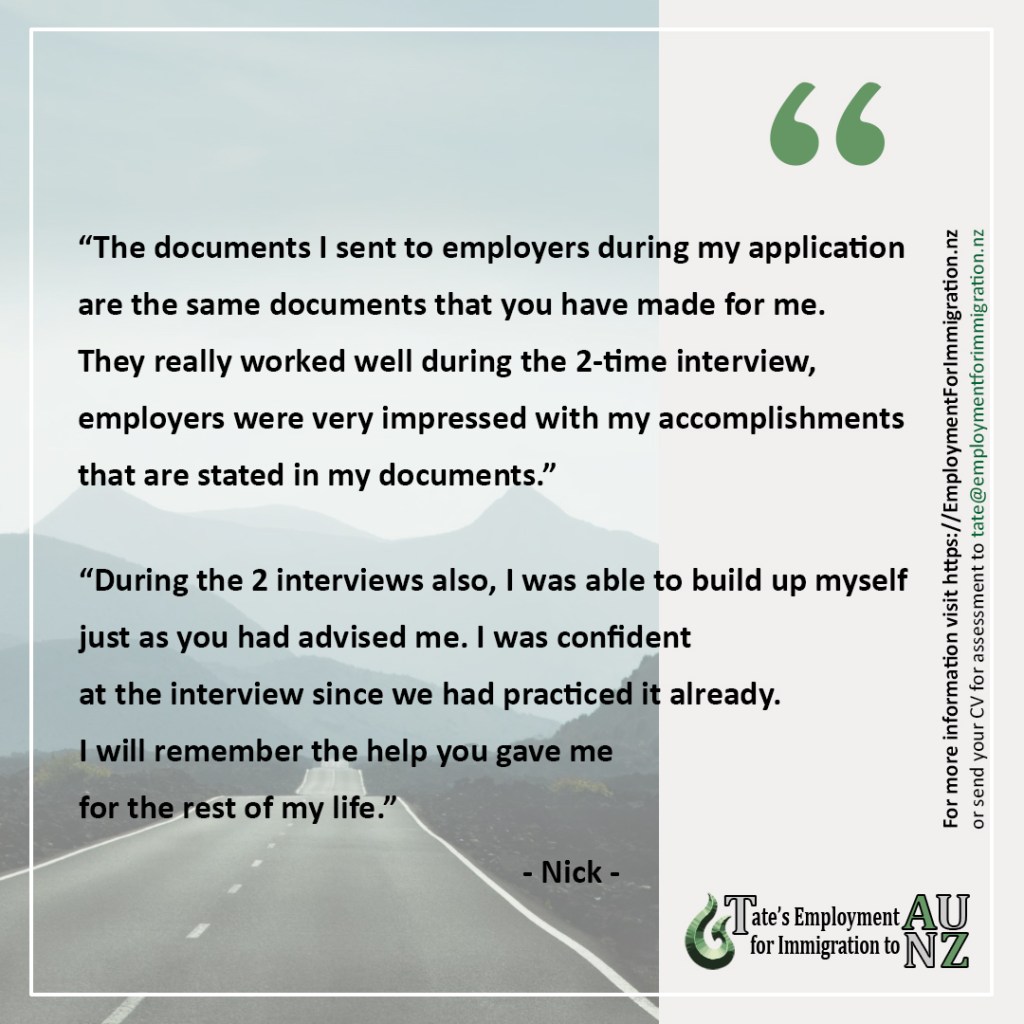
Nick’s Testimonial


Besides this being one of the best testimonials I have ever received, it is coming from one of the highest level professionals I have worked with. Our system generates an 80% direct response rate from employers for any professional, from any level to any industry, role or country. Itโ€™s this same system that helped Nick secure his new role.

Iโ€™m grateful for the opportunity to support professionals like Nick, who excel in such challenging fields. Read more about Nick’s success story >>

Everyone Need Encouragement, Market Updates

Unlocking Opportunities: How New Zealand’s Record Migration Benefits Skilled Job Seekers

New Zealand experienced a record influx of migrants in 2023, with net migration reaching an unprecedented 133,800 people by the end of the year. This surge, the highest since records began, was primarily driven by non-New Zealand citizens. Historical data indicates that such high migration numbers were last seen before the COVID-19 pandemic, highlighting a significant recovery and increase in arrivals. The post-pandemic migration spike is largely attributed to the reopening of borders and New Zealand’s strong economic appeal. Additionally, this trend might reflect efforts to compensate for labor shortages experienced during COVID-19 lockdownsโ€‹ (Stats NZ)โ€‹โ€‹ (Stats NZ)โ€‹โ€‹ (Stats NZ)โ€‹. For foreign job seekers, this influx presents unique opportunities, especially in sectors needing skilled labor.

In contrast, New Zealand also recorded a significant increase in its citizens migrating to Australia. In 2023, over 74,000 New Zealanders moved to Australia, resulting in a net migration loss of approximately 47,000 people. This migration wave is the highest on record, reflecting Australia’s attractive job market and lifestyle. If not for this outflow, New Zealand’s net migration gain would have been 47,000 higher. This dynamic creates a unique scenario for foreign job seekers, indicating potential gaps in New Zealand’s labor market due to the departure of local talentโ€‹ (RNZ)โ€‹โ€‹ (BERL)โ€‹. The ongoing movement highlights the demand for skilled workers to fill these gaps.

The record migration trends in New Zealand offer distinct opportunities across various industries:

  • Construction: The surge in population drives demand for new housing and infrastructure projects, creating jobs for engineers, architects, and construction workers.
  • Healthcare: With more residents, there is a growing need for medical professionals, including doctors, nurses, and allied health workers.
  • Education: The influx of families increases the demand for educators at all levels, from primary to tertiary education.
  • Technology: The expanding economy and digital transformation efforts require skilled IT professionals, software developers, and cybersecurity experts.
  • Agriculture and Hospitality: These sectors are also seeing increased demand due to population growth and tourism recovery post-pandemic.

For qualified and skilled job seekers, New Zealand’s robust economic growth, favorable migration policies, and expanding labor market make it an attractive destination for career advancementโ€‹ (Stats NZ)โ€‹โ€‹ (RNZ)โ€‹.

If you are a skilled and qualified professional in your country and if you want to learn how to find work in New Zealand or Australia, just send your CV to me at tate@employmentforimmigraiton to me for a quick review. I will respond with helpful insights in about a day. โ€“ Tate

Market Updates

Good News for Migrant Teachers

New Zealand has taken significant steps to address the shortage of teachers through various initiatives and funding boosts.

  1. Budget Allocation: The New Zealand government has allocated nearly $53 million for teacher recruitment and training over the next four years. This funding is intended to place and train 1,500 new teachers, with around 400 new teachers added each year. This initiative includes a $20,000 package per placement for aspiring teachers, covering living expenses and tuition fees. Schools will also receive contributions towards the cost of training and mentoring these new teachersโ€‹ (The Spinoff)โ€‹โ€‹ (RNZ)โ€‹.
  2. Salary Increases: There have been substantial improvements in teacher salaries. By December 2024, the top salary for secondary teachers will reach $100,000. Newly trained secondary teachers will see starting salaries increase significantly, providing a more attractive financial incentive for entering the profession. These salary increases are part of the government’s efforts to make teaching a more appealing career choice and to retain experienced teachersโ€‹ (Education in New Zealand)โ€‹.
  3. Overseas Recruitment: To further address teacher shortages, the government has extended funding to support the relocation of 300 overseas teachers to New Zealand. Additionally, there are 425 overseas finders fee packages to assist schools with the costs of recruiting teachers from abroadโ€‹ (RNZ)โ€‹.

These measures reflect a comprehensive approach to not only recruit new teachers but also retain current ones, with a focus on improving working conditions and providing financial incentives. This is part of a broader strategy to ensure a sustainable and well-supported teaching workforce in New Zealand.

If you are a qualified teacher in your country and if you want to learn how to find work in New Zealand or Australia, just send your CV to me at tate@employmentforimmigraiton to me for a quick review. I will respond with helpful insights in about a day. – Tate

Everyone Need Encouragement, Market Updates

Is New Zealand in a Recession or is this My Best Opportunity to Find Work in 2024?

Discover how to maximize your job search during the peak hiring season in New Zealand and Australia! This video provides key insights into why spring is the best time to secure employment, highlighting migration trends.

It is worthy to note that your best employers are not average companies, they are higher-performance companies. Successful companies will be hiring in September and October, as I explain in the video.

Take advantage of this time and ensure your readiness for the busy summer months. Perfect if you are a job seeker looking to make the most of this optimal hiring period.

New Zealand and Australia are the most foreign-friendly countries in the west.

Everyone Need Encouragement

Upskilling: A Path to Success for Aspiring Migrants to New Zealand and Australia

Migrating to New Zealand or Australia for work can be a challenging endeavor, especially if you find yourself on the borderline of qualifications and skills required for these competitive job markets. As a career marketer and job consultant with 30+ years of experience, I want to offer some advice on how upskilling might be your best option and why self-improvement is a valuable goal in itself.

The Importance of Upskilling

Upskilling can significantly enhance your profile, making you a more competitive candidate in the job market. It is not only about meeting the minimum requirements but also about exceeding them and standing out among other applicants. Self-improvement through acquiring new skills or enhancing existing ones can lead to greater job satisfaction, better career prospects, and an improved quality of life.

Investigating Opportunities

To investigate opportunities in New Zealand or Australia, start with a thorough assessment of your current skills and achievements. Compare these with the market demand and immigration requirements in your desired industry. Job advertisements are a valuable resource for understanding the specific qualifications and skills needed for various roles. Familiarity with these requirements can help you set clear goals and identify areas for improvement.

Understanding Immigration Requirements

Over the past couple of generations, both New Zealand and Australia have been increasing their requirements for migrant job seekers. Due to the popularity of these two countries, it is likely this trend will continue. Additionally, the immigration websites for New Zealand and Australia provide detailed information on the qualifications required for different visa categories. If you want customised service, seek out reputable agencies like New Zealand Shores for immigration help. Ensuring you meet these requirements is crucial for a successful application and a smooth transition to working abroad.

Ethical Considerations

While I would love to work with everyone, I face a moral dilemma. Engaging in a business deal without ensuring that a job seeker can realistically secure a job and a satisfactory quality of life in a new country would be unethical. Therefore, if you are on the borderline of qualifications and skills, I encourage you to view upskilling and personal improvement as positive steps that can open doors not only in New Zealand and Australia but also in your home country or other potential destinations.

A Message of Hope

I hope this advice helps you find a path towards an improved profile. By enhancing your skills and aligning them with market demands and immigration requirements, you can significantly increase your chances of success. Self-improvement is a positive goal in itself, and I believe that with dedication and effort, you can achieve your career aspirations.

I wish you all the best in your journey, and perhaps we will meet again when you are ready to take the next step in your career.