
Easy Entry Job Finding Service (offer)

Market Updates

February and March 2025: A Time of Opportunity in New Zealand and Australia’s Job Markets

As February and March approach, job markets in New Zealand and Australia are gearing up for their annual hiring peaks. Historically, these months bring significant opportunities, with various sectors ramping up recruitment to meet business needs for the year ahead.

Why February and March Are Key Months

  1. Historical Hiring Trends: In both countries, February and March traditionally see higher hiring volumes due to companies finalizing budgets and initiating projects after the New Year.
  2. Seasonal Workforce Adjustments: Industries such as construction, education, and healthcare typically ramp up hiring during this period.
  3. Economic and Population Dynamics: Australia’s robust economic growth continues to attract talent from New Zealand, creating gaps in the New Zealand labor market, particularly in highly skilled roles. This broadly impacts both job markets: AUS & NZ.

New Zealand: Sector-Specific Projections

  1. Healthcare & Medical
    • February: 6-8% hiring growth.
    • March: Sustained growth of 4-6%.
    • Driving Factor: Aging population and ongoing healthcare needs.
  2. Professional Services
    • Human Resources & Recruitment: 12-15% growth projected.
    • Consulting & Strategy: 10-12% growth expected.
  3. Construction
    • Modest recovery of 2-3%, with regional areas seeing 6-8% growth in industrial sectors.
    • Infrastructure and residential projects remain key drivers.
  4. Education & Training
    • Projected increase of 3-5% in hiring during March.
  5. Technology and Digital
    • High demand for IT professionals, data scientists, and AI specialists continues to fuel growth.

Australia: Leading the Charge

  1. Healthcare & Social Assistance
    • February and March: 5-7% projected growth.
    • Sector Strength: The largest employment sector in Australia, accounting for 15.6% of the workforce.
  2. Construction
    • Anticipated growth of 3-5%, with regional infrastructure projects leading the way.
  3. Professional Services
    • Demand for technical expertise in engineering, IT, and consulting expected to rise by 4-6%.
  4. Renewable Energy
    • Significant job growth in wind and solar energy projects, reflecting Australia’s green energy initiatives.

Long-Term Projections

  • New Zealand:
    • Healthcare and social assistance: Significant long-term growth due to demographic shifts.
    • Business services, retail, and construction: Adding over 15,000 jobs annually until 2028.
    • Transport and logistics: Strong growth driven by e-commerce, with a projected annual increase of 2.3%.
  • Australia:
    • Professional services and IT: Expected to grow at 5.4% annually.
    • Healthcare: Continuous demand for medical professionals as the population ages.

Cross-Tasman Opportunities

New Zealand faces a talent gap as some of its best workers migrate to Australia in search of higher salaries and greater opportunities. This creates unique opportunities for job seekers in both countries:

  1. For Migrants in New Zealand: Gaps in the labor market provide openings in skilled sectors.
  2. For Local Workers in Australia: Growth in healthcare, construction, and renewable energy creates demand for domestic talent.

Actionable Insights for Job Seekers

  1. Tailor Your Applications: Focus on growing sectors like healthcare, IT, and professional services.
  2. Leverage Networking: Build connections within your target industries to gain an edge in this competitive period.
  3. Stay Updated: Monitor job boards and recruitment trends to identify opportunities early.

Conclusion

February and March represent a pivotal time in the job markets of New Zealand and Australia. For job seekers, this is the time to capitalize on growth in high-demand sectors and take advantage of the unique opportunities brought by economic and demographic shifts. Whether you’re aiming for the healthcare boom or the renewable energy surge, a well-prepared application and proactive approach will help you secure the right role in this dynamic landscape.



Sources for Reference

  1. MBIE Medium-to-Long-Term Employment Outlook
  2. New Zealand Unemployment Trends
  3. RNZ Report on Job Growth Sectors
  4. Seek Employment Reports February/March 2024
  5. JLL Research: APAC Employment Growth

Testimonial Posts

Aqeelah Salie Testimonial

“By the time I had my first meeting with Tate, I had already applied to over 100 teaching positions without receiving a single positive response. Most of the time, I received generic rejection emails like, “Thank you for your application, but you were unsuccessful,” and in some cases, I didn’t even get a response at all.

I explained to Tate that I was confident in my skills for the job listings and knew I was the type of teacher these schools were looking for, but I was struggling to effectively showcase my abilities on my CV. We got to work immediately. The revamped CV, video CV, and interview preparation were incredibly helpful.

On the very first day of phone calls, I secured an interview. Although it wasn’t the right fit, just 10 days after finalizing the job-seeking process with Tate, I had another interview and was offered the job on the spot. As a primary teacher in a role that’s notoriously hard for foreigners to land, I was amazed at how quickly everything came together. This is a true testament to the effectiveness of Tate’s process.

In just two months, I came to New Zealand, revamped my CV, received an interview and job offer, and secured my AEWV. The process was much quicker and smoother than I ever expected. Thank you, Tate!”

Aqeelah Salie
Primary & Secondary School Teacher


Thanks, Aqeelah, for your kind and detailed testimonial! The original challenge you described — applying to over 100 teaching positions without a single positive response — is something I hear often from job seekers in both New Zealand and Australia. Resolving such challenges is always rewarding because, in your case, we now have a school with a dedicated new teacher who brings valuable experience and achievements to the school, the admin staff, the students, and the parents, while also creating a long-term positive impact on the community.

There were many winners and no losers when you filled this important job gap. Well done!

Practical Advice

The Dynamic CV: A Key to Unlocking Job Opportunities

In today’s competitive job market, a CV is more than just a document. It’s a tool that must captivate attention in seconds and also withstand the scrutiny of an in-depth review. This dual purpose is what sets an excellent CV apart from a merely “good” one. Let’s explore this concept using a real-world example — the transformation of a Civil Engineer’s CV from “good” to “exceptional.”

The Problem with “Good” CVs

The 2024 version of this Civil Engineer’s CV could be described as “good” by most people. It included:

  • A list of duties and responsibilities.
  • A professional summary.
  • Ten years of work experience in various roles.

However, these elements alone don’t suffice in today’s competitive market. A “good” CV might include the right sections, but it lacks depth—it’s flat, uninspiring, and fails to stand out.

The Transformation: From Good to Exceptional

By 2025, the same Civil Engineer’s CV had been completely revamped. It became a dynamic document that balanced attention-grabbing highlights with in-depth substance. Here’s a snapshot of the improvements:

The Seven Categories of Excellence:

1. Relevance of Information

  • Good CV: “Worked on various engineering projects.”
  • Exceptional CV: “Directed multimillion-dollar LEED-certified construction projects, achieving 20% faster completion times.”

2. Clarity and Conciseness

  • Good CV: Paragraphs outlining general tasks.
  • Exceptional CV: Bullet points such as:
    • “Optimized project workflows, improving efficiency by 30%.”
    • “Managed stakeholder engagement across 10+ large-scale projects.”

3. Use of Metrics

  • Good CV: “Oversaw project budgets.”
  • Exceptional CV: “Managed a $50M budget, delivering a 15% cost saving through efficient resource allocation.”

4. Professional Presentation

  • Good CV: Dense text blocks with basic formatting.
  • Exceptional CV: Modern design with strategic whitespace and ATS-friendly formatting, ensuring readability and system compatibility.

5. Demonstration of Core Strengths

  • Good CV: “Ensured compliance with regulations.”
  • Exceptional CV: “Implemented compliance protocols that passed audits with zero discrepancies, securing $10M in funding.”

6. Topline Features and Prioritization

  • Good CV: “Experienced engineer with a history of project management.”
  • Exceptional CV: “20+ years of experience leading high-stakes construction projects, delivering measurable outcomes in compliance and cost efficiency.”

7. ATS Analysis

  • Good CV: “Civil engineering, project management.”
  • Exceptional CV: “LEED-certified, compliance, resource optimization, large-scale project management, stakeholder engagement.”

The Core Concept of a Dynamic CV

An exceptional CV is not a biography; it’s a targeted marketing document. Its purpose is to:

  • Secure a spot on the shortlist.
  • Inspire curiosity about your value, leading to interviews.

To achieve this, a CV must:

  • Capture attention with bold, impactful highlights.
  • Offer depth through specific, quantifiable achievements.

Conclusion about CVs

The transformation of this Civil Engineer’s CV exemplifies the power of a dynamic document.  Job seekers are wasting their time with too many tasks and not enough benchmarkable content, too many opinions and not enough proof.  By moving from flat descriptions to value-driven accomplishments, the CV not only stood out but also achieved its ultimate goal: securing job opportunities. In today’s market, an exceptional CV isn’t just an advantage—it’s essential for success.

Moving Beyond CVs

The CV is essential it is standard, it can make the difference between getting shortlisted or not getting shortlisted.  But a CV is rarely a powerful document on its own.  Othe influencing factors involve the application process, multi-media content and using the power of story examples in the interview.  Psychologists have known since the 1960’s that a word document only communicates a tiny part of a message.  Most of the message is communicated by feelings, attitudes, body language, tone of voice.  (Rule of 7%)

What if you could present directly to employers and receive 80% personalized feedback consistently using the power of multimedia with content that ties your core strengths and achievements into the needs of the employer?  Ask Tate “How can I level-up my job search experience?”

Testimonial Posts

Lesley Nyoni Testimonial

“I’m actually amazed with you. When I come to New Zealand, I would like to meet you in person.

Because, you see, I have tried to take quotations from people for the services that you’ve done for me. According to my judgment, it’s very good what you have done for me. I really appreciate it. With all my heart, I know that the honour lies with me to make it happen. It’s not that you are going to do everything for me, but as long as you are guiding me along the way, I really appreciate it. Because I’ve even checked some combos for other services that are offered by those people who call themselves agencies, they charge a lot of money just to do what you have done for me.

You are already on top. It’s only maybe the issue that people might not know about what you can do, your capabilities, but if people can know about your capabilities, especially the ones who are in the category of artisans and who are willing to make things happen for themselves, you are the best person to use.

I want to appreciate everything that we have done so far. I am actually happy.”

Lesley Nyoni
Mechanical Fitter


Lesley is a Mechanical Fitter with over 20 years of experience with diverse experiences in 4 countries. In his career so far he has trained over 30 apprentices. I was honoured to work with Lesley in developing a smart profile that he deserves for securing work.  I am happy with the outcome. We achieved this result together.

Practical Advice

If Suspect a Scam – Use This Checklist

Scams are becoming more sophisticated, and vulnerable groups like migrant job seekers are often targeted. This is because migrating for work is an expensive, unfamiliar process, and scammers exploit that uncertainty.

The good news is that you can protect yourself by following this comprehensive checklist. With these steps, you’ll gain confidence in evaluating job offers, verifying company legitimacy, and ensuring your hard-earned resources are safe.


Typical Profile of a Scammer

When seeking work abroad, it’s essential to recognize the telltale signs of a scammer. Scammers targeting migrants often exhibit these characteristics:

  1. Unregistered or Fake Companies
    • Operate under newly registered or unverifiable company names.
    • Use vague or incomplete business details, such as generic email addresses or missing physical office locations.
  2. Promises That Sound Too Good to Be True
    • Offer unusually high salaries or guaranteed visas with minimal effort.
    • Claim to have special connections with immigration authorities or employers abroad.
  3. Requests for Upfront Payments
    • Demand fees for visas, application processing, or job placement before providing proof of their legitimacy.
    • Insist on using untraceable payment methods like cryptocurrency or wire transfers.
  4. High-Pressure Tactics
    • Push you to act quickly by creating false urgency, such as saying “this is a one-time offer.”
    • Threaten to revoke the opportunity if you don’t comply immediately.
  5. Poor Communication
    • Use unprofessional or poorly written messages, often with spelling and grammar mistakes.
    • Provide vague answers or avoid direct questions about their legitimacy.
  6. Frequent Changes in Company Details
    • Alter their company name, email address, website, or phone number frequently.
    • Lack a long history of operating in their field, often closing operations quickly to evade detection.
  7. Target Vulnerable Individuals
    • Focus on people in desperate situations, such as migrants looking for work abroad.
    • Exploit unfamiliarity with the job market, immigration systems, or local regulations.

By identifying these red flags, you can steer clear of fraudulent schemes and protect yourself from financial and emotional harm. 


Here is a Simple Checklist

1. Start with Basic Research

  • Google search: Enter the company name and owner’s name along with keywords like “scam,” “fraud,” “reviews,” or “complaints.”
  • Social media presence: Check LinkedIn, Facebook, or Instagram for activity. A lack of genuine interaction can indicate fake profiles.
  • Review platforms: Use Trustpilot, Google Reviews, or Yelp to read feedback. Be cautious of repetitive, overly positive comments.

2. Verify Company Registration

3. Investigate Owners and Directors

  • Search the names of owners or directors using:
    • Google Advanced Search: “Name + fraud/lawsuit/bankruptcy.”
    • Public records: Look for connections to dissolved or flagged companies.
    • LinkedIn: Verify their experience and professional background.

4. Check Criminal and Legal History

  • Use available public records:
    • Australia: National Police Checks.
    • New Zealand: Court records or judgments.
    • Google News: Search for lawsuits or criminal investigations.

5. Evaluate Online Presence

  • Website domain age: Check using Whois Lookup. Scam sites often have newly registered domains.
  • Website quality: Look for spelling errors, vague descriptions, or stolen content. Check for plagiarism using Google.
  • Security: Ensure the website uses HTTPS and has an SSL certificate.

6. Assess Job Offers and Advertisements

  • Be cautious if:
    • Salaries seem too high for the role.
    • There are no qualification or experience requirements.
    • They request upfront payments or sensitive information.

7. Confirm Physical Presence

  • Use Google Maps or Street View to verify the office location.
  • Avoid addresses that appear to be residential or shared workspaces.

8. Watch for Behavioral Red Flags

  • Look out for:
    • Vague or sudden changes in policies.
    • High-pressure sales tactics or unprofessional communication.
    • Non-functional contact details.

9. Explore Migration-Specific Resources

  • Support services: Look for government or NGO services for migrants in your destination country.
  • Community forums: Join social media groups or forums where other migrants share their experiences and tips. 

Closing Encouragement

Taking these steps may seem like extra effort, but they’re worth it to protect yourself and ensure your job search is successful. Remember, scammers thrive on urgency and fear—by staying calm and following this checklist, you can make informed decisions and focus on genuine opportunities.

If you have doubts or need support, don’t hesitate to reach out to trusted advisors or migration support services. Together, we can make your job search safer and more successful.

Testimonial Posts

Flavien Charpentier Testimonial

Well, there’s lots of value in it [in your services], and different ones. 

One of them is that you offer a service which is of really really high quality. It’s a rare service. It’s not something you can get everywhere. 

And, you not only offer that service, but I think it’s delivered brilliantly and it helps me to offer myself, if you like, to the market in a much more favourable way. 

Also I even learned about myself!  And it’s also important when it comes to actually doing an interview. Because now, looking at you, I’m looking at myself on the screen, and it helps me as well, moving in a better way. It’s learning. And then, so, not only you help me to find a job, but you also help me to behave better in front of a camera, you know, so, I’m understanding my career better. 

And also you’ve got qualities. You’re sensible enough to see where there is a difference to be made and where your candidate can actually sell his skill set better.  And that you see. You’ve got that vision of people and of the market, which allows you to show the candidate in the best possible way.  

So yeah, great! I’m really happy with your services, Tate. Thank you so much! 

Flavien Charpentier
FMCG Financial Director
[Transcript of the Video]


This is a testimonial from 2021 – the year of uncertainty, lockdowns and no international travel and a low rate of hiring world-wide.  In spite of all this, Flavien was able to advance and get a better job in his country of residence (Switzerland), and I’m proud to have helped him in this process during this challenging time. 

How is this relevant now? The answer is simple – don’t wait for the crisis to motivate you to move in a better direction. If your life goal is to migrate permanently, the best time to take control of your destination is always now.  And if you are ready to migrate permanently to New Zealand, Australia or any other English speaking country – your small steps today can lead you to success sooner than you might think. 

As a first step, I always begin with your resume and a short description of your immigration goals.  Send to me personally at tate@employmentforimmigration.nz for a helpful response, usually on the same day. I will offer meeting options to qualifying candidates in my response.

Testimonial Posts

Huseyin Sayili Testimonial

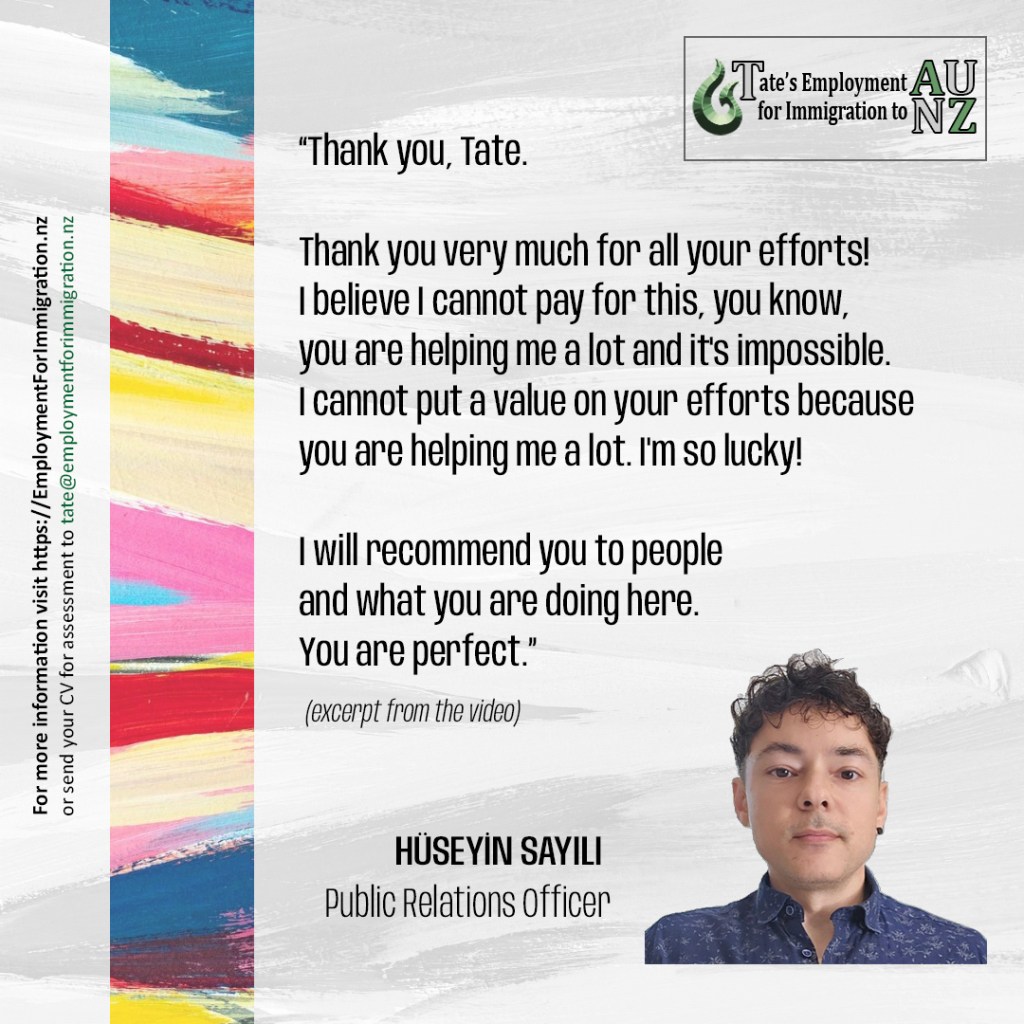
“Thank you, Tate. Thank you very much for all your efforts!
I believe I cannot pay for this, you know, you are helping me a lot and it’s impossible. I cannot put a value on your efforts because you are helping me a lot. I’m so lucky!
I will recommend you to people and what you are doing here. You are perfect.”

HÜSEYİN SAYILI
Public Relations Officer
(excerpt from the video)

Market Updates

The Disruption and Opportunity of AI in the Workforce

Artificial Intelligence (AI) is predicted to transform the global workforce over the next decade, with an impact comparable to the disruption caused by the combustion engine. Estimates suggest that AI could displace up to 300 million jobs worldwide by 2030, affecting approximately 18% of the global workforce. While such predictions may feel daunting, they also signal a wealth of opportunities for businesses, economies, and individuals willing to adapt and evolve.

Which Jobs Are Most at Risk?

AI thrives in environments where routine and repetitive tasks dominate. As such, roles in these categories are the most at risk of being replaced. Some key sectors include:

  • Data Entry, Data Analytics, Number Crunching, Report Writing: Estimated 7.5 million positions could be eliminated by 2027 due to AI advancements.
  • Administrative Secretaries, Legal Research, Coding, Programming: Automation could replace about 5 million roles by streamlining administrative tasks. Programming and coding roles will shift away from doing tasks towards managing outcomes.
  • Telemarketers and Customer Service Representatives: Chatbots and automated systems increasingly handle customer interactions.
  • Manufacturing Workers: Automation and robotics continue to replace manual labor in factories, starting with the most routine and moving progressively towards more complex tasks. However, complex and creative bespoke design works of art will be safe.

If your job is going to be disrupted or replaced entirely by AI, you may either learn to use AI in your job sector and continue your journey of evolution within your role.

Which Jobs Are Safe?

Not all jobs are equally vulnerable. Positions requiring creativity, empathy, and complex problem-solving remain resilient. These include:

  • Healthcare Professionals: Doctors, nurses, and therapists rely on nuanced decision-making and human empathy that AI cannot replicate.
  • Creative Roles: Writers, designers, and artists rely on originality and adaptability, areas where AI is still limited.
  • Educators, Trainers, Coaches and Consultants: Teaching and coaching address individual needs and foster personal connections in ways machines cannot.
  • Leadership and Management Positions: Strategic thinking and people management are safe zones in the AI landscape.

If you want nothing to do with AI, your may consider shifting your job description more towards bespoke artistic creativity or towards roles that feature human support and encouragement.

Opportunities Amid Disruption

While AI may displace some jobs, it is also creating new ones in fields like AI development, implementation, and oversight. This transformative period is a call to action for businesses and individuals to prepare for change. Workers will need to embrace continuous learning and upskill in areas less prone to automation, such as creativity, technical expertise, and emotional intelligence.

The Role of Change Managers

Change managers are essential in navigating this new terrain. They can:

  1. Guide Businesses Through Adaptation: By identifying roles at risk and supporting the upskilling of employees, change managers can help organizations stay competitive while retaining talent.
  2. Strategize Workforce Planning: Ensuring that businesses align their goals with emerging AI opportunities will minimize disruption and maximize innovation.
  3. Mitigate Economic Impact: On a larger scale, governments and organizations must work together to ensure a just transition for displaced workers, creating safety nets and education programs.

Building a Future-Proof Workforce

AI’s disruption is inevitable, but it need not be feared. By focusing on adaptability, fostering innovation, and leveraging human skills that machines cannot replicate, individuals and organizations can turn challenges into opportunities. As history has shown, every technological revolution brings both upheaval and progress. The key lies in preparation and proactive adjustment.

In times of great change, we all have a role to play in change management. This shift is not just about replacing tasks with automation—it’s about reimagining the way we work, think, and create value in a rapidly evolving world. Rather than waiting for change, we can manage change proactively, looking for the opportunties. If businesses and individuals take the lead in embracing this change, the future may be brighter than we imagine.

As AI disrupts and replaces up to 300 million jobs, it ironically creates growth in one area: Change Managers. These professionals are now essential to guide the disruption, navigating the path of least resistance for a soft landing in a rapidly evolving economy for governments, businesses, and society.
Testimonial Posts

Nkossy Phillip Testimonial

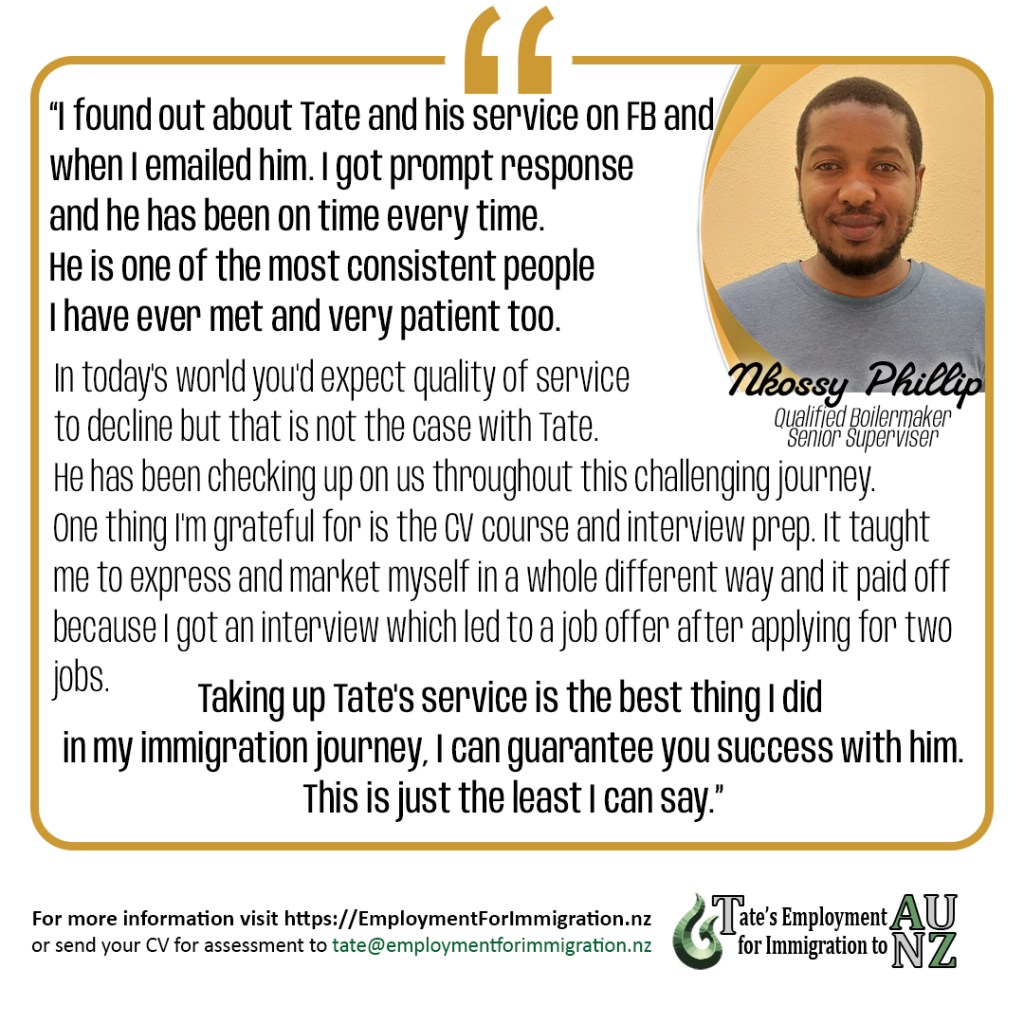
“I found out about Tate and his service on FB and when I emailed him. I got prompt response and he has been on time every time.
He is one of the most consistent people I have ever met and very patient too.
In today’s world you’d expect quality of service to decline but that is not the case with Tate. He has been checking up on us throughout this challenging journey.
One thing I’m grateful for is the CV course and interview prep. It taught me to express and market myself in a whole different way and it paid off because I got an interview which led to a job offer after applying for two jobs.
Taking up Tate’s service is the best thing I did in my immigration journey, I can guarantee you success with him. This is just the least I can say.”

Nkossy Phillip
Qualified Boilermaker
Senior Superviser


Thank you Nkossy. All your hard work has paid off. Only two sets of eyes and you are hired. You will be a great fit here. It has been a pleasure working with you.
Kind regards,
Tate

Market Updates

The New Reality of Finding Teaching Jobs

A Practical Guide

In today’s teaching job market, challenges have grown significantly, even as demand for qualified educators remains high. Based on my direct involvement with clients actively seeking roles, I’ve identified key shifts and strategies to improve your job search success.

Why the Teaching Job Market is Tougher Now
Although teacher shortages persist globally, smaller schools are struggling to keep up with the cost and administrative requirements of hiring. Many prefer to avoid the added expenses involved in processing foreign visas, making it harder for international candidates to enter these roles. Larger schools with stronger funding and the ability to plan ahead are generally more willing to engage with foreign teachers, especially those who bring a prepared, professional profile that stands out from the competition.

Your Path to Success: Targeting and Direct Engagement

Focus on Successful Employers
Aim for schools that have the resources and systems in place to handle overseas applications. Institutions that are better equipped to process work visas and handle the associated costs will consider qualified international applicants today.

Prepare a Strong Profile
A professional, well-prepared CV and supporting presentation materials. Being practiced for the job interview stage is ideal. By highlighting your unique strengths and achievements your first impression is personalised and powerful because employers want to understand you quickly. Your hard work to prepare will make their understanding easy. This is important. Currently, I’ve been able to achieve over an 80% response rate with this approach.

Engage Decision-Makers Directly
Spending time on proper introductions will save time in the long run. Setting yourself apart from the other 100 or 200 CVs in the email box is highly useful for employers and it is the only way to achiieve the high rates of personal feedbacks we are getting. It sometimes happens that your specialised skill can encourage a foreign hiring decision even when there was no plan to hire abroad. Opening the door takes planning and initiative but it pays you back with better results and more learning happens in the process.

Collect Direct Market Feedback
Every interaction is valuable, whether it’s a “yes” or a “no.” Even a rejection can provide insight, helping you refine your approach for the next opportunity. Market feedback isn’t about winning with every effort. It is about improving with every effort. These conversations offer a real-time look into what your market seeks today and how your profile is being considered. Although I am writing about teachers right now, it is the same for every job market.

Conclusion: The Key to Success
In this changing landscape, your success hinges on targeted applications, direct engagement, and constant learning from feedback. With thoughtful preparation and consistent outreach, you can navigate the teaching job market’s new challenges and open doors to exciting opportunities. Continuous improvement will always be your best friend in every long term goal that you have.

Ready to start? Get prepared, be persistent, and reach out directly. If you have any questions, then reach out to me – tate@employmentforimmigration.nz —success awaits!