Tate emphasizes the importance of preparing before starting a job search, with four to six weeks of preparation time needed for a best-in-class presentation profile. February is highlighted as the hot zone for hiring.
Tate offers end-to-end support for job searching for qualifying job seekers. Just send a few comments about your job finding status and your CV to tate@employmentforimmigration.nz
Job Hunting Success Depends on how the job offer stage is managed. After you are selected as the winning candidate, “Document Readiness” and “Clear Communication” are key to solving the rest of the process. I will explain what it means: 1) being document ready and also 2) how to manage delays in the hiring process. Too many people are applying for work without being “document ready”. If that is you, I can help you with this video. It isn’t often I work on Sunday so this must be an important video for someone out there 🙂
Sunday walk
It isn’t often I work on Sunday so this must be an important video for someone out there.
I regularly get calls from middle managers asking for support covering all sorts of industries and roles. Super-skilled and highly qualified are complex profiles that need clear communication to win. But what is the strategy for skilled and under-qualified? Well, like a typical consultant, I can only say “that depends”. Usually, skill level and industry are main factors when under-qualified. The most challenging situation I most often see where my service has limited value is when an underqualfied middle manager is looking for a managerial role in a a high risk industry.
What is so difficult about a hiring a super-skilled, under-qualified middle manager?
I always kindly decline anyone unless I can see a clear shot at job success in the profile. When I arrive at this decision, I have sometimes found it difficult to explain to foreigners who may have built 100 different structures ranging up to to multi-million USD in value why they are unlikely to get a managerial job in the construction industry without adequate qualifications. Probably the best explanation can be presented in the graph below.
The above chart comes from a factsheet published by WorkSafe New Zealand. This act is enforced where the potential for injury to employees is reasonably high. Such environments will include construction sites, factories, stock yards, tree harvesting sites, etc…
As this chart indicates, there are severe consequences for those found reckless or negligent – that’s right, you don’t even have to be reckless, you can simply overlook something and it happens. For example, employing an unqualified manager might be considered as a failure to comply with health and safety duties when that decision is later seen by investigators as a cause for a risk of serious injury, illness or death.
If you are a middle manager lacking qualifications working in a high-risk industry, what are your options?
There are other roles below “manager”, including team lead, foreman, skilled carpenter, etc… This may be a viable entry point for a manager willing to work back up to the managerial level, while also allowing the local employer to keep risks low enough so that a hiring decision can be made.
What if you have little or no “hands on” skills?
Upskilling takes time. For some, it is the best option. I would suggest either to acqauire a relevant bachelor’s degree or learn some “hands on” skills to a level of a qualified tradesman. Maybe even get qualified if that is an option.
What if you want to try anyway?
There have been a number of cases where I have successfully worked with underqualified middle managers in high-risk roles. What happened in these cases was that I gave a clear warning, they decided to go ahead anyway and we went to work to maximise their chances on a range of issues including past practice, performance levels, ongoing study and motivation. Three things help: preparation, persistence and going the extra mile. It is about finding and building relationships. It is about a willingness to conduct face-to-face interviews on the spot. And that is how you maximise the chances, and yes, it can work, but I prefer to look at the other options first because I like to maximise the opportunities and not just the chances.
Finish
And that, my friends explains the challenges in terms of risk and the options in terms of job strategy. I am good at assisting with work but I am not touching your immigration or visa requirements. That will be up to you or your immigration agent. New Zealand and Australia have many high-demand job sectors that need strong candidates. The best job strategy in a nutshell is to position yourself as a low risk, high reward candidate. For details how that might apply to you, just send your CV to me at tate@employmentforimmigration.nz for helpful insights in about a day.
Berenice and Edward confirm that age doesn’t matter in the New Zealand job market. If employees are deemed “fit for the job”, that is all that matters.
Edward and Berenice ran a successful plumbing company that grew from 1 to 6 vans in the span of a few years. Then one day they decided to start a new life in New Zealand. Today they are both working and happily in Whangerei.
At the end of the day, the clients will always define success for a business. If you want best-in-class support and an effective programme that delivers 80 times more responses from employers, you found the right place!
The brain drain from South Africa has transformed the economies and societies of New Zealand and Australia over the last 4 decades. South Africa has given our part of the world some of the most talented professionals in their country. Industry leaders representing all trades, engineering, teaching, health, ITC, manufacturing, logistics, goods and services of all kinds. The people coming are the bedrock of society. They have helped build and maintain cities, towns, industries and services, private and public. By this time, I would guess that every professionally skilled person in South Africa has seen family, friends and colleagues leave for a better life abroad. One of their favourite destinations is little New Zealand..
A 2013 census showed 54,279 South African-born people resident in New Zealand, or 1.36% of our population, 5th highest after UK, China, India, and Australia. 2013 was a long time ago, and the flow has been high the whole time (except for the lockdown years), and the flow will continue, I’m sure because there continues to be great interest on both sides. Australia has larger numbers but reflects a smaller percentage share of talent growth.
Brain drains reflect a shift of production capacity and social stability away from one place to the benefit of somewhere else. In stable countries, most of these people would not relocate. It takes generations to develop a class of people that keep the fabric of society held together. New Zealand has benefited much from this group. Those who benefit the most from South Africa are in several categories, but I will name just two that I am most familiar with: 1) Top income professionals could live anywhere in the world and their top choice is often New Zealand or Australia and 2) Proven talent that finds life at home to be more struggle than success both financially and socially.
Regarding the top income performers – They find what they are looking for in New Zealand when they have security, stability, happier family time, regular contact with nature and a work-life balance. Top performers often talk about their quality of life for themselves and their children as their main reason fro choosing this region of the world. This group needs to be connected with decision makers that understand their value and can make use of their skills. This process often begins with making complex profiles clearly understandable and then plugging them into either a career growth direction or a lifestyle direction or some combination of both.
About proven talent – They find economic growth and opportunity plus all of the things listed above as well. This category often has to “put everything on the line” to make this dream come true, and when it does, they can experience the most positive change to their life experience and for their future growth opportunities. For this group life can instantly improve on all fronts from day 01 and go up from there, but the risks are higher to get from point A to the new life here. This group needs the most planning and risk management support and the confidence that their hard earned immigration investments will bring the success they are looking to achieve.
Brain Drain to New Zealand
A recent article this week that published, “[A]round 8% of people are selling their homes with plans to leave the country. Notably, the data shows that wealthier South Africans – even those in upper-middle-income brackets – are more likely to sell up to emigrate.” – Upper-middle income South Africans are selling up to emigrate
The relocation of talent from South Africa to New Zealand and Australia has been going on for many decades and will continue for a long time until conditions improve dramatically at home. This may take a long time. Until then, countries abroad that are successful in attracting some of the best available talent in the world will continue to benefit from the situation and immigrants will continue to improve their lives.
If you want help getting into contact with hiring managers in these sectors so you can “get the ball rolling” towards immigration, I am happy to help you do that. I just need your CV to start with and some information about your immigration status. What I do with your CV from that stage is to review and give helpful feedback based on your immigration goals.
Remember, everything about immigration for these roles and most others comes down to the job offer, and employers will be increasingly driving the process towards your work visa. So the critical link is going to be your profile getting a response to you from your future employer so that you can be considered seriously enough for that job offer. From that stage of having a written and signed job offer in your hands, the rest of the process can flow naturally based on INZ requirements. For customised insights, I always welcome your CVs and questions to tate@employmentforimmigration.nz
Where is Immigration New Zealand going with this?
My attention was drawn to the following sentence – “More details will be released in coming weeks” and the following two links were immediately provided thereafter:
If you follow the above two links, you will find the first one written by the Labour MP for West Coast-Tasman and Minister of Agriculture, among other things.
The second link was written by the Minister of Digital Economy and Communications.
What seems obvious to me is that the government has decided to manage growth into the agricultural economy and the digital growth economy by priority, ahead of the borders opening for everyone else. Agriculture is the main export industry and the digital economy + communications are seen as critical for us to keep pace with a changing first world economy by the looks of it.
Starting from January 17, 2022, most companies in New Zealand will be operating with a full contingent of staff, ready to make hiring decisions.
When borders finally open, foreign job-seekers will experience the most anticipated job market in the history of Australia and New Zealand.
The Hottest Job Market in History for Top Foreign Talent
I have seen the talent that is getting ready. The first wave of migrants coming into NZ and Australia will include some of the most successful high achievers I have ever seen. This group is likely to enter during the first few months after the border has opened and they are likely to meet employers that have been waiting a long time to expand their business. Some of the best jobs available will be taken by the first wave coming in, but that will probably not satisfy the total demand for skilled labour. I believe that the second wave of immigrants will be even larger because the success of the first wave will be painted all over social media with stories of “hottest job market in history”.
Somewhere between the second and third waves, probably between 6 and 12 months, the job markets will be satiated with enough talent that employers will have to slow down with hiring and start paying attention to training and supporting existing staff, meeting business objectives, achieving a return on these hiring investments that were made.
There Will Be More Video Hires Than Ever Before
For immigrants that would like to get hired on video calls. this is an area of the job market that will continue to grow. Pushed by necessity, employers have been hiring online in record numbers during the lockdown and I speak specifically about those thousands of medial staff that have come in with border exemptions. They were all hired online! Imagine that, 100% hired online by hospitals ad private clinics nationally. So we can expect to see that opportunity expand.
If you want to get work in New Zealand or Australia, there are 101 ways to improve your chances. Everything starts with your profile and your core skills and how your core skills apply into the existing job market demand. It is just that simple. You can forget about the skills shortage lists and the employer accreditation lists. The stating point is your “value deliverable” as a professional, as a candidate profile and that includes everything that hiring managers want to see in order to confidently make a good hiring decision for their employer.
If you want helpful advice about your profile and goals, I will be happy to have a look at your CV and answer your specific questions at no cost.
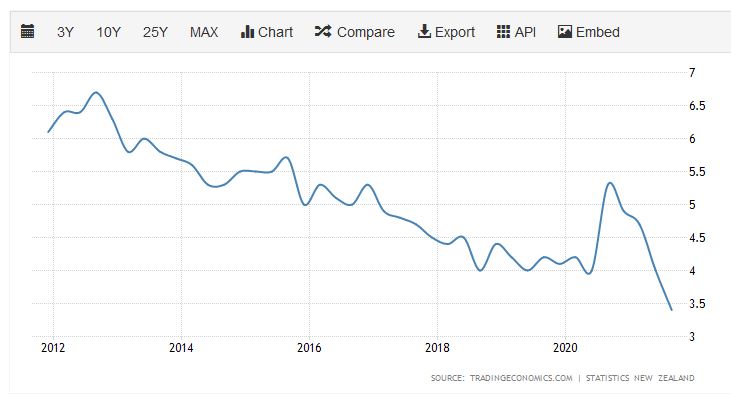
NZ unemployment rate last 10-years. This is the most candidate-short market in NZ history, or at least as far as modern job market history is concerned. A perfect storm for a hiring frenzy when the borders open.
This an event not to be missed by committed foreign talent that already know what they want.
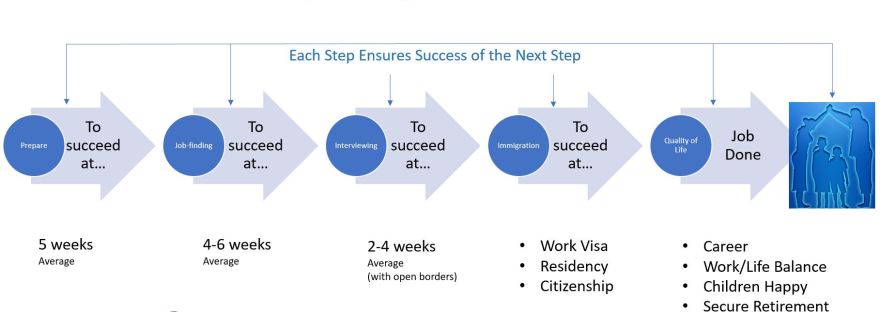
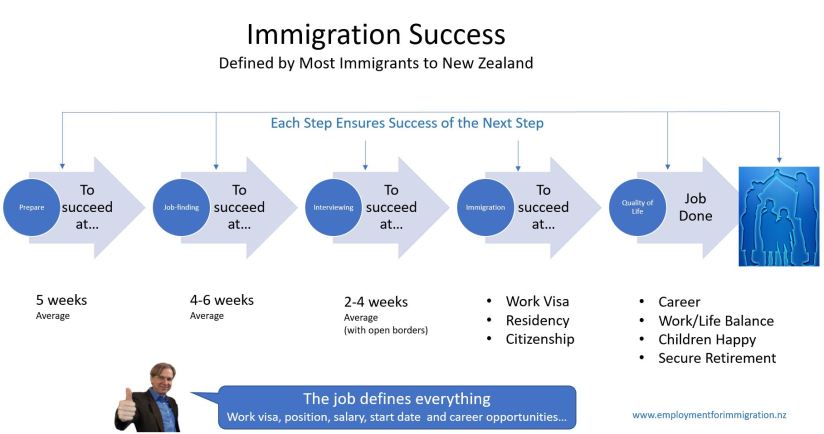
For newcomers especially, starting your new life in New Zealand, Australia or any foreign country can seem overwhelming. It can all seem a bit confusing, especially these days. To help clear up the process, let’s review the strategy backwards, from the end-point of most people.
What are the main goalposts involved here?
7) Get residency – That is usually the #1 goal, right?
6) To get residency, you will need to move a period where you are working-to-residency, yes? There is no other way for most of my Clients.
5) To get work, a qualifying job offer is needed for sure. This is a must.
4) To get a job offer, it is important to line up great meetings with suitable employers offering suitable roles. A targeted approach works. Spamming doesn’t work. Fair enough so far?
3) To enjoy a big list of meetings scheduled even before you leave your home country, you need an effective and customised marketing campaign that targets quality employers. So it is about meetings, meetings, meetings. You have control over this area, more so than you know.
2) Before starting any sort of campaign, a stand-out profile should be crafted that sets you apart from all of the other candidates based on who you are and your proven skills. This is obvious right? We can’t just set up meetings and give an average profile. It needs to connect.
1) To find out more, my process really begins with your CV and your core strengths and your goals.
Dos this help clear up the process?
I have been through this backwards and forwards with all industries, all levels of roles, every region and many countries. Your journey is always a personal experience for you and for me. The systems I have created will assist us to bring out your best and make those connections and get the job done.










 Employment for Immigration to New Zealand, Australia and Beyond