Market Updates

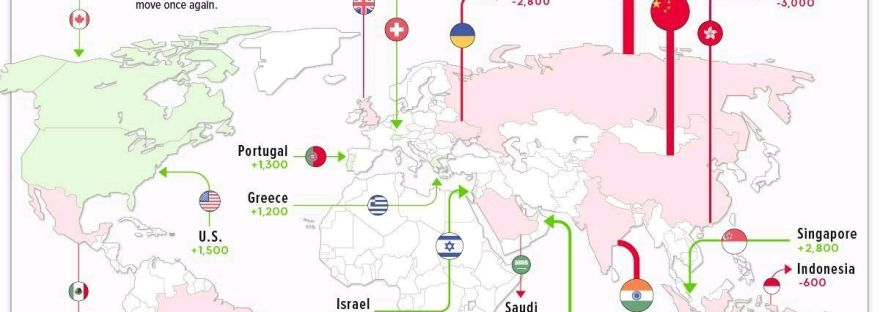
Millionaire Migration Map

A few interesting facts about millionaire migrants:

1) Little New Zealand is getting half as many millionaire migrants as the United States while having only 1.5% of the population.

2) The only country receiving more millionaires than Australia is the UAE but since the UAE almost never allows citizenship, Australia will end up getting some of those as well.

3) NZ + Australia receives 4,300 millionaire migrants compared to 2,500 that US + Canada, which is like saying NZ + Australia get 170% more millionaires than the US + Canada with only 8% of the population.

Insights from the Millionaire Migration Map – If millionaires are generally smart and capable people who have the ability to live almost anywhere, then why so many want to live in New Zealand and Australia?

And can we enjoy some of the same benefits of peace, nature, opportunity, weather, family, culture, future, etc… as they do?

Market Updates

New Zealand is still New Zealand

After landing in New Zealand, foreign migrants typically comment about the friendliness of Kiwis, the cleanliness of the city, the beauty of the nature and the safe, relaxed nature of society. New Zealand is also one of the few genuinely “kid friendly” countries in the world. Job seekers have said these to me this week after landing in New Zealand and the same things were said also last month and last year and during lockdowns and before lockdowns for many years prior. New Zealand hasn’t changed.

During lockdowns, the reputation of New Zealand has been tarnished and dragged through the mud. In many cases, this is deserved. However, policies from our government don’t reflect the New Zealand society. I can offer proof of this statement based on what incoming migrants have been telling me.

I can respect the opinions of people who have been financially and professionally harmed by the bad polices of our government during lockdowns. But who is really to blame. It was a tiny few people in certain government departments who created and enforced bad policy.

New Zealand is still the best country for all those reasons that people have always loved about New Zealand. Those things have remained remarkably constant for many decades.

In my opinion and based on the informal opinion polls that I receive from new migrants; New Zealand is still the best country for all those reasons that people have always loved about New Zealand. Change is always happening, but those things have remained remarkably constant for many decades.

Market Updates

This week in review

I had a good experience contacting employers this week. I talked with 50 employers so far and will continue today with a couple more sessions scheduled.

This week I had a client get a job offer within 24-hours of a calling session. When things happen this fast, you know it was a perfect-fit type of decision from the side of employers. It is really great when that happens. 🙂

I am finding that most of the employers are comfortable with the hiring process by now. The fear of INZ has gone way down but trust has still not returned, and I don’t think it will return completely because the hiring process for foreigners continues to shift and policies continue to be misunderstood. And yet, the hiring continues because uncertainty is down to acceptable levels. The time from a hiring decision to starting work is shrinking, which is good for everyone.

Australia is still pulling talent from New Zealand, adding pressure to our candidate-short market and that is across the board. Australia has always had a stronger economy; they pay more and have warmer weather. On the other hand, the Aussie immigration process is more complex and about twice more expensive than New Zealand from the point of view of most foreign job seekers.

Both New Zealand and Australia continue to require all the diverse skills that were in demand prior to the lockdowns, especially tradesmen, engineers, medical, teachers, and specialists of all disciplines and sectors.

If you have exceptional skills and the suitable qualifications, then it is worth spending the time to communicate your strengths clearly as part of your job finding process so that employers see you as a low-risk, high value addition to their team. Whether niche or traditional, almost any skilled background can be successful in both NZ and Australian job markets with the right preparation and approach.

With holidays coming up, we have 6-weeks of an active job market before hiring stops for about 4 weeks. Then comes the post-holiday hiring boom. It happens every year and it is always good to hit the post holiday hiring season with a good plan.

Good luck everyone! Things are slowly getting better over here.

Practical Advice

Sail Through the “Hope Trap” Until You Win

The #1 problem of finding work abroad is getting into initial conversations with employers. For most people, the efforts are too high, and the results are too low.

When this challenge is overcome there is another challenge that may seem a bit surprising to some people. It is something I call the “Hope Trap”.

What is the Hope Trap? That is when a job seeker decides to stop looking for work as soon as one meeting is scheduled with one employer.

From the job seeker’s point of view, it makes sense. They have so much weight on their shoulders. The immigration process is time consuming and expensive and risky. Migrants sometimes want the job search to be finished, so when there is a slight chance of getting hired, it is tempting to stop a successful effort and “hope” that this future meeting will result in the perfect job offer.

The way to avoid the “Hope Trap” is to continue job finding until a contract is signed. This is exactly what the employers are doing when they look for candidates.

If you or someone you know is tempted to stop looking for work when a meeting has been arranged with an employer, tell that person to continue because “the game isn’t over until you win!”

Practical Advice

Need a “Document Checklist”?

This checklist was published by the Department of Immigration New Zealand for use by “migrant workers who have been asked to apply for an AEWV.”

In case you have problems connecting, I have copied the pages below:

Page 1

=-=-=-=-=-=-=-=-=-=

Page 2

=-=-=-=-=-=-=-=-=-=

Page 3

=-=-=-=-=-=-=-=-=-=

Other languages offered on the Immigration New Zealand website: >> here

Job Finding Stories

Inspiring Testimonial from a Migrant Who Tried Different Job-finding Systems in New Zealand

Tired of getting nowhere in the NZ or Australian job markets? This story will inform and inspire you.

Great testimonial from a great Business Analyst. Pieter talks about the process of his Accredited Employer Work Visa (AEWV) and what he did to get HIRED QUICKLY. I appreciate his kind words and wish him well into his bright future.

Practical Advice

Is it Getting Easier for Foreigners to Get Hired in New Zealand Today?

What are the advantages of getting hired through the Accredited Employer Work Visa (AEWV)?

Both employers and job seekers are reporting many advantages. I will get into that in a second. But first, what if you contact an employer that is not yet accredited? I always suggest to simply give this link: https://www.immigration.govt.nz/employ-migrants/new-employer-accreditation-and-work-visa

The link above will explain to employers how easy it is today to hire foreign job seekers.

What employers are telling me about the AEWV:

  • It is easy
  • not expensive
  • takes 10-days (Work Visa another 20-days)
  • More control over outcome

How easy is it?

I have seen a small one-person tradesman-owned company go through this process successfully even though it was his first time hiring a foreigner. If he can do it, certainly larger companies with some admin staff can do it.

Foreign job seekers and local employers have a clear pathway for working together. It doesn’t take long, it isn’t expensive and employers don’t have to rely on third parties to do the job check.

10x Cheaper?

By comparison, a New Zealander would have to pay up to 10 times more for a skilled candidate by local recruiters versus hiring a foreigner through the AEWV system. Often the quality of candidate is better from abroad also.

Example:

  • Cost of candidate placed by recruiter typically reaches $10,000-15,000 NZD
  • Cost pf candidate placed through the AEWV system approximately $1,500 NZD

Summary: There is no reason for a local NZ employer to hesitate to hire a foreigner today. The AEWV system allows them to find a good candidate first, get accredited 10-days later, and launch the rest of the process towards a work visa while retaining control in-house the entire way.

If you need help getting to the job-hiring stage, just send your CV to me at tate@employmentforimmigration.nz with a short description of your status. I respond with helpful advice to all qualifying candidates within in 1-day.

Market Updates

Online Job Offers in New Zealand are Happening at a High Rate

New Zealand employers have been screaming out for front line tradespeople for decades.

During the last 2.5 years, demand gone up but there was almost zero supply of candidates due to closed borders.

So far, we are in the first week of this new Accredited Employer-led Work Visa system and the rate of online hiring from NZ employers has never been higher. Here are the hottest jobs in the market…

Front Line Tradespeople in High Demand:

  1. Plumbers (residential, industrial, civil, commercial)
  2. Electricians (residential, industrial, civil/power, commercial, auto, marine…)
  3. Mechanics (petrol, diesel, aeronautical, marine…)
  4. Fabricators (light, heavy)
  5. Fitters (mechanical, electrical, etc…)
  6. Machinists (different materials, tolerances, tools)
  7. Carpenters
  8. Butchers
  9. Chefs
  10. etc…

The ratio of online interviews and job offers is higher than anyone can remember.

What Other Roles are in High Demand?

  1. Engineers (mechanical, civil, commercial, electrical, electronic, chemical… etc… basically most engineers so long as you have proven skills)
  2. Project Managers with Project Management Professional accreditation or Prince2, really great qualifications to work with. If you have these qualifications, it means you already have proven skills to consider
  3. IT / ICT engineers, programmers, developers, project leads
  4. Technical sales professionals, business developers
  5. Accountants that are big 4 experienced or chartered with business acumen for delivering financial goals to the bottom line through inter-departmental collaboration
  6. Teachers (primary, secondary, specialised)
  7. Front line medical practitioners
  8. Other specialised professionals, including Veterinarians, Dentists, Occupational Therapists, Clinical Psychologists, etc… as long as you comply to NZ standards at the professional board where your industry is regulated, it is worth checking out for job market demand.

What if You Aren’t In the Above Lists?

There are too many niche categories to list. Also, I am just typing these down from memory, I am sure I missed some major categories that have incredibly high demand right now.

Here is another way to quickly estimate if your profile might have high demand in NZ / Australia today… If you are a proven high achiever with a long track record for success, you may want to investigate further. Equally, if you are a young rising star with a short but powerful track record, I would like to see your CV.

Logically, it makes sense to be in this market is before everyone else enters, and before demand for your skills becomes satisfied.

HOW CAN YOU FIND OUT?

To get Insights about your chances, likely job demand and best strategies, just send your CV to me at tate@employmentforimmigration.nz and include a statement about your goals. I will respond within a day with helpful insights based on job market realities in New Zealand / Australia today.

Market Updates, Practical Advice

How to Help New Zealand Employers Hire You Today

Many New Zealand Employers don’t yet know how to hire foreign migrants, so don’t be surprised. The employer-led system is only starting now.

If you want to help a NZ Employer hire you today, here is what you can do…

  1. Ask the employer if they are aware of the new Employer Accredited Work Visa (AEWV) coming into effect July 4.
  2. If the employer is interested to find out more, it’s all right here: https://www.immigration.govt.nz/employ-migrants/new-employer-accreditation-and-work-visa/accreditation-types-and-employers-requirements

The benefits of the employer-led process are simple to explain:

In the past, employers only issued the job offer and then they often would wait for an immigration agent to confirm or request a change to the job offer in order to achieve compliance.

Today, the process is streamlined. The term “employer led” system means exactly that. Employers control the job offer and the work visa at the same time.

If you are a job seeker wanting to fast-track your job-finding process, send your questions to me at tate@employmentforimmigration.nz

I am 100% job-focused. If you require specific immigration advice, just see the INZ government website or find a NZ licensed Immigration Agent. If you want a referral of a reliable and proven immigration agent, I can find your match as part of my services.