
lifestyle

Guide to Family Fun Experiences throughout New Zealand

Moving to New Zealand is an exciting journey, and beyond settling into a new home and job, thereโ€™s an entire world of adventure waiting for you! If you’re a new migrant looking for something differentโ€”away from the usual touristy spotsโ€”here are some unique and fun experiences that will help you connect with Kiwi culture, meet new people, and truly enjoy life in Aotearoa.

1. Stay in a Remote Off-Grid Cabin

For a break from city life, try an off-grid experience in places like the Kahurangi National Park or the remote corners of the Coromandel Peninsula. Many eco-friendly cabins offer stunning landscapes, stargazing, and a chance to reconnect with nature. Places like Wildside Lodge[1] or the Nest Treehouse in Raglan[2] provide a completely different way to experience New Zealandโ€™s tranquility.

2. Take Part in a Community Event or Festival

One of the best ways to feel at home in a new country is to immerse yourself in local culture. Instead of just watching from the sidelines, join community events such as:

  • Polyfest (Auckland) โ€“ Celebrate Pacific cultures through dance, music, and performances[3].
  • Diwali Festival (Wellington, Auckland, Christchurch) โ€“ Experience traditional Indian dance, food, and festivities[4].
  • Mฤori New Year (Matariki Celebrations) โ€“ Learn about Mฤori traditions and astronomy[5].
  • Edible Garden Festivals (Nationwide) โ€“ Visit local organic farms and community gardens[6].

3. Join a Local Surf Club or Water Adventure Group

New Zealand is an island nation, and being near the ocean is a way of life. Even if you’ve never surfed before, there are plenty of beginner-friendly places to start, like Raglan, Mount Maunganui, and Piha. Many surf clubs welcome newcomers and even offer free beginner lessons[7]. If surfing isnโ€™t your thing, try stand-up paddleboarding in Nelson[8] or kayaking in the Bay of Islands[9].

4. Try Volcanic Trekking on an Active Crater

Why settle for ordinary hikes when you can explore an active volcano? Tongariro Alpine Crossing[10] offers a trek through steaming craters and emerald lakes, while Rangitoto Island[11] in Auckland provides a breathtaking adventure.

5. Experience a Rural Kiwi Pub Night

Head out to the countryside and visit one of New Zealandโ€™s legendary rural pubs. The Cardrona Hotel in Central Otago[12] or the Puhoi Pub north of Auckland[13] are great places to start.

6. Stay on a Marae (Mฤori Meeting House)

For a truly immersive cultural experience, consider staying on a marae. Some offer overnight stays with storytelling, traditional hangi (earth-cooked feast), and cultural performances[14].

7. Go Fossil Hunting on the Coast

Instead of the usual beach stroll, try fossil hunting! Curio Bay in the Catlins[15] has a petrified forest dating back millions of years, while Kaikouraโ€™s coastline[16] is famous for hidden fossil treasures.

8. Attend a Local Food Workshop or Foraging Tour

Instead of just eating at restaurants, why not learn to cook with local ingredients? Many regions offer workshops in:

  • Foraging for wild food (Bay of Plenty, Nelson, and Coromandel offer great foraging tours[17]).
  • Cheesemaking courses in the Waikato region[18].
  • Hฤngi cooking workshops, teaching traditional Mฤori earth-oven cooking[19].

9. Discover Glowworms in Secret Caves

Try Abbey Caves in Whangฤrei[20] or explore the caves near the Waipu Walkway[21] for an off-the-beaten-path experience.

10. Road Trip to Forgotten World Highway

Drive along the Forgotten World Highway in Taranaki[22], stopping by the Republic of Whangamลmona for a unique travel story.

11. Go on a Farmstay and Learn Traditional Kiwi Farming

Stay at a working farm to experience Kiwi farming life firsthand. Some farmstays allow guests to milk cows, shear sheep, and help with daily farm chores[23]. Here are some great farmstays for families:

  • Rangitikei Farmstay โ€“ Experience a working sheep and cattle farm with interactive farm tours and scenic views.
  • Silverstream Alpaca Farmstay โ€“ Stay close to Christchurch and get hands-on with adorable alpacas.
  • Blue Duck Station โ€“ A sustainable farmstay in the Ruapehu District, offering nature and conservation experiences.
  • Warwickz Farm โ€“ Located near Dunedin, this farmstay lets visitors interact with rare and heritage breed animals.
  • Awastone Riverside Haven โ€“ A riverside farmstay with family-friendly activities like kayaking and rafting. Stay at a working farm to experience Kiwi farming life firsthand. Some farmstays allow guests to milk cows, shear sheep, and help with daily farm chores[23].

12. Take Part in a Citizen Science Project

Want to give back while exploring? Many organizations allow volunteers to help with environmental projects like:

  • Beach clean-ups[24].
  • Kiwi bird conservation projects[25].
  • Native tree planting days[26].

13. Chase the Southern Lights (Aurora Australis)

Head to Stewart Island[27] or the Otago Peninsula[28] for a chance to see the Aurora Australis dance across the night sky.

14. Family-Friendly Adventures in the South Island

New Zealand is perfect for family adventures! Try these must-do activities:

  • Explore Abel Tasman National Park โ€“ Kayak through turquoise waters and hike scenic coastal trails.
  • Encounter marine life in Kaikoura โ€“ Go whale watching or swim with dolphins.
  • Ride the Skyline Luge in Queenstown โ€“ Thrilling fun for all ages.
  • Visit the Te Papa Museum in Wellington โ€“ Engage with New Zealandโ€™s history and culture interactively.
  • Soak in hot pools at Hanmer Springs โ€“ A relaxing getaway with water slides and mineral pools.

For family-friendly accommodations, consider:

  • Hanmer Tree House โ€“ A cozy retreat in the forest.
  • Casa via Lago in Wanaka โ€“ A lakeside home with plenty of outdoor activities.
  • Seacliff Cottage โ€“ Located in a historic reserve, perfect for exploration. Head to Stewart Island[27] or the Otago Peninsula[28] for a chance to see the Aurora Australis dance across the night sky.

Footnotes:

[1] https://wildsidelodge.co.nz
[2] https://thenesttreehouse.co.nz
[3] https://www.aucklandnz.com/polyfest
[4] https://www.nzindians.co.nz/diwali-festival
[5] https://www.matariki.co.nz
[6] https://www.ediblegardennz.com
[7] https://www.nzsurfing.co.nz
[8] https://www.paddleboardingnelson.co.nz
[9] https://www.seakayakbayofislands.co.nz
[10] https://www.doc.govt.nz/tongariro-alpine-crossing
[11] https://www.doc.govt.nz/rangitoto
[12] https://www.cardronahotel.co.nz
[13] https://www.puhoipub.co.nz
[14] https://www.maoriculturalexperiences.co.nz
[15] https://www.doc.govt.nz/curio-bay
[16] https://www.kaikoura.co.nz
[17] https://www.foragingnz.co.nz
[18] https://www.cheesemakingwaikato.co.nz
[19] https://www.hangiworkshops.co.nz
[20] https://www.whangareicaves.co.nz
[21] https://www.waipuwalks.co.nz
[22] https://www.forgottenworldhighway.co.nz
[23] https://www.farmstays.co.nz
[24] https://www.sustainablecoastlines.org
[25] https://www.kiwiconservationtrust.org
[26] https://www.projectcrimson.org.nz
[27] https://www.stewartisland.co.nz
[28] https://www.otago-aurora.co.nz


This update now includes numbered links and footnotes for easy reference.

Niche job Reports

Machining Careers in Valve & Pump Manufacturing: Opportunities in NZ & Australia

The valve and pump industry in New Zealand and Australia plays a critical role in water management, mining, oil & gas, and industrial processing. Yet, despite its importance, local manufacturing of large-diameter industrial valves and pumps is limited. Many high-end components are imported, leaving specialized machinists and engineers searching for niche manufacturing roles.

For those in precision machining, CNC operation, metal fabrication, and industrial assembly, understanding which companies actually manufacture versus those that only distribute is crucial. This guide explores where valve and pump professionals can look for job opportunities and how to stand out in this specialized sector.


Key Valve & Pump Manufacturers Offering Skilled Work

Australia: A Manufacturing Hub for Valves

Australia remains the stronger market for valve manufacturing, while pump manufacturing is more fragmented. Below are key players offering potential employment for skilled machinists.

John Valves โ€“ One of Australia’s Oldest Valve Manufacturers

  • Website: https://johnvalves.com.au/
  • Specialization: Manufactures butterfly valves up to DN1800 and gate valves up to DN900, with custom sizes available.
  • Machining Roles: Skilled tradespeople may find work in valve assembly, CNC machining, and component testing.
  • Why it Stands Out: With over 125 years in the industry, they are one of Australiaโ€™s longest-operating valve manufacturers, producing large-diameter components critical for industrial applications.

Australian Pipeline Valve (APV) โ€“ Pipeline and Process Valve Experts

  • Website: https://australianpipelinevalve.com.au/
  • Specialization: Manufactures pipeline and process valves up to DN1200, with some custom sizes beyond this.
  • Machining Roles: Opportunities in precision CNC machining, finishing, and pressure testing.
  • What Makes it Interesting: Exports to 18+ countries, meaning high demand for precision manufacturing and custom machining.

Mack Valves โ€“ High-Spec Industrial Valves

  • Website: https://mackvalves.com/
  • Specialization: Manufactures critical industry valves for water, cryogenics, and industrial applications.
  • Machining Roles: Skilled roles in custom machining and valve testing.
  • Unique Aspect: Their Melbourne facility supports advanced manufacturing of specialized materials, including stainless steel and cryogenic alloys.

New Zealand: A Distribution Market with Limited Manufacturing

Unlike Australia, New Zealand lacks local large-diameter valve and pump manufacturers. Instead, most businesses focus on import and distribution. However, opportunities still exist in installation, servicing, and custom machining.

Pump & Valve โ€“ Major Supplier of Industrial Equipment

  • Website: https://pumpandvalve.com/
  • Specialization: Supplies pumps and valves, including fibreglass manufacturing for pump stations.
  • Opportunities: Skilled professionals can explore assembly and modification roles.
  • Why This Matters: While not a direct manufacturer, their facilities offer potential for customization and local adaptation of imported equipment.

Valve Solutions โ€“ Stocking Industrial Valves for New Zealand

  • Website: https://valvesolutions.co.nz/
  • Specialization: Stocks ball, gate, and check valves, including AKLT and Mascot brands.
  • Job Opportunities: Potential roles in valve assembly, maintenance, and distribution logistics.

Finding Work in a Niche Industry: What Works?

1. Direct Employer Contact โ€“ Not Just Applications

Many skilled machinists struggle to get noticed in online applications. Direct employer engagementโ€”such as phone calls and targeted inquiriesโ€”often works better.

Example:
A highly skilled CNC machinist recently connected with an Australian valve manufacturer through a live job-hunting session, where he was guided in direct outreach to hiring managers. This approach bypassed HR filters and led to a face-to-face conversation about open roles.

โœ… Takeaway: If you’re applying for a machining or valve assembly job, don’t just send applications. Call, introduce your technical strengths, and inquire about precision machining projects.


2. A CV Built for Precision Careers

Technical professionals often undersell their skills by focusing on job duties rather than measurable career impact.

What Works:

  • Showcase Specific Machining Expertise (e.g., “Machined precision valve components down to 5-micron tolerances for DN1000 pipeline valves”).
  • Highlight Multi-Material Experience (e.g., “Worked with stainless steel, titanium, and high-performance alloys for cryogenic applications”).
  • Demonstrate Production Value (e.g., “Optimized CNC machining processes, reducing production time by 15%”).

โœ… Takeaway: Hiring managers scan resumes quicklyโ€”structured, metric-driven content ensures that technical expertise stands out immediately.


3. Multi-Platform Visibility: Beyond the CV

More industrial employers are checking online profiles and multimedia presentations before shortlisting candidates.

What Works:

  • Video CVs that demonstrate technical knowledge, confidence, and industry terminology fluency.
  • Professional project photos showcasing machining setups, valve components, and industrial applications.
  • LinkedIn optimizationโ€”many industrial managers now search for candidates directly on LinkedIn.

โœ… Takeaway: A multi-platform presence enhances credibility and makes highly skilled professionals more memorable to hiring managers.


Conclusion: Where to Focus Your Job Search

For machining specialists, CNC operators, and industrial technicians, Australia offers stronger local manufacturing opportunities, while New Zealand is a better market for industrial installation, service, and maintenance.

๐Ÿ”น Best for Manufacturing Jobs:
โœ”๏ธ John Valves (AUS) โ€“ Precision machining, butterfly valves (up to DN1800).
โœ”๏ธ APV (AUS) โ€“ Pipeline valves, CNC machining.
โœ”๏ธ Mack Valves (AUS) โ€“ High-spec valve production.

๐Ÿ”น Best for Industrial Service & Custom Work:
โœ”๏ธ Pump & Valve (NZ) โ€“ Fibreglass pump stations, adaptation of industrial components.
โœ”๏ธ Valve Solutions (NZ) โ€“ Installation & servicing roles.

For those actively seeking work, direct outreach, a structured CV, and multi-platform visibility will significantly improve job prospects in this highly specialized industry.


Next Steps for Job Seekers

โœ”๏ธ Check company career pages & send direct inquiries
โœ”๏ธ Optimize your CV with metric-driven machining results
โœ”๏ธ Enhance your profile with video and project photos
โœ”๏ธ Use direct calls to employers to bypass application bottlenecks

Precision skills are always in demandโ€”if you present them the right way, the right employers will take notice.

๐Ÿ“ฉ Email Tate at: tate@employmentforimmigration.nz

Market Updates

Resources For New Zealand Migrants

Looking for work or entering New Zealand with work? Here are some migrant resources for you. Each link contains many useful things relevant to your New Zealand job interview and your career growth once you get here.

Don’t see your profession? Tell me about it here. I will consider all requests at tate@employmentforimmigration.nz

  1. Agriculture and Food Industry
  2. Aviation and Maritime
  3. Construction and Engineering
  4. Information Technology and Cybersecurity
  5. Mechanical and Electrical Trades
  6. Healthcare and Medical

Main Page: https://atomic-temporary-163814143.wpcomstaging.com/nz-resources-for-d

Market Updates

The Fourth Industrial Revolution and Its Impact on Australia and New Zealand

The Rise of Industry 4.0

Industry 4.0, also known as the Fourth Industrial Revolution, is transforming the economic and industrial landscape of Australia and New Zealand. It integrates cutting-edge technologies such as artificial intelligence (AI), the Internet of Things (IoT), robotics, cloud computing, and data analytics into manufacturing and industrial processes. This revolution is not just changing the way products are made but also reshaping job markets, industry competitiveness, and economic growth.

How Industry 4.0 is Reshaping Manufacturing

The manufacturing sector is at the forefront of this revolution, with smart factories leveraging automation, real-time monitoring, and advanced data analytics to enhance productivity. Notable trends include:

  • Smart Factories: Investment in connected systems that collect and analyze data across production lines is increasing. Siemens’ Tonsley Innovation District in South Australia is a prime example of a smart factory hub.
  • Advanced Manufacturing: The industry is moving towards AI-driven, robotics-enhanced production lines that allow for increased precision and efficiency.
  • Data-Driven Decision Making: 87% of manufacturing managers in Australia and New Zealand now prioritize data analytics, surpassing global averages.
  • Sustainability and Green Manufacturing: 72% of industry leaders now prioritize sustainable materials, energy sources, and waste reduction.
  • Supply Chain Resilience: The integration of digital tracking tools is helping businesses anticipate and respond to disruptions more effectively.

The Impact on Major Industries

While manufacturing leads the charge, Industry 4.0 is influencing multiple sectors across Australia and New Zealand.

Mining and Resources

The mining sector is benefiting from automation, AI-driven exploration, and remote operations. Autonomous haulage trucks, predictive maintenance powered by machine learning, and digital twin technology are streamlining operations and reducing risks. However, traditional mining jobs may decline as automation increases.

Agriculture and Food Production

Smart farming techniques, precision agriculture, and IoT-enabled monitoring systems are improving crop yields and resource efficiency. Drones, automated irrigation, and AI-based pest management are transforming agribusiness, making it more sustainable and profitable.

Construction and Engineering

The use of 3D printing, digital modeling (BIM), and automated machinery is revolutionizing construction. Robotics and AI are reducing manual labor while increasing efficiency, safety, and sustainability in infrastructure projects.

Logistics and Supply Chain

IoT, blockchain, and AI-driven forecasting are helping businesses optimize logistics networks, predict demand surges, and manage inventory in real-time. Automation in warehousing and transport is reducing operational costs and improving efficiency.

Healthcare and Biotech

Telehealth, AI diagnostics, and robotic surgeries are advancing medical care. The digital transformation of patient records and AI-driven drug discovery are opening new frontiers in biotech innovation and personalized medicine.

Winners and Losers in the Economy

As with any industrial revolution, Industry 4.0 creates both opportunities and challenges.

Winners

  • Skilled Tradespeople & Engineers: Those specializing in automation, robotics, IoT, and AI integration will be in high demand.
  • Data Scientists & Cybersecurity Experts: As industries become increasingly data-driven, professionals skilled in data analytics, cybersecurity, and AI development will see growing opportunities.
  • Sustainability Specialists: Experts in green manufacturing, renewable energy, and waste management will benefit from the push toward sustainability.
  • IT Professionals & Digital Transformation Consultants: Businesses are seeking guidance on integrating Industry 4.0 technologies effectively.

Losers

  • Low-Skilled Manual Laborers: Jobs in traditional manufacturing, warehousing, and even some service industries are at risk due to automation.
  • Legacy Businesses That Fail to Adapt: Companies that resist digital transformation may struggle to compete with data-driven and automated rivals.

How Skilled Professionals Can Adapt

To stay competitive in an Industry 4.0-driven job market, professionals need to upskill and align with emerging technologies:

  • Engineers & Tradespeople: Gaining expertise in AI-assisted machinery, smart factory operations, and industrial automation will be critical.
  • IT & Data Professionals: Expanding knowledge in AI, machine learning, cybersecurity, and cloud computing will ensure relevance.
  • Managers & Business Leaders: Embracing data-driven decision-making, digital project management, and sustainability leadership will enhance career prospects.

Where Are the Gaps for Skilled Migrants?

As Industry 4.0 accelerates, skill shortages are emerging, creating opportunities for foreign professionals in high-demand fields. Areas with strong demand include:

  • Industrial Automation & Robotics Engineers
  • AI & Machine Learning Specialists
  • Cybersecurity Experts
  • Data Scientists & Analysts
  • Renewable Energy & Sustainability Experts
  • Advanced Manufacturing Technicians
  • IoT & Cloud Computing Specialists
  • Smart Logistics & Supply Chain Analysts

A Bright Future: Economic Growth and High Quality of Life

The Fourth Industrial Revolution presents both disruption and opportunity. For those who adapt, Australia and New Zealand offer strong economies, global leadership in advanced industries, and an enviable quality of life. With the right skills and strategies, professionals can leverage Industry 4.0 to secure high-paying, future-proof careers in one of the worldโ€™s most dynamic regions.

Sources by Category

General Industry 4.0 Overview

  1. SAP Industry 4.0: https://www.sap.com/australia/products/scm/industry-4-0/what-is-industry-4-0.html
  2. KPMG Industry 4.0 Report: https://kpmg.com/au/en/home/insights/2023/10/industry-4-0-industrial-manufacturing.html

Manufacturing and Automation

  1. Gov2 on Australian Manufacturing: https://www.gov2.com.au/the-future-of-australian-manufacturing-embracing-industry-4-0/
  2. Robycs Technology in Australia: https://robycstechnology.com.au/industry-4-0-in-australia/
  3. Tulip on Smart Factories: https://tulip.co/ebooks/industry-4-0/

Mining and Resources

  1. IBM Mining Technology Report: https://www.ibm.com/think/topics/industry-4-0
  2. EY Mining & Automation Insights: https://www.ey.com/en_au/mining-metals/ai-in-mining

Agriculture and Food Technology

  1. AgTech Adoption in Australia: https://www.mbie.govt.nz/business-and-employment/economic-development/industry-transformation-plans/advanced-manufacturing
  2. Precision Farming Solutions: https://www.callaghaninnovation.govt.nz/assets/documents/Industry-4-0/Aotearoas-Industry-4.0-journey-november-2024.pdf

Healthcare & Biotech

  1. AI in Healthcare: https://business.canon.co.nz/insights/digital-transformation-in-manufacturing-industry
  2. Smart Healthcare Solutions: https://www.smartindustry.com/benefits-of-transformation/digital-transformation/article/55132388/smart-factories-a-roadmap-to-optimization-not-overhaul

Market Updates

The Best Countries for Forestry Managers Looking to Migrate in 2025

Overview

The demand for forestry managers in 2025 is primarily driven by the size of a countryโ€™s forestry sector, total forest area, and employment levels in forestry-related roles. Analyzing Western countries, the United States and Canada stand out due to their vast forest areas and well-developed forestry industries. Finland and Sweden also exhibit high demand due to their economic dependence on forestry.

Key Findings

  • United States has the highest demand for forestry managers among Western countries in 2025.
  • Canada follows closely, with significant employment opportunities in the sector.
  • Finland and Sweden exhibit strong demand due to their economic reliance on forestry.
  • Germany, Australia, and New Zealand have active forestry sectors but show comparatively lower demand for forestry managers.

Demand in Key Countries

United States

  • Forest Area: 304 million hectares.
  • Employment: Approximately 11,300 foresters (U.S. Bureau of Labor Statistics).
  • Trends: Job listings on Indeed and ZipRecruiter indicate strong hiring in states like California and North Carolina.
  • Market Growth: Expected to grow by 2.7% from 2022 to 2032.

Canada

  • Forest Area: 310 million hectares.
  • Employment: 46,000 in forestry and logging (2022).
  • Registered Foresters: Over 5,300 in British Columbia alone, with a national estimate between 10,000 and 15,000.
  • Economic Contribution: $33.7 billion in GDP (2022).
  • Job Market: Strong demand across provinces, particularly in British Columbia and Alberta.

Finland

  • Forest Area: 22.95 million hectares.
  • Employment: 160,000 directly and indirectly in forestry.
  • Economic Contribution: EUR 12 billion in exports (2023).
  • Hiring Trends: Forestry roles actively listed on Glassdoor.

Sweden

  • Forest Area: 27.8 million hectares.
  • Employment: 30,200 in forestry (2022); total industry employment exceeds 60,000.
  • Economic Contribution: SEK 184 billion in exports (2023).
  • Job Listings: Available on platforms like Glassdoor.

Germany

  • Forest Area: 11.4 million hectares.
  • Employment: 562,000 in agriculture, forestry, and fishing.
  • Demand Level: Moderate, with job postings on Indeed.

Australia

  • Forest Area: 125 million hectares.
  • Employment: 5,600-5,900 projected in 2025.
  • Demand Level: Moderate, with active job listings on SEEK and Indeed.

New Zealand

  • Forest Area: 7.8 million hectares.
  • Employment: Over 40,000 in the forestry sector.
  • Job Listings: 226 active forestry-related jobs on SEEK.
  • Economic Contribution: $6.0 billion in projected export value (2025).

Comparative Table: Forestry Sector Indicators

CountryForest Area (Million Ha)Employment in Forestry (2022-2024)Registered Foresters (Estimate)Economic Contribution
United States30411,300 foresters~11,300Significant, exact GDP not detailed
Canada31046,000 (industry total)~10,000-15,000$33.7B in 2022 GDP
Finland22.95160,000 (direct/indirect)Not specifiedEUR 12B exports in 2023
Sweden27.830,200Not specifiedSEK 184B exports in 2023
Germany11.4562,000 (agri, forestry, fishing)Not specifiedNot detailed
Australia1255,600-5,900 (projected 2025)Not specifiedNot detailed
New Zealand7.8Over 40,000Not specified$6.0B export value projected 2025

Discussion

  • The U.S. and Canada have the strongest demand for forestry managers, with the U.S. leading in absolute numbers.
  • Finland and Sweden have strong demand due to their economic reliance on forestry.
  • Germany, Australia, and New Zealand maintain notable forestry sectors but show lower demand compared to North America and Nordic countries.
  • The lack of precise numbers for forestry managers, especially in Canada, highlights the decentralized nature of forestry regulation and reporting.

Conclusion

For migrants looking to work as forestry managers, the United States and Canada offer the best opportunities, followed by Finland and Sweden in Europe. The U.S. likely has the highest absolute demand, supported by its large forestry sector and extensive job listings.


Key Citations

  • Careers in Forestry: U.S. Bureau of Labor Statistics.
  • The Job Market for Foresters: CareerExplorer.
  • Overview of Canada’s Forest Industry: Natural Resources Canada.
  • Forest Industry in Finland: Maa- ja metsรคtalousministeriรถ.
  • Forestry Labour Force in Sweden: Skogsstyrelsen.
  • Germany – Employment Data: 2024-2025 Forecast.
  • Forestry Industry Reports: SEEK, Indeed, Statista, Forestry Professionals BC.

Migrants considering relocation into the forestry sector should prioritize these countries based on their career goals and the local job market trends in 2025.

lifestyle

The Ultimate Family-Friendly Guide to New Zealand: Best Outdoor Experiences and Activities

New Zealand is a paradise for families seeking adventure, relaxation, and memorable experiences. From stunning landscapes to hands-on farm stays, the country offers countless opportunities for fun-filled family time. This guide covers the top activities, nature experiences, and unique accommodations that cater to families.


Top 10 Outdoor Activities for Families in New Zealand

1. Beach Hopping in Abel Tasman National Park

  • Location: South Island
  • Description: Explore golden beaches, turquoise waters, and lush coastal forests. Kaiteriteri Beach is a family favorite, perfect for safe swimming and beach games.
  • Tip: Donโ€™t miss Split Apple Rock, accessible via kayak or boat tour [1].

2. Kayaking in the Bay of Islands

  • Location: North Island
  • Description: Take a guided kayak tour through the stunning Bay of Islands, home to marine wildlife and historic sites.
  • Tip: Look out for dolphins and penguins along the way! [2]

3. Exploring Aucklandโ€™s Best Beaches

  • Location: North Island
  • Description: Family-friendly beaches like Browns Bay, Big Manly Beach, and Cheltenham Beach offer calm waters, playgrounds, and picnic spots.
  • Tip: Visit during low tide for rock pool exploration [3].

4. Hiking the Abel Tasman Coast Track

  • Location: South Island
  • Description: A Great Walk of New Zealand, this track offers easy hikes with breathtaking coastal views. The Marahau to Anchorage section is great for families.
  • Tip: Take a water taxi one way to save energy [4].

5. Wildlife Spotting in Abel Tasman National Park

  • Location: South Island
  • Description: Spot dolphins, seals, and rare bird species in their natural habitat.
  • Tip: Join an eco-tour for a guided wildlife experience [5].

6. Exploring Rotoruaโ€™s Geothermal Parks

  • Location: North Island
  • Description: Witness bubbling mud pools, steaming vents, and geysers at places like Te Puia and Wai-O-Tapu.
  • Tip: Visit at sunset for a magical glow from the geothermal steam [6].

7. Ziplining on Waiheke Island

  • Location: North Island
  • Description: Soar above native forests and enjoy breathtaking views of the Hauraki Gulf.
  • Tip: Book in advance, as slots fill up quickly [7].

8. OGO Zorbing in Rotorua

  • Location: North Island
  • Description: Roll down a hill inside a giant inflatable ball! This activity is great for kids and parents alike.
  • Tip: Try the wet ride for extra fun [8].

9. Digging a Hot Pool at Hot Water Beach

  • Location: Coromandel Peninsula, North Island
  • Description: Dig your own hot pool in the sand, heated by natural geothermal springs.
  • Tip: Visit during low tide for the best experience [9].

10. Riding the TranzAlpine Scenic Train

  • Location: South Island
  • Description: One of the worldโ€™s most scenic train journeys, traveling from Christchurch to Greymouth through stunning landscapes.
  • Tip: Bring a camera to capture the breathtaking views [10].

Best National Parks for Family Hiking

1. Abel Tasman National Park

  • Location: South Island
  • Description: Features golden beaches and scenic coastal trails perfect for family hikes.
  • Accessibility: Easy, flat walks ideal for young children [11].

2. Nelson Lakes National Park

  • Location: South Island
  • Description: Offers lakeside strolls and tranquil beech forests.
  • Tip: Visit in autumn for stunning foliage [12].

3. Egmont National Park

  • Location: North Island
  • Description: Home to Mount Taranaki, featuring short, easy trails through lush rainforests.
  • Tip: Walk the Goblin Forest Loop for a magical experience [13].

4. Aoraki/Mount Cook National Park

  • Location: South Island
  • Description: Stunning alpine scenery with glaciers and kid-friendly walks near Mt. Cook Village.
  • Tip: Take the Hooker Valley Track for spectacular views [14].

5. Rakiura National Park (Stewart Island)

  • Location: Stewart Island
  • Description: A remote paradise with pristine beaches and easy walking trails.
  • Tip: Look out for the elusive kiwi birds at dusk [15].

Categorized and Numbered Links for Easy Access

Outdoor Activities & Beaches

  1. Abel Tasman National Park
  2. Bay of Islands Kayaking
  3. Auckland’s Best Beaches
  4. Abel Tasman Coast Track
  5. Wildlife Spotting in Abel Tasman

Geothermal & Adventure Activities

  1. Rotorua Geothermal Parks
  2. Ziplining on Waiheke Island
  3. OGO Zorbing Rotorua
  4. Hot Water Beach
  5. TranzAlpine Scenic Train

National Parks & Hiking Trails

  1. Nelson Lakes National Park
  2. Egmont National Park
  3. Aoraki/Mount Cook National Park
  4. Rakiura National Park

Market Updates

Australiaโ€™s High-Demand Job Segments: Opportunities for Skilled Migrants in 2025

Australia is currently experiencing significant shortages across various professions, creating a wealth of opportunities for skilled migrants with qualifications and proven expertise. From healthcare to education, technology to trades, the demand for talented professionals in roles such as psychologists, teachers, software engineers, nurses, electricians, and more is at an all-time high.


Job Segments and Roles in Demand

Below, weโ€™ve categorized the listed professions into their key job segments, reflecting Australiaโ€™s current labor market needs.

1. Health Professionals

  • Psychologist
  • Registered Nurse

2. Education Professionals

  • Primary School Teacher
  • Secondary School Teacher

3. Information and Communication Technology (ICT) Professionals

  • Software Engineer
  • Developer Programmer

4. Trades and Technicians

  • Electrician
  • Carpenter
  • Motor Mechanic
  • Fitter
  • Metal Fabricator
  • Chef

5. Business and Management Professionals

  • Sales and Marketing Manager

Why These Shortages Exist and What the Future Holds

Each job segment faces unique challenges contributing to the shortage of skilled workers. Hereโ€™s a breakdown of the reasons behind the demand, future projections, and cutting-edge changes shaping these fields.

1. Health Professionals

  • Why the Shortage Exists: An aging population and rising healthcare needs, particularly in mental health services and regional care, have outstripped the supply of psychologists and registered nurses.
  • Future Outlook: Demand will continue to grow as Australiaโ€™s population ages, with an increasing focus on accessible healthcare.
  • Cutting-Edge Changes: Telemedicine and personalized care are revolutionizing the sector, offering new ways to deliver services.
  • Interesting Fact for Migrants: Regional areas often offer incentives like visa pathways or higher pay to attract health professionals willing to work outside major cities.

2. Education Professionals

  • Why the Shortage Exists: Growing student populations and retention challenges, especially in rural schools, have created a gap in primary and secondary teaching roles.
  • Future Outlook: The need for teachers is expected to persist, driven by population growth and educational reforms emphasizing STEM (Science, Technology, Engineering, and Math).
  • Cutting-Edge Changes: Technology integration, such as virtual classrooms and AI-driven learning tools, is transforming education delivery.
  • Interesting Fact for Migrants: Teachers may need to have their qualifications assessed by the Australian Institute for Teaching and School Leadership (AITSL) to ensure recognition.

3. Information and Communication Technology (ICT) Professionals

  • Why the Shortage Exists: Rapid digital transformation and global competition for tech talent have fueled demand for software engineers and developer programmers.
  • Future Outlook: The tech sectorโ€™s growth shows no signs of slowing, with rising needs in AI, cybersecurity, and cloud computing.
  • Cutting-Edge Changes: Innovations in artificial intelligence, machine learning, and data security are at the forefront of this field.
  • Interesting Fact for Migrants: Australiaโ€™s tech hubs, like Sydney and Melbourne, are thriving, and many companies sponsor visas for skilled ICT workers.

4. Trades and Technicians

  • Why the Shortage Exists: A lack of locally trained workers, combined with booming construction, infrastructure projects, and a recovering hospitality sector, drives shortages in roles like electricians, carpenters, motor mechanics, fitters, metal fabricators, and chefs.
  • Future Outlook: Ongoing infrastructure development and hospitality growth ensure sustained demand for tradespeople.
  • Cutting-Edge Changes: Automation in manufacturing, sustainable building materials, and advanced culinary techniques are reshaping these trades.
  • Interesting Fact for Migrants: Trades often qualify for the Skilled Occupation List, easing the migration process, and apprenticeships can be a pathway to permanent residency.

5. Business and Management Professionals

  • Why the Shortage Exists: Economic diversification and the expansion of digital commerce have increased the need for sales and marketing managers adept at modern strategies.
  • Future Outlook: As businesses embrace e-commerce and data-driven approaches, demand for skilled managers will rise.
  • Cutting-Edge Changes: Digital marketing tools and data analytics are redefining how managers operate.
  • Interesting Fact for Migrants: Experience with international markets can be a significant advantage, as Australian firms value global perspectives.

Employer Expectations for Skilled Migrants

Australian employers in these high-demand fields seek more than just technical expertise. Generally, they prioritize:

  • Qualifications and Experience: Proven skills and recognized credentials are essential, often requiring assessment by relevant Australian bodies (e.g., AHPRA for health professionals).
  • Adaptability: The ability to adjust to Australiaโ€™s collaborative and innovative workplace culture is highly valued.
  • English Proficiency: Strong communication skills are critical for teamwork and client interaction.
  • Cultural Fit: Employers appreciate migrants who embrace Australiaโ€™s emphasis on work-life balance and diversity.

Taking time to understand local norms and gaining Australian work experience (even through volunteering) can set candidates apart.


What Professionals Love About Living in Australia

Once skilled migrants secure quality work at market rates, they often cite the following as highlights of life in Australia:

  • High Quality of Life: Safe cities, excellent healthcare, and a sunny climate make Australia a top destination.
  • Work-Life Balance: A culture that values time off allows professionals to enjoy beaches, mountains, and vibrant urban life.
  • Welcoming Communities: Australiaโ€™s multicultural society and friendly locals help newcomers feel at home.
  • Natural Beauty: From the Great Barrier Reef to the Outback, the countryโ€™s landscapes are a major draw.

Conclusion

Australia will hire high achievers in any industry. We have identified a particularly sharp need for the following roles from among the top 20 high demand roles for 2025: psychologists, teachers, software engineers, nurses, tradespeople, and managers presents a golden opportunity for skilled migrants. These shortages, driven by demographic shifts, technological advancements, and economic growth, show no signs of abating, promising a bright future for these professions. With employers eager for qualified talent and a lifestyle that blends career success with personal fulfillment, Australia is calling. If youโ€™re a professional in one of these high-demand fields, now is the time to explore the possibilities Down Under!

Candidate Clips

Top-tier HSEQ Candidate – Opportunity Alert โ€“ Meet Gidion!

It was an honour to work with and get to know Gidion. His career is nothing short of inspiring!

From electrician to engineer, then stepping into SHE management and rising to SHEQ executive overseeing 42,000 staff across 27 sites, including 18 plants in 6 countries. Then, he restarted in New Zealand, quickly making his mark:
๐Ÿ† Multiple industry awards in his first 2 years in NZ.
๐ŸŽ“ Earned his Masterโ€™s degree while simultaneously securing a scholarship.
Gidion has been continuing his leadership roles at Ryman Healthcareโ€™s construction divisionโ€”until its NZ operations closed.

Now is a rare opportunity for any company in New Zealand to get a proven high performer in multiple countries and 5 industries. Gidion brings hands-on, high-impact leadership in Health, Safety, Environment, and Quality – He wonโ€™t be on the job market for long!

Market Updates

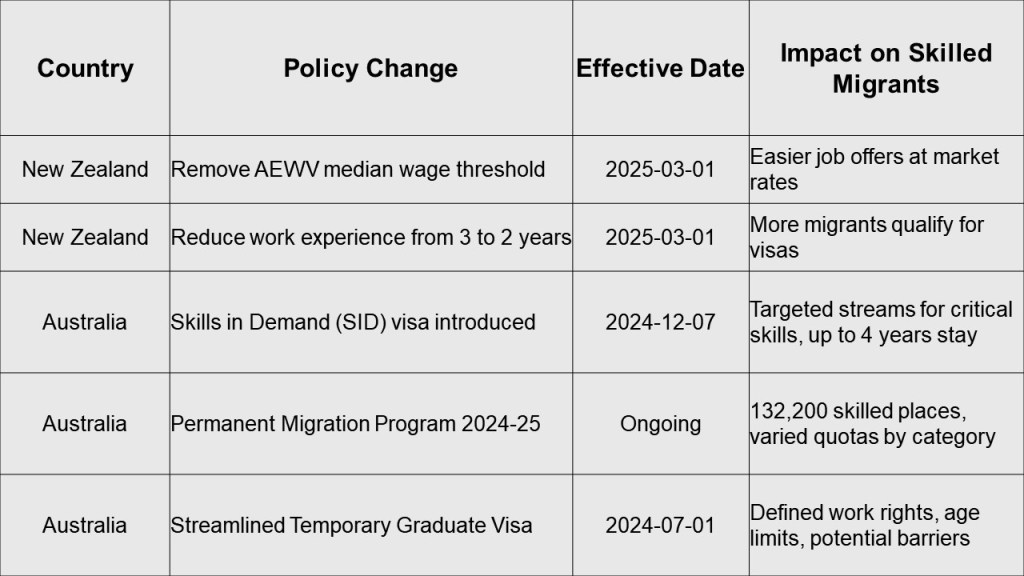
Changes to Skilled Migration in New Zealand and Australia: What You Need to Know

Governments in New Zealand and Australia are making significant changes to skilled migration policies, aiming to simplify the process and address ongoing labor shortages. For skilled professionals looking to relocate, these adjustments could mean easier access to work opportunities. While details are still emerging, hereโ€™s a breakdown of whatโ€™s changing and how it might impact job seekers.


New Zealand: Easier Access for Skilled Migrants

New Zealand is implementing a series of reforms to the Accredited Employer Work Visa (AEWV), starting in 2025. These updates aim to streamline the process and increase access for skilled workers:

  • Removal of Median Wage Threshold (Effective March 2025): Employers will no longer need to offer salaries above the national median wage. Instead, wages can be based on market rates, making more job opportunities accessible to skilled migrants.
  • Reduced Work Experience Requirement (Effective March 2025): The minimum required work experience for visa eligibility is being reduced from three years to two, allowing more workers to qualify.
  • New Seasonal Visa Pathways (Effective November 2025): These will include a multi-entry three-year visa for experienced workers and a seven-month single-entry visa for lower-skilled roles, particularly in agriculture.
  • Streamlined Job Check Process (Effective July 2025): The government is working to simplify the employer Job Check process, reducing delays in hiring skilled workers.

These changes aim to make migration more accessible for professionals across various industries. However, eligibility still depends on employer demand and individual qualifications.


Australia: Overhaul of Skilled Migration Pathways

Australia is also restructuring its skilled migration system with new visa options and streamlined pathways:

  • Introduction of the Skills in Demand (SID) Visa(December 2024): Replacing the Temporary Skills Shortage (TSS) visa, this new visa allows stays of up to four years and includes three streams:
    • Core Skills: For occupations in demand.
    • Specialist Skills: For highly skilled workers with higher salary thresholds.
    • Labour Agreement: For occupations negotiated with industries.
  • Permanent Migration Program Adjustments (2024-25): Australia has allocated 185,000 places, with 132,200 for skilled migrants. Employer-sponsored visas are increasing, while independent skilled migration quotas are reducing.
  • Temporary Graduate Visa Changes (July 2024): This visa now has clearer work rights and duration limits, with an age cap of 35 for most applicants.
  • New Ballot Process for Select Nationalities (October 2024): Certain countries, such as India and China, will have a lottery system for select visas, introducing an element of chance into the application process.

These adjustments are part of Australiaโ€™s broader Migration Strategy to attract skilled professionals and fill labor gaps.


What This Means for Skilled Migrants

The reforms in both countries are designed to:

  • Reduce barriers for skilled professionals.
  • Provide more opportunities through employer-sponsored pathways.
  • Address workforce shortages in key industries such as construction, IT, healthcare, and agriculture.

However, eligibility criteria and employer preferences still play a crucial role in migration success. If youโ€™re considering a move, staying informed about industry trends and job market demands will be key.


Need More Information?

For visa-related queries, consider consulting reputable immigration agencies such as New Zealand Shores and Australian Shores. If youโ€™re seeking job search advice and professional guidance, Employment for Immigration provides tailored support for skilled migrants.


Final Thoughts

Both New Zealand and Australia are making it easier for skilled workers to enter their job markets, but the full impact of these changes will depend on implementation and industry needs. Staying informed and preparing strategically will be essential for those looking to take advantage of these new opportunities.

Practical Advice

Skype is Shutting Down after 20-years. Here are some alternatives.

Skype is closing down in May 2025. My clients around the world will be searching for an alternative service to make calls primarily to New Zealand and Australia. See the article from CNN here: https://edition.cnn.com/2025/02/28/tech/skype-microsoft-shutdown/index.html

Key Points

  • It seems likely that several virtual phone number providers can replace Skype for quality calls to New Zealand and Australia, with local caller ID for employer comfort.
  • Research suggests that global providers like Twilio, Vonage, and RingCentral are accessible from regions like Asia, Middle East, Africa, South America, Europe, North America, Pacifica, and Eastern Europe.
  • The evidence leans toward good call quality varying by location and internet, with costs starting from $9โ€“$20 per user per month, plus per-minute charges.
  • An unexpected detail is that many providers offer free trials, helping users test call quality before committing.

Provider Overview

Below is a list of recommended service providers, categorized by their global availability, ensuring they meet your needs for quality calls and local caller ID in NZ and AUS. These providers are suitable for users in various regions, with call quality depending on your location and internet connection.

Service Details

  • Twilio: Offers virtual numbers in over 100 countries, including NZ and AUS, with caller ID masking. Costs around $1.50 per month for a NZ number, plus per-minute call rates. Features include SMS, call recording, and forwarding.
  • Vonage: Provides international calling with virtual numbers, starting at $19.99 per month for basic plans, with additional international call charges. Includes call forwarding and voicemail.
  • RingCentral: Cloud-based platform with virtual numbers, starting at $20 per user per month, plus international call costs. Offers team messaging and video conferencing.
  • JustCall: Call center software with virtual numbers, starting at $15 per user per month, with pay-as-you-go calls. Features call recording and routing.
  • AVOXI: Global communication solutions, with variable pricing by country, including monthly fees and per-minute charges. Offers call forwarding and recording.
  • KrispCall: Cloud telephony with virtual numbers, starting at $9 per user per month, plus international call costs. Includes call routing and recording.

Testing and Verification

To ensure quality before purchase, consider:

  • Using free trials offered by many providers to test call clarity from your location to NZ and AUS.
  • Checking customer reviews from users in your region for reliability.
  • Verifying network coverage in your area and the destination countries.
  • Contacting support for region-specific performance insights.

Survey Note: Comprehensive Analysis of Virtual Phone Number Providers for International Calling

This detailed survey note explores alternatives to Skype for making quality calls to New Zealand and Australia, focusing on services that provide local caller ID to enhance employer comfort. Given Skype’s closure in May 2025, the need for reliable, high-quality communication solutions is pressing, especially for global clients. The analysis covers providers accessible from regions including Asia, Middle East, Africa, South America, Europe, North America, Pacifica, and Eastern Europe, with a focus on call quality, cost, and service options. It also includes guidance on testing and verifying service quality prior to purchase, ensuring users can make informed decisions.

Background and Context

The user’s query highlights the importance of maintaining quality connections for calls to New Zealand and Australia, with a specific requirement for local caller ID to appear on the employer’s phone. This feature is crucial for fostering trust and familiarity, particularly in business communications. Given the global distribution of the user’s clients, the solution must be accessible and effective across diverse regions, with call quality being a primary concern alongside cost and functionality.

The research began by identifying the need for virtual phone number services that allow calls to be made with a local number appearing as the caller ID, rather than the user’s actual foreign number. This led to an exploration of VoIP and cloud-based communication platforms, which are well-suited for international calling with such features. The analysis considered major global providers known for their extensive coverage and then categorized them by region to align with the user’s requirements.

Methodology

The investigation involved searching for services that offer virtual phone numbers in NZ and AUS, with the capability to mask caller ID for outgoing calls. Key criteria included call quality, cost structures, and service options, with a focus on providers that have a presence or good performance in the specified regions. Given the global nature of these services, the approach was to identify major providers and assess their suitability for users in each region, acknowledging that call quality may vary based on local internet infrastructure and provider network coverage.

Detailed Provider Analysis

The following table lists the identified service providers, their descriptions, cost estimates, and service options, based on available information as of March 2, 2025. These providers are recommended for their ability to meet the user’s needs across all regions, with notes on regional considerations where applicable.

ProviderDescriptionCost EstimateService Options
TwilioCloud communications platform with virtual numbers in over 100 countries, including NZ and AUS, supporting caller ID masking.~$1.50/month for NZ number, plus per-minute call ratesSMS, MMS, call recording, call forwarding
VonageGlobal telecommunications company offering virtual numbers and international calling services.Starts at $19.99/month for basic plans, additional international call chargesCall forwarding, voicemail, call recording
RingCentralCloud-based platform with virtual numbers, suitable for international calling with team features.Starts at $20/user/month, plus international call costsTeam messaging, video conferencing, call queues
JustCallCloud-based call center software with virtual numbers, focused on business communications.Starts at $15/user/month, pay-as-you-go for callsCall recording, call monitoring, call routing
AVOXIGlobal provider of cloud-based communication solutions, offering virtual numbers and international calling.Variable by country, monthly fees and per-minute chargesCall forwarding, voicemail, call recording
KrispCallCloud telephony platform providing virtual numbers and international calling services.Starts at $9/user/month, plus international call costsCall forwarding, call recording, call routing

Regional Accessibility and Call Quality

Given the global nature of these providers, they are accessible from all specified regions: Asia, Middle East, Africa, South America, Europe, North America, Pacifica, and Eastern Europe. However, call quality may vary based on the user’s location and internet connection. For example:

  • In Asia, providers like Twilio, Vonage, and JustCall have offices in countries like Singapore and India, suggesting good local coverage.
  • In the Middle East, Twilio and Vonage have operations, with AVOXI also likely having coverage due to its global network.
  • For Africa, Twilio and Vonage have partnerships, and KrispCall may offer competitive service based on its pricing.
  • In South America and Europe, major providers like Twilio, Vonage, and RingCentral are well-established, with strong network infrastructure.
  • North America and Pacifica (including the US and Canada) benefit from the providers’ strong presence, given their headquarters locations.

To determine the best provider for a specific region, users should consider local reviews and network coverage, as these factors influence call quality. For instance, providers with local data centers or partnerships with regional telecoms may offer better performance.

Cost and Service Options

Costs vary significantly, with plans starting as low as $9 per user per month (KrispCall) to $20 per user per month (RingCentral), plus additional per-minute charges for international calls. This flexibility allows users to choose based on their call volume and budget. Service options like call recording, forwarding, and routing enhance functionality, particularly for business users, while features like SMS and video conferencing add value for comprehensive communication needs.

Testing and Verification Strategies

To ensure quality before purchase, users can leverage the following strategies:

  • Free Trials: Many providers, such as Twilio, Vonage, and JustCall, offer free trials or demo accounts. Use these to test call clarity and reliability from your location to NZ and AUS.
  • Customer Reviews: Check online reviews and ratings from users in your region, available on platforms like G2 or Capterra, to gauge performance and reliability.
  • Network Coverage: Verify the provider’s network coverage in your area and the destination countries, often detailed on their websites, such as Twilio.
  • Support Services: Contact provider support for region-specific performance insights, ensuring they offer 24/7 assistance for any issues.
  • Cost Comparison: Compare pricing plans to find the most cost-effective option, considering both monthly fees and per-minute rates for international calls.

These steps help mitigate risks and ensure the chosen service meets your quality and cost expectations, particularly given the global scope of your clients.

Unexpected Findings

An interesting detail is the availability of free trials, which is not always highlighted in initial searches. This feature allows users to test call quality without financial commitment, providing a practical way to assess suitability before purchase, especially for users in regions with variable internet quality.

Conclusion

This survey note provides a comprehensive overview of virtual phone number providers suitable for replacing Skype, focusing on quality calls to NZ and AUS with local caller ID. By considering global providers like Twilio, Vonage, and RingCentral, and leveraging testing strategies, users can find a reliable solution tailored to their regional needs and budget. The information is current as of March 2, 2025, and users are encouraged to verify details with providers for the latest offerings.

Key Citations